Solutions use natural units unless a conversion is displayed. The surviving paper has damaged source illustrations in c and c; the corresponding numerical readings remain explicit TODOs. All eight questions, including all five alternatives in 8, are treated.
Treat the electron and electron antineutrino as effectively massless particles in the centre-of-momentum frame, retain only the charged current, and use the Fermi interaction: . Take between incoming and outgoing electron antineutrino directions. The V-A interaction selects a right-helicity electron antineutrino and a left-helicity electron. Their opposite incoming directions give total angular momentum projection one. The outgoing pair has the same projection along its own axis. The Wigner D-matrix element is , so the squared helicity amplitude is proportional to . The inactive initial electron helicity is included in the unpolarized normalization supplied by the paper.
The boost from the centre-of-momentum frame to the laboratory frame has , while the incoming electron antineutrino has and . ThusThe requested identity therefore uses ; it is not exact at finite target mass. With , the absolute Jacobian determinant is , givingThe suppression at backward scattering follows from angular momentum conservation: rotating projection through cannot leave projection along the original axis. Replacing by gives the supplied dependence.
Use the parton model, neglect antiquarks, binding and target mass corrections, quark masses, muon mass, QCD scaling violation and the W boson propagator correction. The struck quark is effectively free during the short interaction and carries parton momentum fraction , giving . The charged current reaction is . Its helicity amplitude has the same factor as in a. Define the effective parton distribution function by , summing only kinematically accessible final quarks; for valence-only protons and accessible this is approximately . It is not the unweighted sum .Here is the inclusive deep inelastic scattering variable, and in the scaling limit. Integrating gives , henceThe moment measures the momentum fraction in the active quarks. Approximate linearity is evidence for scattering from pointlike spin-one-half constituents with approximately scale-independent parton distribution functions, rather than coherent scattering from an extended proton. It is an intermediate-energy prediction: thresholds, experimental deep inelastic scattering cuts, QCD scaling violation and eventually the finite W boson propagator modify it.
Strike a target with high-energy protons, collect negative pions and kaons with magnetic horns, and let them decay in a long evacuated decay tunnel: and . Absorb residual hadrons and range out muons in shielding. Focusing selects the negative parent sign and therefore enriches muon antineutrinos; other parent decays leave a finite contamination. Monitor the parent flux and use a near detector to constrain the unoscillated spectrum.
A massive segmented calorimeter supplies interaction probability and measures the hadronic shower. Alternate dense absorber plates with scintillation counters or tracking planes, and magnetize the iron or add a downstream magnetic muon detector. The signal is a positive muon plus a hadronic shower; the sign rejects much of the muon neutrino contamination. For a contained muon, its range gives energy; for a penetrating track, curvature gives . Multiple measurements and a field map determine the fitted momentum and sign. Summed calibrated shower response estimates the struck quark's visible hadronization energy, not the energy of a free observable quark. Correct for invisible nuclear losses, noncompensating response, leakage and acceptance. Neglecting target recoil corrections, and .
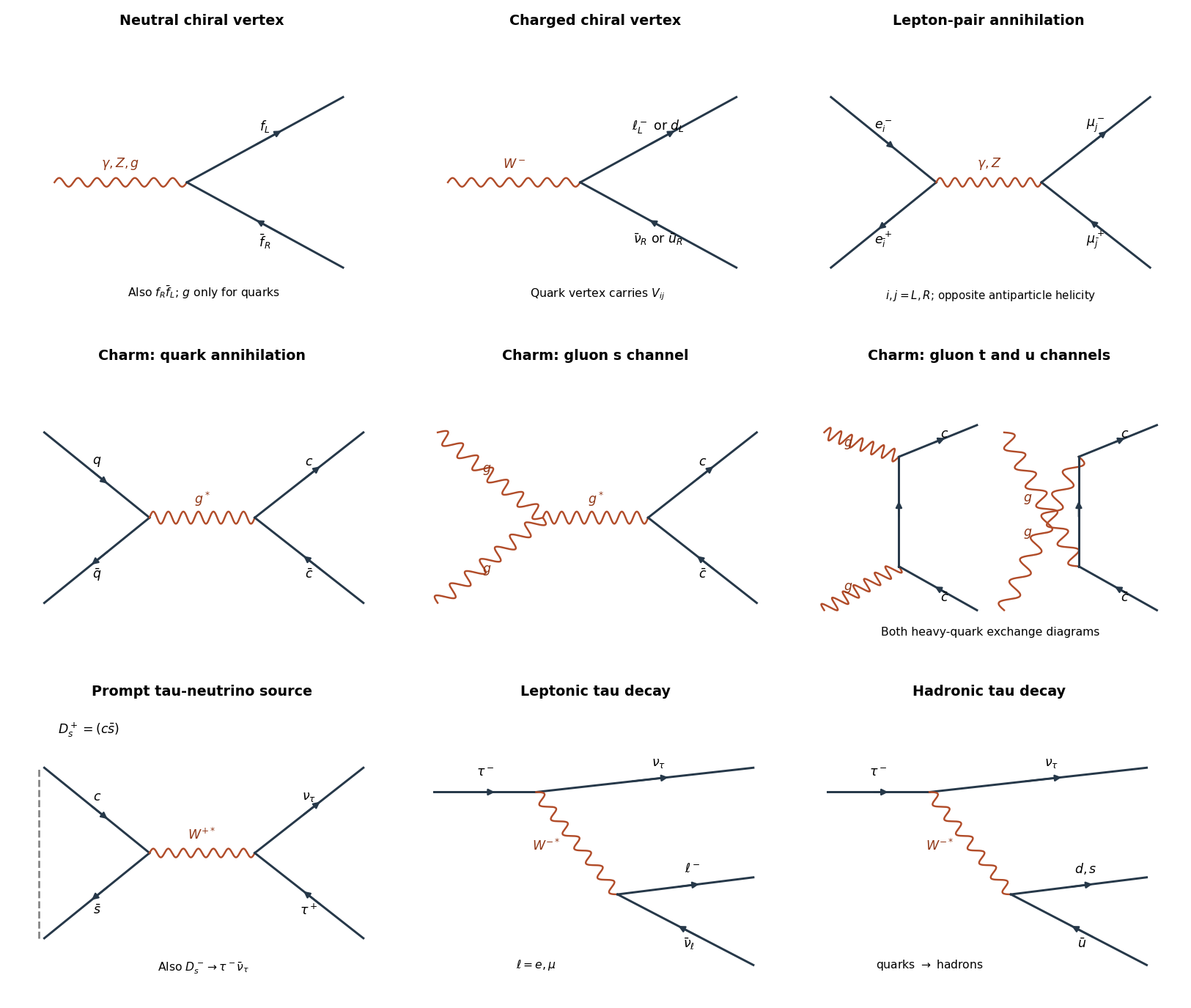
At energies large compared with fermion masses, the gauge interactions preserve chirality on each fermion line. A photon couples to charged fermions with equal left and right coefficients . A gluon couples to either quark chirality with coefficient . A Z boson couples to both, with coefficients on left-chiral fields and on right-chiral fields. A W boson couples only to left-chiral fermions and the associated right-helicity antifermions: or , and the charge-conjugate channels. For quarks the coefficient includes the CKM matrix. There is no Standard Model right-chiral neutrino gauge vertex.
For outgoing pairs at a neutral vertex, the allowed helicities are and ; the latter labels helicity, not the chirality of the corresponding antifield. Only the -channel photon and Z boson diagrams contribute to at tree level among these gauge exchanges. A W boson changes charged leptons into neutrinos, and gluons do not couple to leptons.

Assume unpolarized beams, , a single exchanged photon, full azimuthal coverage and no radiative corrections. Take between incoming and outgoing . The four nonzero helicity amplitudes have magnitudes for equal incoming/outgoing negative-particle helicities, and for opposite ones. Averaging four initial spin states and summing the final ones givesThe massless two-body phase space givesThe even distribution reflects the equal left/right photon couplings and is symmetric under interchange of forward and backward directions.
Include the Z boson amplitude and its quantum interference with the photon amplitude. Define , , , , , andFor the same unpolarized and massless approximations as b, the complete tree-level angular distribution isThe absolute squares include the pure terms and their interference. Put and . The even part is and the odd part is . Thus the forward-backward asymmetry is .
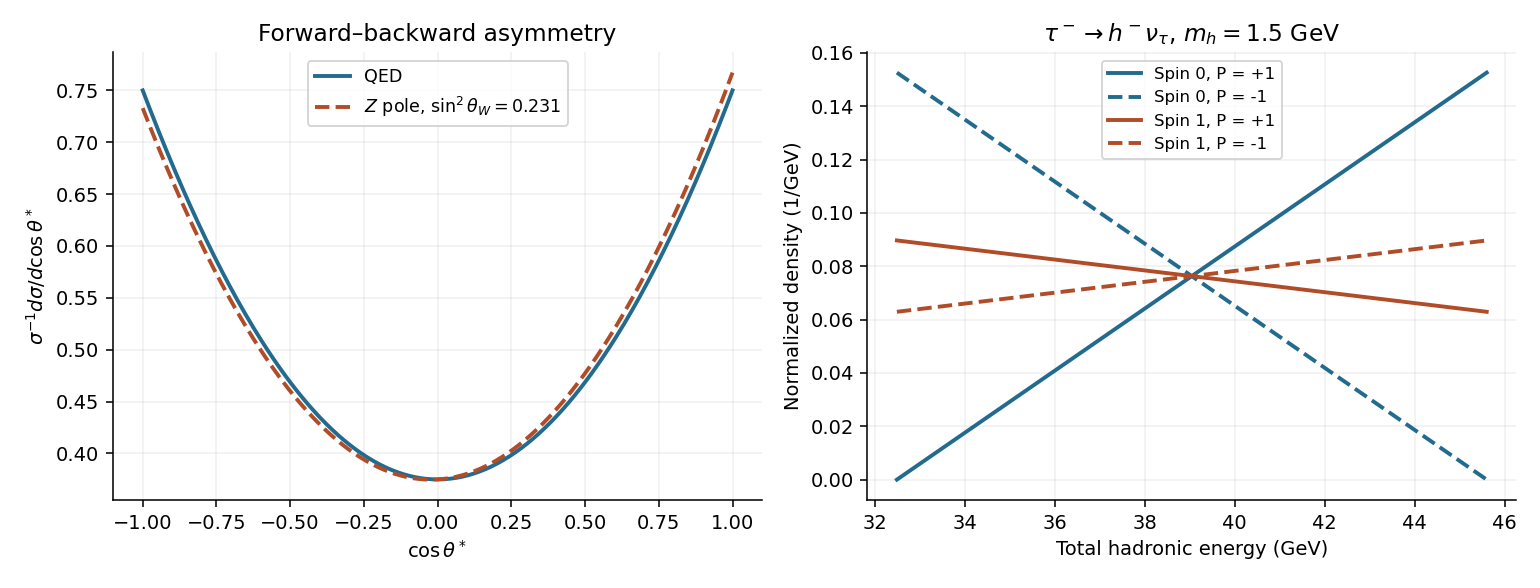
At the Z boson pole, neglect the small photon contribution and use real tree-level couplings. Thenwhere , . For charged leptons, . Fitting the forward/backward counts, after detector and radiation corrections, therefore measures the weak mixing angle, conventionally an effective leptonic angle once electroweak corrections are included. For illustration gives and . This illustrative parameter choice is not extracted from this paper's data. The real tree-level photon-Z boson interference vanishes exactly at the pole but matters away from it.
Direct formation in through one virtual photon selects the vector meson quantum numbers . The nonzero mode and absence of are consistent with this assignment: the two spin-zero kaons require odd orbital angular momentum for negative parity, whereas identical bosons cannot have an odd relative wave. This argument neglects the tiny CP violation in neutral kaons.
Assuming the decays conserve isospin, their equal rates indicate . The Clebsch-Gordan coefficients giveAn state lacks , while has squared coefficients rather than . The branching fractions alone determine neither nor these relative phases; the single-photon formation and approximate strong interaction isospin conservation are essential additional inputs.
For the resonant contribution only, subtract nonresonant Bhabha scattering and its interference before interpreting a fitted area. The integrated narrow vector resonance area follows from the Breit-Wigner resonance cross section, with , , and , becomesAcross a narrow scattering resonance, treat the prefactor and partial decay widths as constant and extend the integral over to the real line. Since ,A normalized beam-energy response convolves the line shape without changing this full area. It can completely change the observed peak height and apparent width. If a uniform acceptance is not already unfolded, use . The distinction between for this exclusive final state and for an inclusive final state is essential.
TODO: the numerical resonance-area reading is unavailable from the retained source. Page 6 retains the upper data panels but loses the lower part of the scanned data image, including the numerical horizontal energy calibration. A vertical cross section scale and an apparent peak cannot supply without that calibration. The decoded image contains 2,834,898 of 4,437,216 required RGB bytes; the archived bundle has the same truncation. No horizontal scale or natural decay width is inferred from the display width.
The recoverable numerical conversion is nevertheless definite. With , , , and , b givesThis coefficient assumes the plotted exclusive electronic sample has not already been corrected for acceptance. A restored area, with continuum subtraction and acceptance convention checked, would complete the estimate. A tabulated modern J/psi meson width would be external information rather than a reading of these data.
The narrow scattering resonance indicates suppressed strong interaction decay. In the quark model, is below the open-charm quark threshold, so its constituents cannot simply emerge in separate charmed mesons. The OZI rule suppresses annihilation into light hadrons; for a color-singlet state the leading purely gluonic channel needs three gluons. The observed leptonic channels remain competitive. Its mass and fit charmonium; the small width alone would not uniquely identify the new quark flavour without the wider spectrum and threshold evidence.
For a neutral bound state, meson parity and charge conjugation give and . In spectroscopic notation , the integer labels radial excitation, is orbital angular momentum, the total constituent spin, and their total angular momentum. The surviving level diagram contains eight states:
- : , , .
- : , , .
- : , , .
- : , , .
- : , , .
- : , , .
- : , , .
- : , , .
The spin-dependent splittings distinguish the singlet and triplet levels and the three triplet P levels. The radial excitation changes neither parity nor charge conjugation.
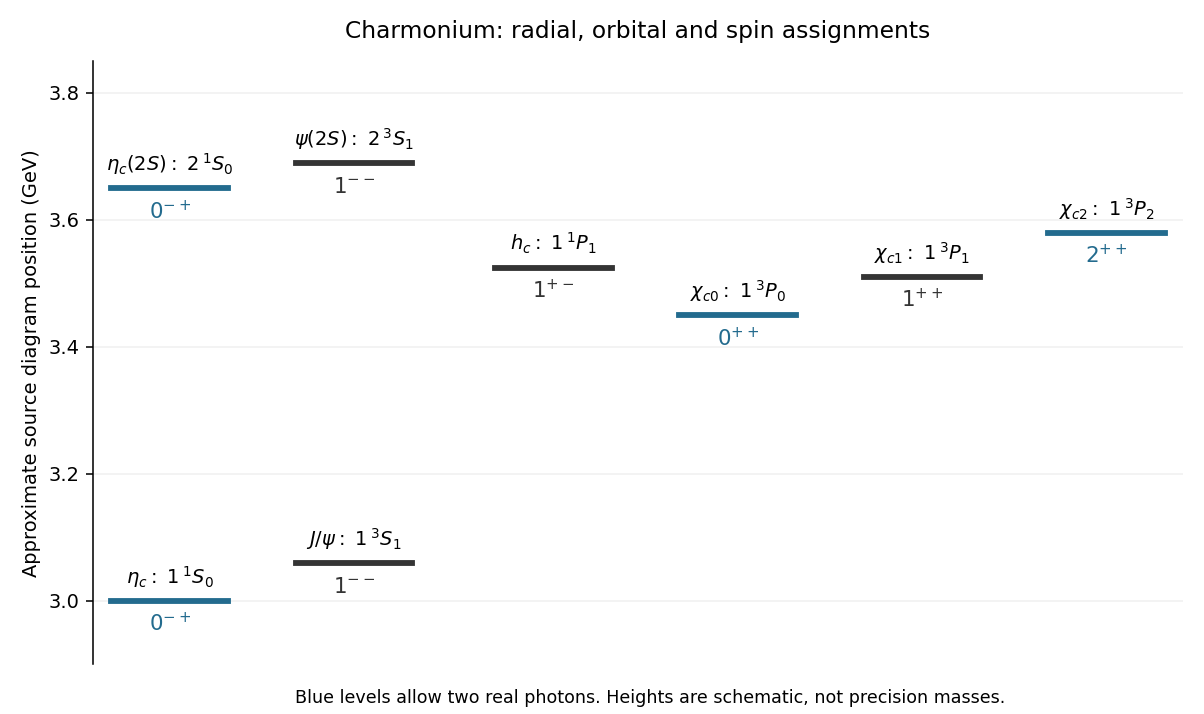
Charmonium assignments for the eight surviving source levels
. Original redraw with approximate vertical positions from the intact right-hand source diagram. Positions are schematic; labels and quantum-number assignments, rather than precision masses, are the content. Details.
The four allowed two-real-photon states are , , and . Two photons have , excluding , and ; the Landau-Yang theorem excludes because . Both scalar and pseudoscalar two-photon amplitudes exist, so and are allowed. The J/psi meson was discovered first because its assignment permits direct, resonantly enhanced single-photon formation in and a clean dilepton peak in hadron production. The lighter cannot be formed by one photon; it needs less favorable production channels and has a broader two-gluon decay.
A spin-zero at rest has no preferred axis, so is isotropic after summing final spins. A J/psi meson formed in unpolarized high-energy has transverse alignment. Its distribution can be writtenwhere contain the two independent helicity amplitudes. It is generally anisotropic; the approximate massless, helicity-conserving limit has . The tabulated branching fraction does not fix . An ensemble equally populated in all three spin projections would instead be isotropic: alignment of the production ensemble matters.
Assume coherent production and detection, relativistic neutrinos, two active neutrino flavours, propagation in vacuum, negligible packet separation and no absorption. Invert the given real lepton mixing matrix to obtain and , where , . With phases in natural units,Using the paper's opposite sign convention conjugates this probability amplitude and leaves the probability unchanged. For equal momentum, and , so . The equal-energy convention gives the same leading result from the momentum difference; evaluating each component at a different arrival time would incorrectly double the phase.Since ,This gives the stated factor . Neutrino oscillation in this approximation measures , not the absolute neutrino mass or its ordering.
The Fermilab primary proton beam strikes a target, producing secondary pions and kaons. Horn focusing selects positive parents; their decays and produce a predominantly muon neutrino beam. A decay tunnel permits decay before the remaining charged secondaries encounter an absorber. A near detector constrains the flux and interaction spectrum, while the distant MINOS detector measures its change.
The alternating scintillation counters and magnetized iron give a sampling calorimeter and a magnetic tracking volume. A charged current event has a long negative muon track and a localized hadronic shower. Estimate by range if contained or magnetic curvature if exiting, and by the calibrated scintillator pulse-height sum. Reconstruct , with corrections for nuclear binding, invisible energy and detector response. The muon charge separates most wrong-sign muon antineutrino events; short showers without the track are primarily neutral current candidates. The source's baseline is used in the calculations below.
TODO: a numerical estimate from the missing MINOS spectrum cannot be supplied. On source page 7 the graph is absent: PDF Form /Im3 invokes undefined image /Im1 with no image resources, and the archived bundle has the same defect. In particular, no measured minimum energy survives. For maximal mixing angle, the first minimum of muon neutrino survival obeysA restored spectrum or fitted data are needed to choose . This is a relation for the survival minimum; a minimum in the raw event spectrum also depends on flux, cross section and smearing. For context only, accelerator and atmospheric results put the splitting at a few , versus the solar splitting about , roughly thirty times smaller. This known scale is not a reconstruction of the absent graph. [ref]
Combined analysis of muon-neutrino disappearance and electron-neutrino appearance by MINOS Collaboration. MINOS combined three-flavour analysis, 2014
Finite event statistics, hadronic shower energy resolution, the muon scale, near-to-far flux extrapolation, interaction and nuclear modeling, backgrounds and detector calibration limit the precision; the baseline itself is comparatively well known. In a two-flavour vacuum fit the sign of is inaccessible. Evidence for dominant includes the zenith-angle-dependent atmospheric deficit in Super-Kamiokande, approximately preserved active neutral current rates, small electron-flavour appearance at this scale, atmospheric tau appearance and direct tau appearance in OPERA. The latter had already reported four candidates and evidence in 2014; a later five-candidate discovery result is not needed for this June 2015 answer. [ref]
Observation of tau neutrino appearance in the CNGS beam by OPERA Collaboration. OPERA tau-appearance result, 2014
These tests constrain a dominant sterile conversion as well as conversion into electron neutrinos.The tau-neutrino charged-current threshold requires specifying the stationary target and the lightest allowed final state. For a free neutron, the lowest charged current channel is . At threshold both final particles are at rest relative to one another in the centre-of-momentum frame, soThe equal-nucleon-mass approximation gives . More generally for a target of mass and a recoil system with minimum allowed invariant mass . A stationary electron in instead gives . The customary answer therefore presumes a nucleon target; nuclear thresholds and practical deep inelastic scattering thresholds differ.
In a dense beam dump, long-lived pions and kaons usually interact and lose energy before decaying. Their residual stopped decays yield low-energy neutrinos, below the useful high-energy tau-interaction sample. Prompt charmed mesons have much shorter lifetimes and can decay before reinteraction. This suppresses the conventional muon neutrino background relative to the prompt component. The production sequence is Quantum chromodynamics creation of , principally with also allowed, followed by hadronization and its charge conjugate. The process includes both quark-exchange diagrams and the three-gluon diagram. Fragmentation also produces other hadrons; the proton does not turn directly into one isolated Ds meson.The charge-conjugate chain gives a prompt tau antineutrino and a secondary tau neutrino. Thus each leptonic Ds meson chain produces both tau-flavour signs. The corresponding Feynman diagrams are shown in a.
For the CKM matrix, diagonalizing the up/down quark mass matrices by leaves in the charged current:The three-generation unitary matrix has three physical mixing angles and one CP violation phase after field rephasings. At fixed kinematics and hadronic matrix element, rates are proportional to ; phase space, parent lifetimes, form factors and helicity suppression must also be included when comparing branching fractions.
For a charged pseudoscalar meson , leptonic pseudoscalar decay width givesThe Ds meson channel is Cabibbo-favoured, , whereas the charged D meson channel uses . Taking , and in GeV givesIncluding the approximate lifetime ratio and the given production ratio gives a tau yield ratio about , already much greater than one even with equal decay constants. This is an illustrative estimate using approximate additional mass/lifetime inputs, not a determination from the production cross sections alone. A neutral D meson cannot annihilate to the charged pair by electric charge conservation; its semileptonic tau modes have insufficient phase space once the required strange or nonstrange recoil hadron is included. Light mesons are below threshold; bottom production is much smaller at this fixed-target energy. Consequently neither the larger production rate nor ordinary light-hadron production outweighs the Ds meson tau source. [ref]
Final tau-neutrino results from the DONuT experiment by DONUT Collaboration. DONuT final analysis: prompt beam production and tau-neutrino flux model
For this dump scheme, there is no practical parent-sign or lifetime selection that isolates only the relatively rare Ds meson tau channel: other charmed hadrons promptly produce electron neutrinos and muon neutrinos by semileptonic decay. Both electron and muon modes have the same charged current couplings and similar available phase space, so comparable and fluxes are plausible. The tau lepton also decays into electron and muon channels. A rare tau-producing channel cannot remove the abundant prompt backgrounds, and its two-step chain emits both tau-flavour signs.
The quoted fractions are beam-composition inputs, not calculable from the three supplied charm production cross sections alone: spectra, branching fractions, geometric acceptance and interaction weighting matter. Impossibility of a pure tau source is a practical statement about this production method, not a fundamental prohibition on selecting tau flavour at an oscillation maximum.
Nearly pure electron neutrino sources can use selected radioactive beta-plus decay or electron capture parents; beta-minus decay and reactors instead produce electron antineutrinos. A boosted radioactive-ion beam gives directional electron-flavour flux. Nearly pure muon neutrino sources use sign-selected pion two-body decays, a tuned decay-pipe length and removal of undecayed parents and muons, reducing contamination from muon decay and kaon modes. Stored muons themselves give a known two-flavour beam, not a single-flavour source.
Use and restore temporarily. The free Dirac equation is , with . Its Hermitian conjugate is . Multiplying on the right by and using gives the adjoint equationThe Dirac adjoint and original equations give and . Adding gives the continuity equationThe Dirac current transforms as a four-vector; the positive density is the time component, not a Lorentz scalar. With ordinary units the number current is and the electron charge current is times it.
For either normalized two-spinor , givesThe Dirac equation alone does not fix : a normalization convention is needed. In the usual covariant external-spinor convention , choose real positive . Then and . A second common convention is unit rest density, , giving and density . Both explain why the boosted density is not one particle per unit coordinate volume: the density is a four-current component and changes under a Lorentz transformation.
One may instead choose unit laboratory density, , or box normalization for one particle in volume . An infinite plane wave is not normalizable to one particle over all space; a localized wave packet is required for that. Thus a unique cannot be inferred from the prompt without specifying which of these conventions is intended.
Let . The eigenvalues of are , each with multiplicity two, and orthonormal bases for their eigenspaces areA general linear combination of the two positive-energy solutions has upper spinor and lower spinor . An x-spin eigenvector needs and the lower spinor to have the same eigenvalue. The Fixed-axis spin obstruction for positive-energy Dirac spinors isIts norm is , so it vanishes exactly when . For example with , the upper produces lower , excluding a common eigenvector for every . In the nonrelativistic limit, the lower components are , and approach x-spin eigenvectors. At rest they are exact.
The prompt's unrestricted claim of impossibility at relativistic energies needs qualification: for momentum parallel to x these combinations remain exact eigenvectors at any energy. For a beam transverse to x, such as the conventional z-directed beam, the intended impossibility holds, and the lower components are no longer negligible. A transported relativistic spin observable differs from this fixed matrix; helicity is the conserved projection along momentum for a free particle.
An electron gun releases electrons by thermionic emission, field emission or photoelectric effect, accelerates them through an electric potential, and uses electrostatic or magnetic lenses to form a beam in vacuum. A hot unpolarized cathode does not by itself select spin.
For a polarized source, illuminate a suitable semiconductor photocathode, commonly strained GaAs, with circularly polarized light near its band-gap threshold. Optical angular-momentum selection rules preferentially populate one conduction-electron spin; emission from a negative-electron-affinity surface extracts the selected population. Reversing the light's circular polarization reverses the beam polarization. Strain and a suitable excitation wavelength suppress transitions that dilute the selection. Solenoids and spin rotators orient the spin after acceleration, and a scattering polarimeter measures the achieved polarization; it need not be .
The basic Feynman diagrams have followed by , , or , with the latter pairs undergoing hadronization. See the charged-current diagrams in a. Neglect all daughter masses, QCD corrections and inaccessible charm final states, and assume lepton universality. Each leptonic mode then has one unit of decay width; the two accessible quark combinations have three color charge states and total CKM weight . ThereforeThe result is an inclusive parton model estimate. Perturbative QCD corrections increase the hadronic contribution, while muon mass, nonperturbative dynamics and radiative corrections also matter; the physical fraction is roughly .
Every ordinary hadronic mode already contains a tau neutrino, so it contains a lepton as well as hadrons if invisible particles are counted. For an additional visible charged lepton, a virtual photon can internally convert in a hadronic mode, for example . The extra electromagnetic vertices suppress such modes; they are not a large fraction of the inclusive width. Alternatively a daughter pion or kaon can decay semileptonically or leptonically in flight, for example followed by a semileptonic neutral-kaon decay. Those are secondary decay chains, not independent primary tau lepton branching fractions. Lepton-flavour-violating neutrinoless modes such as do not contribute appreciably in the Standard Model.
At the Z boson pole, the accessible primary fermion pairs are , , , the three channels, and . The top quark is too heavy. The charged channels also have photon exchange, and the electronic channel has a substantial nonresonant Bhabha scattering contribution. On-shell W boson pairs are above threshold; they are not primary decays.
A tau lepton pair gives two approximately back-to-back narrow low-multiplicity cones, usually one or three charged tracks per cone, with overall charge zero and missing energy and momentum from neutrinos. Opposite hemispheres can show electron, muon or hadronic tags. A decay vertex or track impact-parameter information helps establish the short tau lepton flight. Reject Bhabha scattering and dimuon events by their nearly full visible beam energy, particle identification and little missing momentum; reject ordinary quark multijets by their broader high-multiplicity activity and larger visible invariant masses. Control two-photon backgrounds with visible transverse momentum, forward activity and event geometry. Selection efficiencies depend on decay mode and must be calibrated.
In , charge and missing four-momentum show an invisible neutral component beyond the visible charged lepton. The distributions are consistent with three-body V-A interaction decay; hadronic modes such as instead have two-body missing-mass kinematics. Production and decay accounting assigns and their antiparticles minus one. Searches for wrong-flavour and neutrinoless channels constrain violations. These observations establish a useful approximately conserved tau-family number in ordinary interactions, rather than proving an exact law from missing energy alone.
To establish that the invisible particle is distinct from and , combine decay evidence with the absence of unsuppressed tau production by conventional electron- and muon-flavour beams, and direct tau neutrino charged current interactions. DONUT observed the short displaced tau lepton decay in nuclear emulsion after a neutrino interaction. [ref]
Observation of Tau Neutrino Interactions by DONUT Collaboration. DONUT first direct tau-neutrino interaction report
Neutrino oscillation means individual family numbers are not exact conserved quantities during propagation, even though they are an excellent approximation for these local decay assignments.Write the leptonic partial decay width asHere is defined from muon decay, so the coupling denominator fixes the convention. Measure . The ratio tests after the known phase space and radiative corrections. Comparing with the muon lifetime and the fifth power of the mass ratio tests . Hadronic comparisons such as tau-to-pion versus pion-to-muon decay supply additional universality tests with their own hadronic and electromagnetic corrections.
Use a high-multiplicity hadronic mode with only one invisible neutrino, and reconstruct the total visible four-momentum . In the tau lepton rest frame,Fit the endpoint of the hadronic invariant mass distribution, preferably together with its laboratory energy boundary at known beam energy. The two-dimensional boundary uses more information than the single largest observed mass. Detector smearing, unseen neutral products, backgrounds, beam radiation and hadronic spectral modeling must be included. Absence of a displaced endpoint generally sets an upper bound rather than a positive neutrino mass measurement. Strictly the flavour state contains several mass eigenstates; an unresolved endpoint constrains the corresponding weighted mass spectrum.
Neglect radiation, take , , and treat a fixed hadronic invariant mass as a single recoil system in . With negligible neutrino mass,Thus , numerically approximately to . In the ultrarelativistic limit the range is . A spread of hadronic invariant masses broadens these endpoints; an average mass alone is not a strict endpoint specification for the whole sample.
Let denote a positive-helicity , and measure from its laboratory flight direction in its rest frame. For a spin-zero hadronic recoil, the left-helicity tau neutrino and angular momentum conservation giveFor example a tau lepton with spin along can emit a left-helicity neutrino along , carrying spin along , with the spin-zero recoil along . A positive-helicity tau lepton then gives a harder visible recoil. If , and , the more general tau hadronic polarimetry formula isFor spin-zero recoil . For a spin-one system produced by the V-A interaction, the longitudinal and transverse weights are , with opposite angular slopes; summing gives . At this is about , so the negative-helicity tau lepton has the higher mean total hadronic energy, about versus , within that spin-one model. [ref]
Tau polarization and correlated decays in neutrino experiments (2023). Polarized tau decay: longitudinal and transverse spin-one recoil distributions, Eqs. (5)–(6)
The supplied mean invariant mass does not specify the recoil's spin composition or its helicity amplitudes. Consequently the last sign cannot be universal: positive helicity is harder for a spin-zero recoil, negative helicity is harder for the specified spin-one recoil, and a mixture requires its measured spectral weights. Polarization of an intermediate vector or axial-vector meson also changes the division of energy among its daughter hadrons; that information is not fixed by the total jet invariant mass alone.

The Goldhaber experiment inferred neutrino helicity from the circular polarization of a nuclear gamma ray. A spin-zero metastable europium-152 nucleus captures an inner-shell electron, producing a spin-one excited samarium-152 daughter and an electron neutrino; the daughter promptly emits a roughly gamma ray to its spin-zero ground state. For a nearly stationary initial atom, the daughter recoils opposite the neutrino. Selecting photons emitted along that recoil relates the daughter spin projection, the photon helicity and the neutrino helicity.
The selection used resonant absorption and scattering in samarium. Nuclear recoil normally shifts an emitted gamma ray below the absorption resonance; the daughter recoil from electron capture supplies a compensating forward Doppler shift. Resonant scattering therefore preferentially selects forward photons, fixing their direction relative to the otherwise invisible neutrino. A samarium scatterer and scintillation counting identify this resonant component. Transmission through magnetized iron, whose Compton scattering depends on the relative electron and photon spins, then analyzes the circular polarization. Reversing the magnetization reverses the analyzing asymmetry and helps control instrumental offsets.
The selected photon and neutrino normalized helicities have the same sign: their momenta are opposite, while the daughter angular-momentum accounting gives opposite spin projections along the recoil axis. The observed negative photon helicity therefore establishes predominantly left-helicity neutrinos, consistent with the V-A interaction. It measures a helicity correlation, not a tiny neutrino mass or a literal observation of the neutral particle's trajectory.[ref]
Helicity of Neutrinos by Maurice Goldhaber and others. 1958, pp. 1015–1017: capture cascade, resonant selection and polarization measurement
Nuclear fusion in the Sun produces predominantly electron neutrinos, through the pp chain and subsidiary reactions. The historical solar-neutrino deficit could have reflected either a source-model error or flavour transformation. In a two-flavour approximation, mixing gives the vacuum survival law derived in a. In matter the additional electron neutrino charged current potential is . Dropping a common diagonal term, the flavour Hamiltonian isThe MSW effect enhances mixing near . An initially electron-like high-density state follows its instantaneous mass eigenstate approximately adiabatically as solar density falls. After phase averaging, high-energy solar survival approaches , while low-energy vacuum-averaged survival approaches , neglecting the small third-angle correction.
The Sudbury Neutrino Observatory used about a kilotonne of heavy water viewed by photomultipliers. Its three channels separate flavour from total active flux:The charged current channel measures electron flavour, the neutral current channel measures all active flavours nearly equally, and elastic scattering is more sensitive to electron flavour but also detects the others. Cherenkov radiation gives the charged-particle energy and direction. Neutrons were detected through capture gamma rays, with later salt loading and dedicated counters improving the neutral-current separation. The different angular patterns, light isotropy and energy spectra permit a combined channel fit, with radioactive backgrounds and calibrations controlled.
The measured electron flux was lower than the total active flux, while the latter agreed with solar fusion expectations. This directly established a non-electron component and removed a simple overall source-flux error as the explanation. [ref]
Direct evidence for neutrino flavor transformation from neutral current interactions by SNO Collaboration. SNO neutral-current flavour-transformation report, 2002
Super-Kamiokande supplied high-statistics directional elastic-scattering data; radiochemical chlorine/gallium experiments supplied complementary thresholds, and reactor antineutrino disappearance independently confirmed the solar mass-squared difference. Together these support large-angle mixing at rather than the atmospheric splitting in c.The bottom quark has charge and left-handed weak isospin , requiring a charge- partner in a complete Standard Model weak doublet. Completing the third quark generation also maintains the quark/lepton cancellation of gauge anomalies. A three-generation CKM matrix permits an irreducible CP violation phase. Flavour constraints and loop corrections, including their strong top-mass dependence in electroweak precision observables, provided indirect evidence before direct production. These arguments identify the required partner and its interactions; they do not by themselves fix its mass.
The Tevatron collided protons and antiprotons at . Quantum chromodynamics produces , mainly through annihilation there. Each top quark decays predominantly to before hadronization, giving . The dilepton channel has two isolated oppositely charged leptons, missing transverse momentum from neutrinos, and bottom jets. The single-lepton channel has an isolated electron or muon, missing transverse momentum, and four leading jets, two consistent with bottom decay. The all-hadronic channel has more background. Secondary-vertex and soft-lepton tags identify bottom hadrons.
CDF and D0 reported independent excesses in 1995, with event kinematics and reconstructed masses consistent with a common very heavy quark. Fits assign jets to the two decay chains and compare with expected jets, multijet and instrumental backgrounds. Agreement of counts, bottom content and reconstruction across channels is stronger evidence than an excess in one event class alone. [ref]
Observation of Top Quark Production in Pbar-P Collisions by CDF Collaboration. CDF top-quark observation, 1995
[ref]The CKM matrix appears in the charged current of b. For a tree semileptonic transition, a schematic extraction is . Measure an absolute rate or differential spectrum, calculate or independently determine the hadronic factor, and solve for the modulus. The process is not a direct count of quark flavours in a detector: form factors, decay constants, nuclear structure and radiation can limit the result.
- : superallowed nuclear beta decay, with neutron and pion beta decay cross-checks; correct for nuclear and radiative effects.
- : spectra with the form factor; compare and using decay constants.
- and : exclusive and , or inclusive charmless/charmed semileptonic spectra; separate the rare charmless component and control the hadronic calculation.
- and : charm semileptonic or leptonic decays with form factors or decay constants, and charm production by neutrinos; charm-tagged W boson decays give a complementary constraint.
- : single-top quark production and the ratio of to all decays, under stated assumptions about allowed interactions.
- and : neutral B-meson mixing frequencies and rare loop-induced decays, with loop dynamics and hadronic inputs. Mixing-frequency ratios cancel some common uncertainties.
Rate moduli alone do not determine the complex phase. CP-asymmetric decay distributions and interference in neutral-meson systems, or tree-level interference, constrain the phase and the CKM unitarity triangle. Unitarity supplies consistency checks and indirect determinations, but a fit that imposes it must be distinguished from a direct measurement of an element.
A general-purpose collider detector surrounds the interaction region with complementary layers. The layout makes the measured signals useful together: tracks establish charged trajectories, calorimeters sum deposited energy, and outer detectors identify penetrating muons.
- An inner vertex detector, usually fine silicon pixels or strips, measures precise hits and displaced decay vertices. A larger tracking volume follows charged trajectories through a magnetic field. Curvature supplies transverse momentum and charge sign; hit geometry and known field determine the track. Neutral particles leave no direct ionization track.
- An electromagnetic calorimeter, using dense crystals or absorber/sampling layers, measures electrons and photons through electromagnetic particle showers. Electrons have matching tracks; unconverted photons ordinarily do not. Segmentation provides position and shower-shape discrimination.
- A deeper hadronic calorimeter samples hadronic showers from hadrons and measures jet energy. Its larger depth contains nuclear cascades; invisible binding losses, leakage and differing electromagnetic/hadronic response require calibration.
- An external muon detector, behind most of the absorber, records long penetrating tracks. Matching them to inner tracks identifies muons; magnetic instrumentation can give an additional momentum measurement. Hadron punch-through and decays in flight are backgrounds.
- Dedicated particle identification uses specific ionization, time of flight, Cherenkov radiation or transition radiation to distinguish species over appropriate momentum ranges. The choice depends on the collider and physics goals.
- Forward detectors and luminosity monitors cover small polar angles and constrain normalization. Fast trigger and data-acquisition systems select useful collisions within bandwidth limits while recording efficiencies and timing.
Near-hermetic coverage permits a missing transverse momentum estimate from the calibrated vector sum, signaling neutrinos or other invisible particles but also sensitive to detector failures and escaping jets. At a hadron collider the initial parton longitudinal momenta are unknown, so missing longitudinal energy cannot be inferred in the same way; an collider supplies stronger initial-state constraints. Every subsystem needs alignment, calibration and independent control samples for reliable combined reconstruction.
Articles by others on the same topic
There are currently no matching articles.