At the parton level, the dominant valence reactions are through W boson exchange and through W boson exchange. The first also acts on , while the second acts on with the appropriate Cabibbo-Kobayashi-Maskawa matrix factors; crossing supplies the antiquark reactions. The lines in the figure show fermion number flow; the Positron and antineutrino arrows point opposite to their momenta.
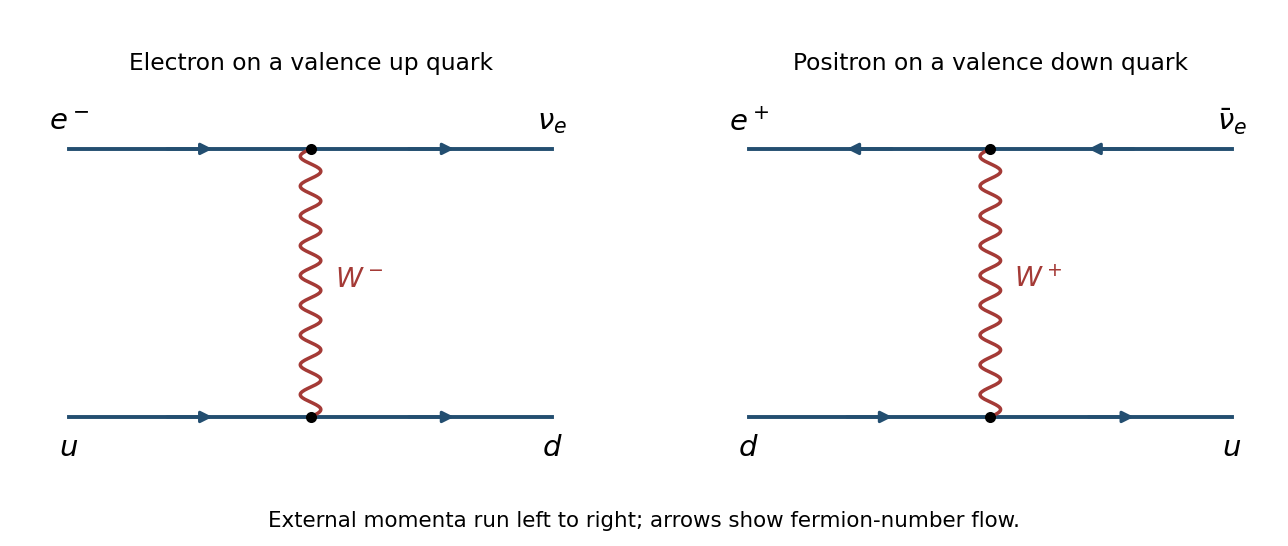

For unpolarized beams, the leading charged current cross sections, suppressing Cabibbo-Kobayashi-Maskawa matrix factors, have the formHere each parton distribution function is evaluated at . The proton has two valence up quarks and one valence down quark; moreover, its valence contribution in the Positron reaction carries the chiral angular factor . Both effects favour . Increasing at fixed collider energy enforces , progressively suppressing the sea relative to the valence quarks; large further suppresses the Positron valence term. There is no universal factor of two valid at every .
The escaping neutrino prevents direct reconstruction from a scattered charged lepton. Instead use the Jacquet-Blondel reconstruction. With the axis along the proton beam, measure the complete hadronic final state and formThese relations follow from four-momentum conservation, with the unobserved neutrino transverse momentum opposite to the measured hadronic sum. A nearly hermetic hadronic calorimeter, supplemented by tracking detectors, must measure jets, their energies and their directions. Forward losses, initial-state radiation and small cause significant reconstruction uncertainties.
Articles by others on the same topic
There are currently no matching articles.