Starting with the electron neutrino state in a, the survival probability amplitude isTaking its squared absolute value givesThis derives the supplied survival probability from the evolution operator rather than from a Hamiltonian entry. It also shows why the two written forms agree. For the stipulated phase and , , so at ,The phase decreases monotonically from to over the open interval . Differentiating gives . The interior maxima occur at and the interior minima at . Enumerating those phases givesThe minimum just above must not be lost by rounding the lower endpoint. Neither excluded endpoint is an additional extremum.
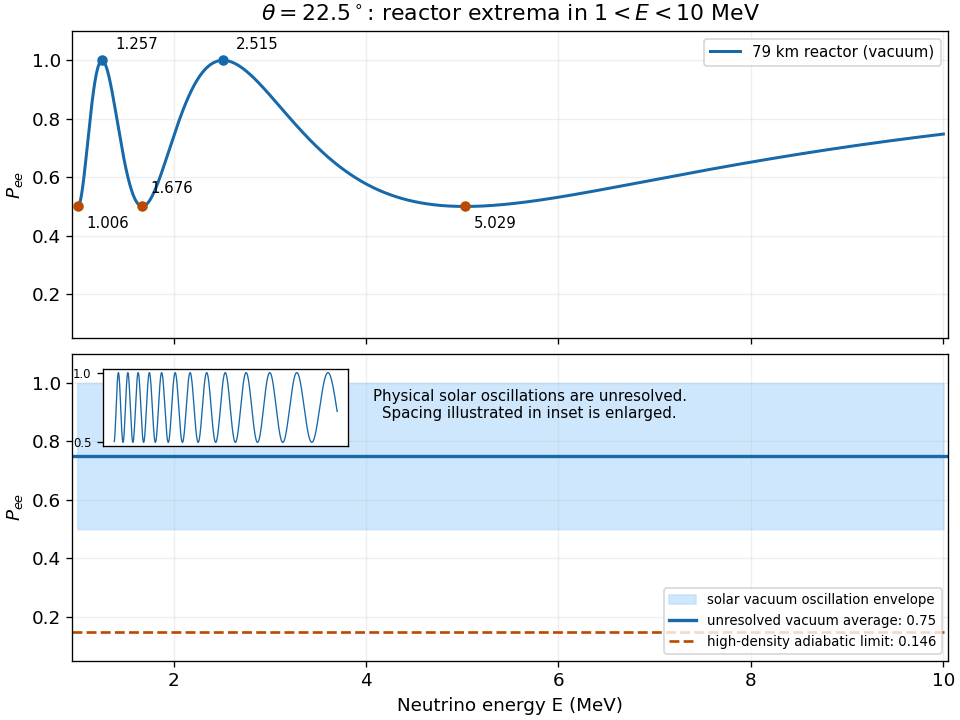
Reactor survival extrema and the unresolved solar vacuum-oscillation envelope
. Details. 
For solar neutrinos propagating in the same vacuum model, the vastly longer baseline makes the oscillations extremely fine in energy, with the same bounds and . The figure uses a deliberately schematic enlargement of the oscillation spacing to show those bounds. A detector energy resolution averages very many periods, so andThe detector averages event rates weighted by source spectrum, interaction cross section and response; the displayed constant follows when these vary slowly across each tiny oscillation period. Reactor production physically gives electron antineutrinos. In this two-flavor vacuum approximation their survival probability is identical; the positive matter-potential discussion in d concerns solar neutrinos.
Articles by others on the same topic
There are currently no matching articles.