A mass eigenstate has a definite neutrino mass and acquires a definite propagation phase at fixed momentum. An interaction eigenstate is the neutrino flavor selected by a weak charged current: is produced or detected together with an electron, and together with a muon. The two bases are related by a unitary matrix, here the real rotation matrix .
Inverting the supplied transformation gives and , where , . If , these bases coincide: each produced neutrino flavor propagates as one mass eigenstate, and there is no neutrino oscillation, even if the two masses differ. Conversely, equal masses also prevent vacuum neutrino oscillation, even when a nonzero basis-rotation angle is written down.
Write and . Since the supplied rotation matrix is real and orthogonal, . Direct matrix multiplication gives the flavor-basis HamiltonianThe common term produces only an overall quantum phase. The off-diagonal elements couple the two interaction eigenstates in the Schrödinger equation. Flavor change requires both and . For ultrarelativistic neutrinos in vacuum, , so a nonzero squared-mass difference is needed. Observable neutrino oscillation also requires coherent production and propagation of the two components and a resolvable nonzero relative phase; special propagation times can return the initial flavor even when these Hamiltonian conditions hold.
A useful distinction for the next part is that is an energy, not a time-dependent survival probability amplitude. The latter is the element of .
Starting with the electron neutrino state in a, the survival probability amplitude isTaking its squared absolute value givesThis derives the supplied survival probability from the evolution operator rather than from a Hamiltonian entry. It also shows why the two written forms agree. For the stipulated phase and , , so at ,The phase decreases monotonically from to over the open interval . Differentiating gives . The interior maxima occur at and the interior minima at . Enumerating those phases givesThe minimum just above must not be lost by rounding the lower endpoint. Neither excluded endpoint is an additional extremum.
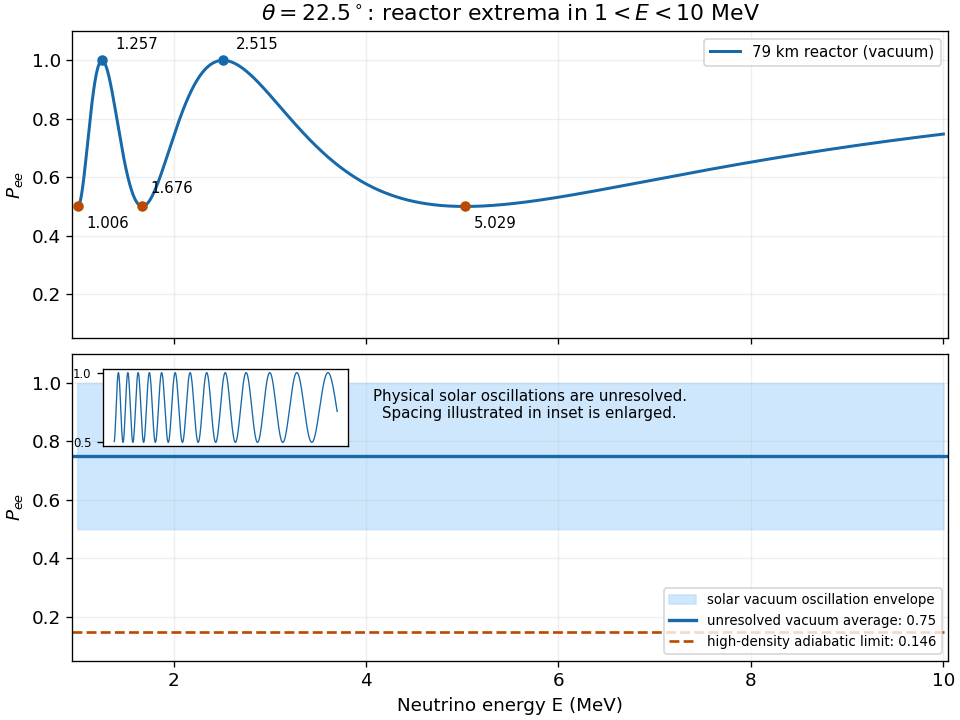
Reactor survival extrema and the unresolved solar vacuum-oscillation envelope
. Details. 
For solar neutrinos propagating in the same vacuum model, the vastly longer baseline makes the oscillations extremely fine in energy, with the same bounds and . The figure uses a deliberately schematic enlargement of the oscillation spacing to show those bounds. A detector energy resolution averages very many periods, so andThe detector averages event rates weighted by source spectrum, interaction cross section and response; the displayed constant follows when these vary slowly across each tiny oscillation period. Reactor production physically gives electron antineutrinos. In this two-flavor vacuum approximation their survival probability is identical; the positive matter-potential discussion in d concerns solar neutrinos.
For a positive electron neutrino matter potential and the normal ordering implicit in positive , choose by continuous diagonalization of the matter Hamiltonian. With , the quadrant is fixed byAt high density , soTaking a principal-value arctangent alone and concluding would select the wrong branch. The production state is the second matter propagation eigenstate, rather than literally the vacuum mass eigenstate while still inside the dense medium.
Assume the solar density decreases slowly enough for adiabatic matter-enhanced neutrino conversion, and neglect subsequent Earth matter effects. The state follows continuously into the vacuum mass eigenstate . Since ,This is substantially below the phase-averaged vacuum result . There is no interference between two populated vacuum mass eigenstates in this ideal adiabatic limit. More generally, after phase averaging, at production if the evolution is adiabatic. In the high-density limit, a nonadiabatic level-jump probability instead gives . Thus the supplied core-density condition alone does not guarantee the numerical Earth result: the usual solar adiabatic assumption is also needed. These are the stipulated two-flavor parameters, not a precision prediction for the measured three-flavor solar spectrum.
Articles by others on the same topic
There are currently no matching articles.