For a planar lamina in the -plane and three mutually perpendicular axes through one common point, the perpendicular axis theorem is . Indeed , while and . Planarity and the common axis intersection are essential.
For two parallel axes, one through the centre of mass and one a perpendicular distance away, the parallel axis theorem iswhere is the total mass. Expanding the squared distance in the defining moment of inertia integral leaves a cross term proportional to . The second axis need not pass through the body, and uniform density is not required, but the reference axis for must pass through its centre of mass.
For a uniform disk, the surface mass density is . Integrate concentric annuli of mass about the central perpendicular axis:The result is specific to a uniform thin disk and that axis; it is not the diameter-axis moment of inertia, which is by planar symmetry and the perpendicular axis theorem.
Let be the original disk centre and the hole centre. The source geometry has , , all collinear. The removed disk has mass , since its area is one quarter of the original disk's. Use the parallel axis theorem for both the original disk and the removed disk:Subtracting the missing material's moment of inertia givesHere continues to denote the original unperforated disk mass; the earring itself has mass .
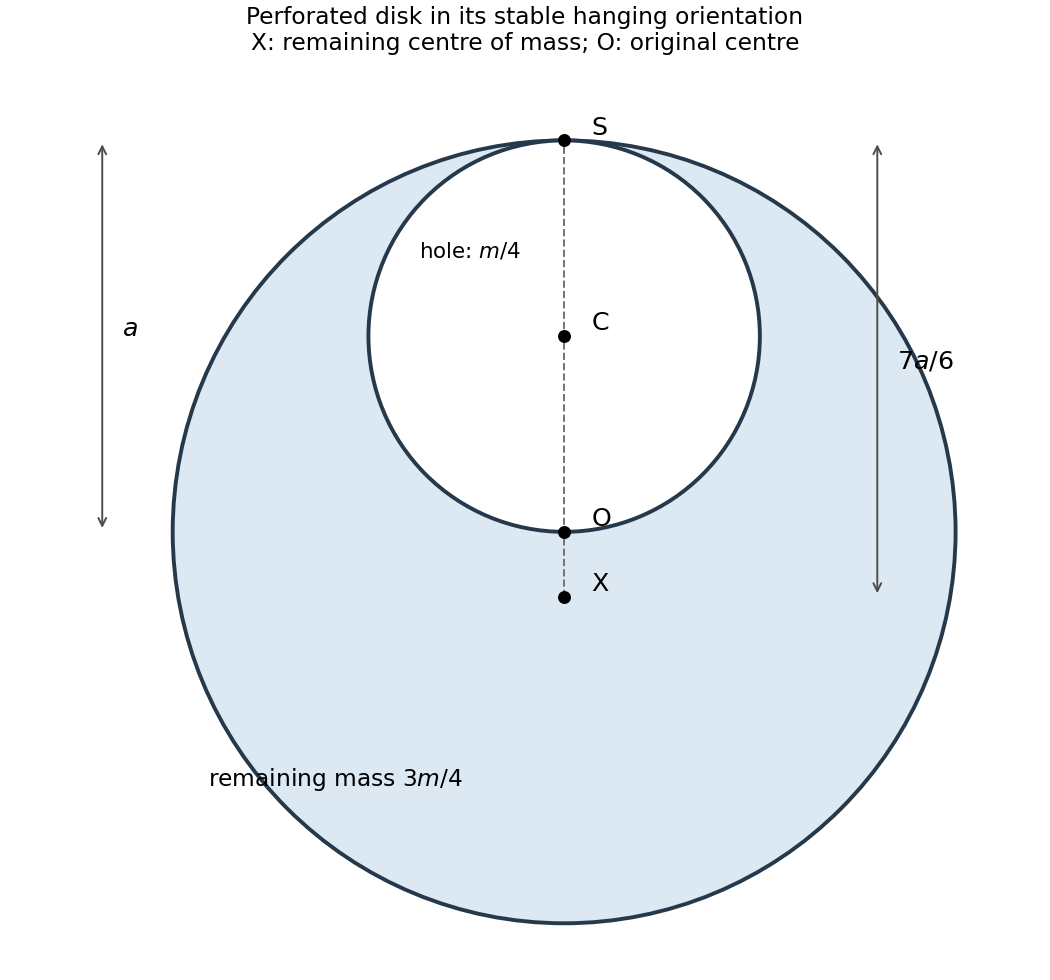

Take the positive coordinate from toward . The centre of mass of the remaining material has coordinateThus . If is the small angular displacement from the stable hanging orientation, gravity gives torque about the suspension point. The physical pendulum equation isUsing the small-angle approximation gives simple harmonic motion withBoth the reduced mass and displaced centre of mass matter; changing only the moment of inertia would give an incorrect frequency.
Articles by others on the same topic
There are currently no matching articles.