During the short collision, the pivot's impulse has zero torque about the pivot, so angular momentum conservation about that point givesThe bullet stops rather than becoming embedded: immediately after impact only the rod contributes to the kinetic energy. Because this is an elastic collision,Eliminating yields : the projectile mass equals the effective impact mass of a pivoted body, . Hence the bullet has one third of the rod's mass, andOrdinary momentum conservation for the bullet and rod together would be incorrect: the fixed pivot supplies an external impulse. The short-impact approximation neglects the change in gravitational potential energy during impact.
The source's tangential arrows respectively point along and against the original motion; point radially outward and inward. Write for the initial orbital radius, for the circular orbital speed, and for the small added speed. The resulting trajectories follow the velocity kick on a circular Kepler orbit formulas. Here orbital energy includes kinetic energy and gravitational potential energy; angular momentum refers to the central object.
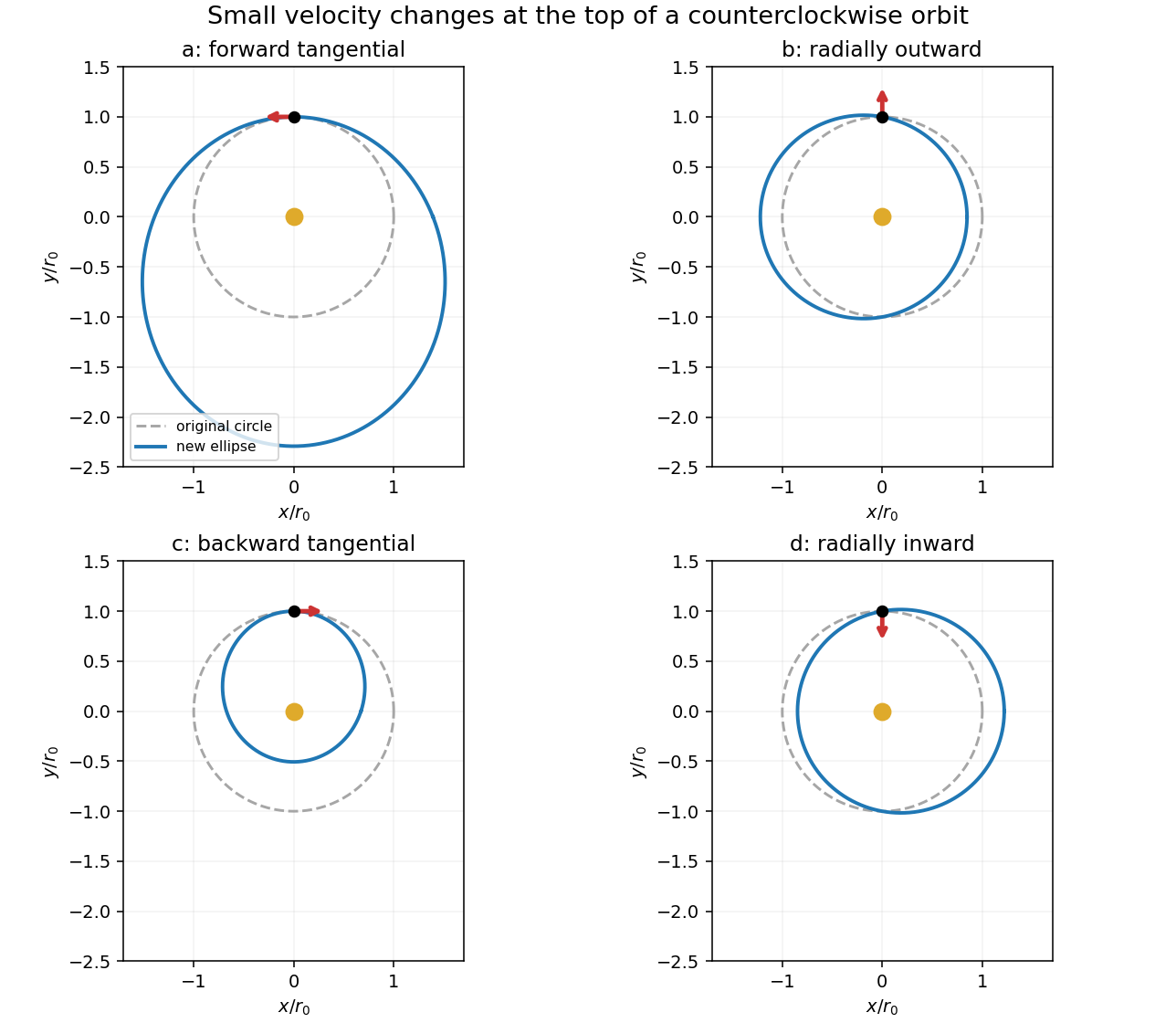
Four Kepler orbits following small tangential or radial velocity changes
. Details. Adding tangential velocity along the existing motion increases both orbital energy and angular momentum:For a sufficiently small kick the Kepler orbit remains an ellipse. At the kick point its radial velocity vanishes and its tangential speed exceeds the circular orbital speed, so that point becomes the pericentre. The ellipse extends farther outward than the original circle.
A radial outward kick has no angular impulse about the centre. ThereforeThe initial position is on the outward-moving portion of a bound elliptic Kepler orbit, between pericentre and apocentre, rather than at either turning point. The eccentricity is and the semilatus rectum remains . The orbital energy change is second order: it vanishes to first order in the impulse but is positive for any nonzero kick.
For a small opposing tangential kick,The new tangential speed is less than the circular orbital speed, so the kick point is the apocentre of an ellipse. The orbit falls inward from the original circle. The signs assume ; a large velocity reversal is outside the stated small-impulse regime.
The inward radial kick also leaves angular momentum unchanged and increases orbital energy by . Its eccentricity and semi-major axis equal those in case , but the orientation of its eccentricity vector is reflected about the initial radius. The satellite initially moves inward on its ellipse, toward pericentre. Neither radial kick decreases the orbital energy.
For planets with negligible mass compared with the Sun, Kepler's third law gives , where is the semi-major axis. Relative to Earth,Thus the requested orbital-distance estimates are about 0.39 and 5.2 times Earth's. Strictly, the period fixes the semi-major axis, not a time-averaged radius of an arbitrary eccentric orbit; identifying the two as a mean distance is the usual elementary orbital-size convention.
In the pion rest frame, momentum conservation makes the muon and neutrino momenta opposite, with common magnitude . For a massless neutrino, ; energy conservation and the relativistic energy-momentum relation giveSubstitute into the second equation. The terms cancel, leavingFor completeness, the complementary relativistic two-body decay energy is . The result is a total energy, including the muon rest energy, rather than its kinetic energy.
Treat the ladder as a uniform slender rigid body. While both contacts remain imposed, its centre of mass is , with speed . Its central moment of inertia is . Adding translational and rotational kinetic energy givesTaking the floor as zero gravitational potential energy, the Lagrangian, conjugate momentum and Euler-Lagrange equation areThe positive sign is appropriate: gravity increases the angle from the vertical. These are the constrained equations of a frictionless sliding ladder. Real wall contact is unilateral: a wall cannot pull the ladder. Once the computed normal force would become negative, the two-contact model ceases to apply; the question explicitly assumes that contact persists.
Write for the imposed constant angular velocity. In inertial polar coordinates, the bead has . Its constrained Lagrangian isThe reduced Lagrangian has no explicit time dependence, so its Lagrangian energy function is conserved:This is the Jacobi integral , since the bead's actual inertial energy and axial angular momentum areThe motor maintaining the stick's angular velocity supplies torque and does work. Indeed , generally nonzero. A time-independent reduced Lagrangian therefore need not imply conservation of the bead's inertial kinetic energy when its imposed constraint is moving.
Choose upward velocity positive during ascent. Gravity and linear drag both point downward, giving the linear differential equationAt the highest point , soThe vertical ascent under linear drag time is smaller than for , because . Its zero-drag limit is , as required by constant-gravity projectile motion.
Choose downward velocity positive. The remaining rocket mass is , and the upward rocket thrust has magnitude , where is the relative rocket exhaust speed. The rocket equation including gravity isThis follows by applying momentum conservation to the rocket and its just-expelled rocket propellant, with gravity supplying the external impulse. Applying to the rocket alone would omit the exhaust momentum flux.
Integrating the rocket equation with givesThis formula holds during the constant-flow burn, while and fuel remains. The negative logarithmic term represents the slowing due to upward rocket thrust.
Height decreases at rate . Set ; an antiderivative needed for the rocket equation isConsequentlyDifferentiating this expression recovers and substituting gives , which check both the sign and the integration constant.
The specified rocket fuel fraction gives , so . Imposing yieldsThen fixesNumerically,The associated constant mass loss rate is . The initial upward thrust acceleration already exceeds and increases as mass falls, so the downward speed decreases monotonically to zero. This calculation assumes constant lunar gravitational acceleration, constant relative rocket exhaust speed, and negligible drag.
For two particles, let and . The centre-of-mass frame velocities are , so . Thus before and after an isolated collision the two momentum vectors are equal and opposite. For an elastic collision their common magnitude is also unchanged: only their direction rotates.
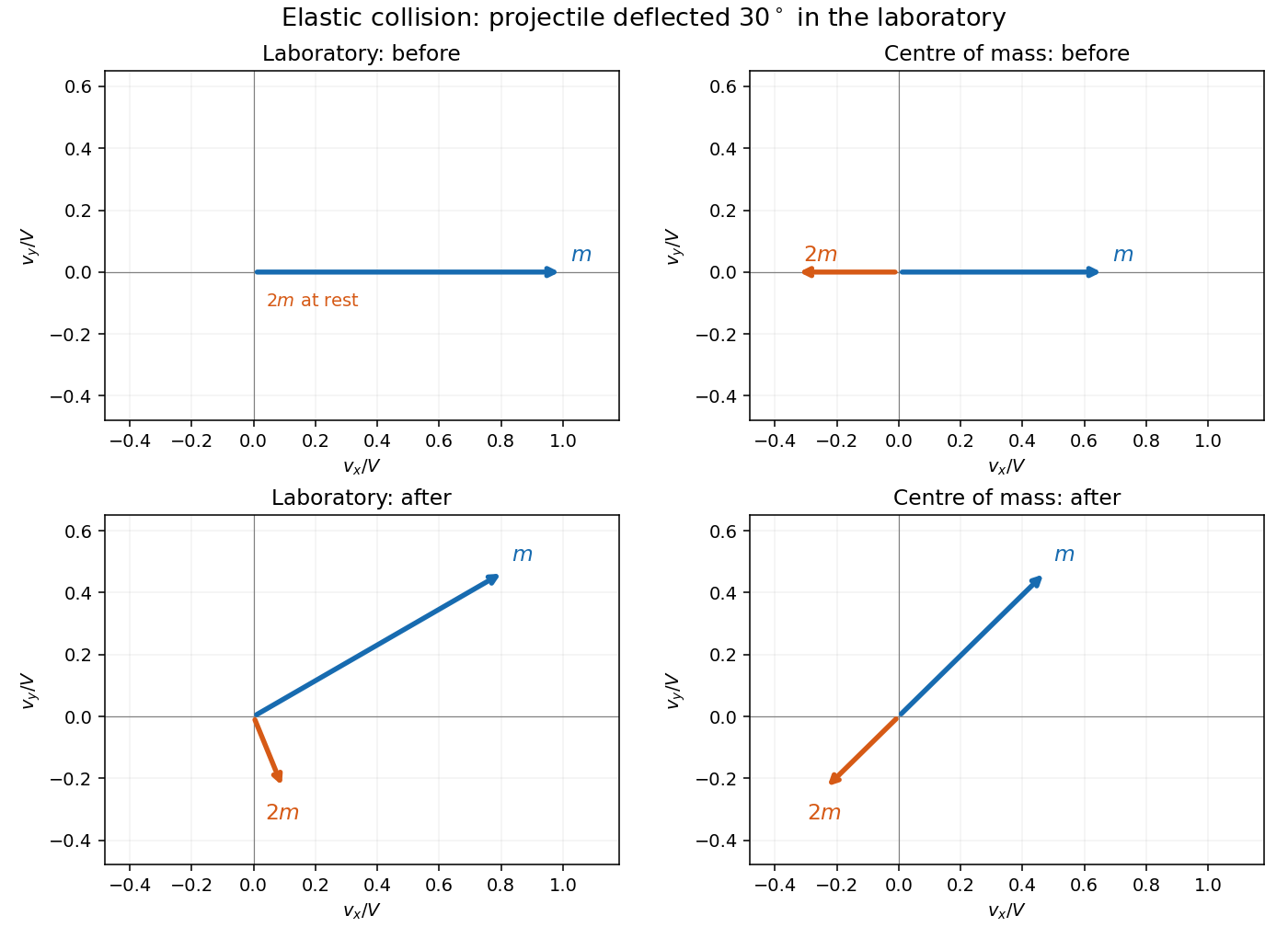
The kinetic energy decomposition about the center of mass separates unchanged bulk translation from relative motion:The reduced mass reduces the calculation to one relative velocity. After solving the geometry in the centre-of-mass frame, add to each velocity to return to the laboratory. The four panels below illustrate this for the subsequent example.
For equal masses , the reduced mass is . The kinetic energy of their centre of mass cannot be removed by an isolated collision, since total momentum is fixed. Therefore the maximum energy available for conversion to internal forms is the initial relative kinetic energy,It is attained by a perfectly inelastic collision in which the final relative velocity is zero. This concerns the convertible initial kinetic energy, not an arbitrary pre-existing internal energy reservoir.
For masses and , the constant centre-of-mass velocity is . Initially the laboratory velocities are and zero, while the centre-of-mass frame velocities are and . After the elastic collision they areAdding produces the lower-left panel's laboratory velocity vectors. The given laboratory angle impliesThe centre-of-mass frame scattering angle is therefore different from the laboratory angle. Reflection across the -axis gives the equally possible negative-angle configuration.
Let be the projectile's final speed, taking its deflection above the -axis. Momentum conservation givesSubstituting these into kinetic energy conservation, , gives . Its positive root is . HenceThese vectors satisfy and . For the reflected deflection, reverse both components.
Einstein's postulates state that the laws of physics have the same form in every inertial frame, and that light in vacuum has the same speed of light in every inertial frame, independently of the motion of its source. For a primed frame moving with velocity relative to an unprimed frame, with coincident origins at , the Lorentz transformations areThe following worldlines use Earth-frame time in years and distance in light years, so numerically . The instantaneous turnaround is the idealized limit of a short acceleration stage; the elapsed proper time is calculated along each inertial segment.
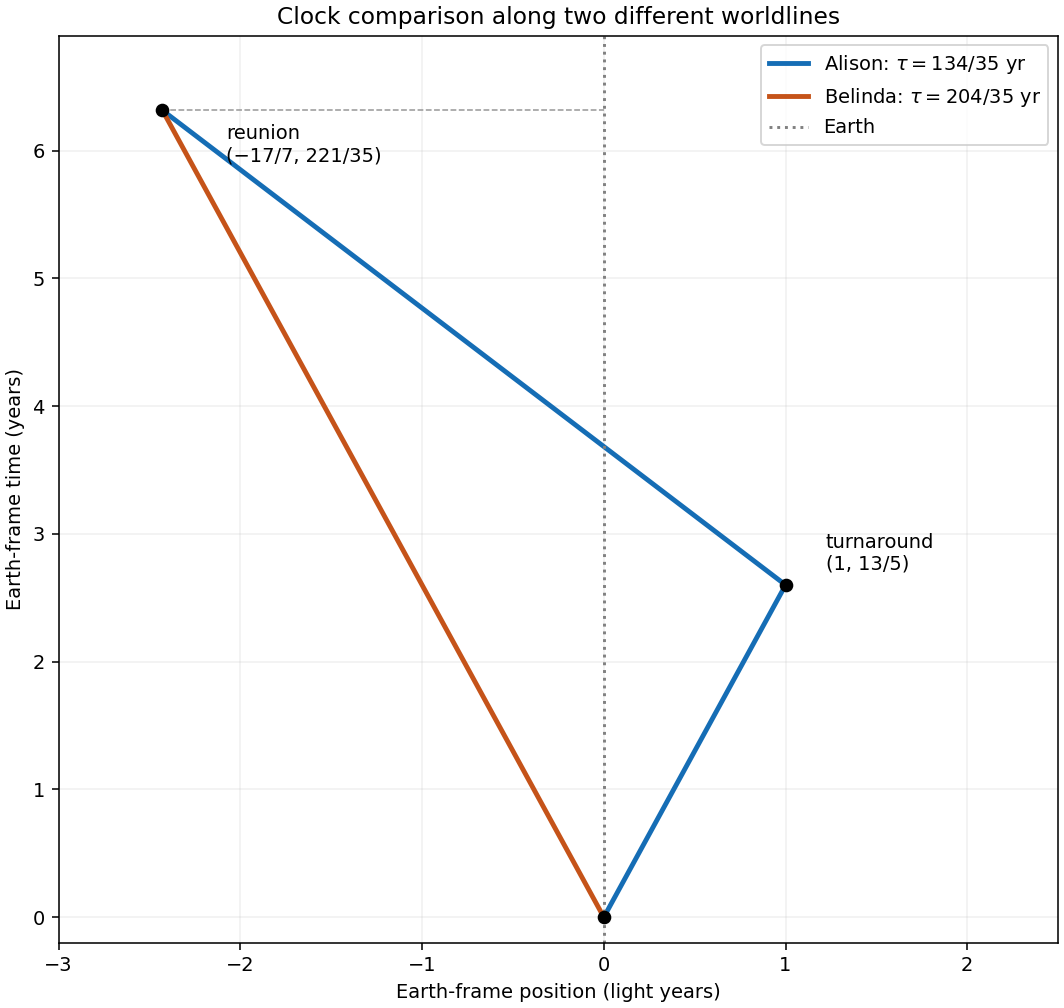
Alison reaches the station at years. Her return worldline iswhile Belinda's is . Equating them givesThis is the elapsed Earth-frame time, measurable by synchronized clocks in that inertial frame. A signal announcing the reunion reaches a clock physically on Earth later; its light-travel delay is not part of the requested frame-time comparison.
Belinda remains in one inertial frame with , so the time dilation factor is . Her elapsed proper time isThe reunion event is shared by both twins, making their clock readings directly comparable without any convention for synchronizing separated moving clocks.
Alison's outbound proper time is years. Her return Earth-frame duration is years, with time dilation factor . Adding the two segments,Alison is two years younger than Belinda at reunion. Her turnaround changes inertial frames, and the faster return segment accumulates less proper time per unit Earth-frame time. The twin paradox is resolved by comparing the complete worldlines, not by applying one constant time dilation factor to Alison's whole journey.
For a planar lamina in the -plane and three mutually perpendicular axes through one common point, the perpendicular axis theorem is . Indeed , while and . Planarity and the common axis intersection are essential.
For two parallel axes, one through the centre of mass and one a perpendicular distance away, the parallel axis theorem iswhere is the total mass. Expanding the squared distance in the defining moment of inertia integral leaves a cross term proportional to . The second axis need not pass through the body, and uniform density is not required, but the reference axis for must pass through its centre of mass.
For a uniform disk, the surface mass density is . Integrate concentric annuli of mass about the central perpendicular axis:The result is specific to a uniform thin disk and that axis; it is not the diameter-axis moment of inertia, which is by planar symmetry and the perpendicular axis theorem.
Let be the original disk centre and the hole centre. The source geometry has , , all collinear. The removed disk has mass , since its area is one quarter of the original disk's. Use the parallel axis theorem for both the original disk and the removed disk:Subtracting the missing material's moment of inertia givesHere continues to denote the original unperforated disk mass; the earring itself has mass .
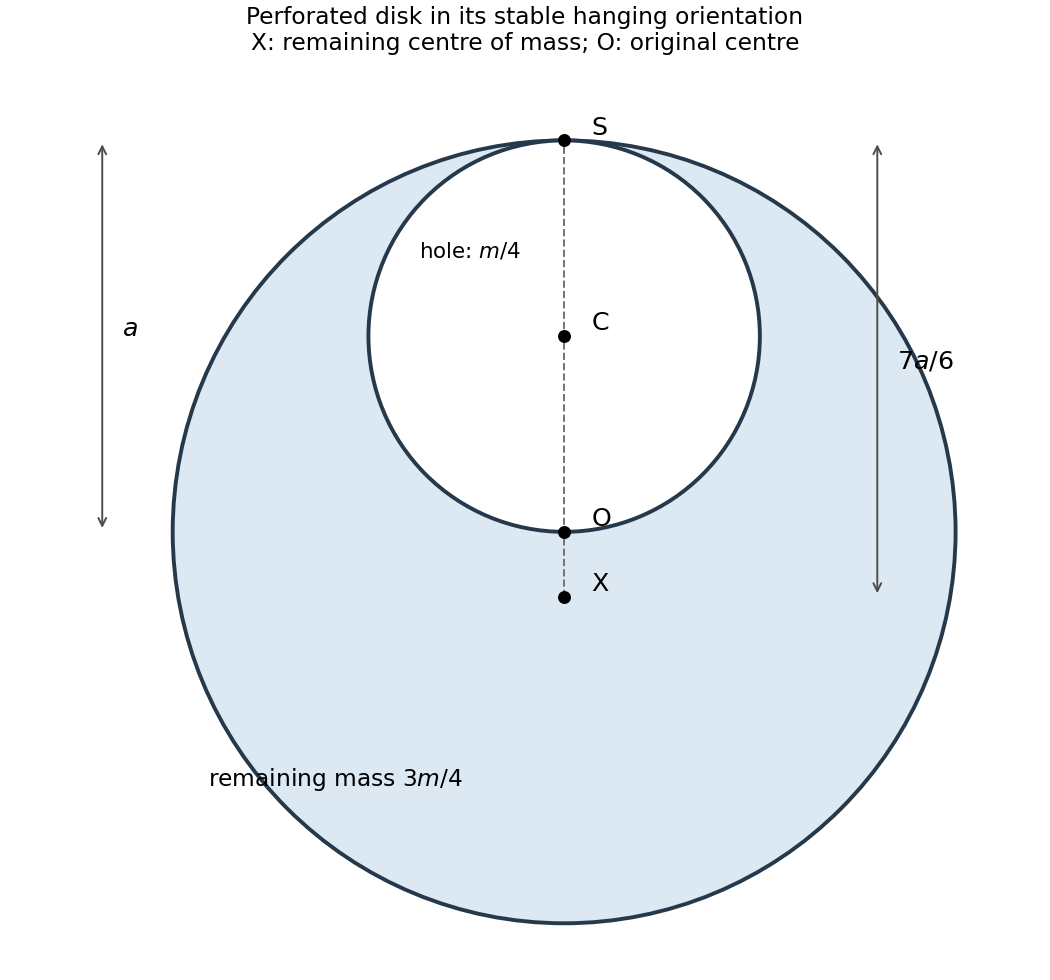


Take the positive coordinate from toward . The centre of mass of the remaining material has coordinateThus . If is the small angular displacement from the stable hanging orientation, gravity gives torque about the suspension point. The physical pendulum equation isUsing the small-angle approximation gives simple harmonic motion withBoth the reduced mass and displaced centre of mass matter; changing only the moment of inertia would give an incorrect frequency.
Articles by others on the same topic
There are currently no matching articles.