The parallel axis theorem relates the moment of inertia about an axis through the centre of mass to that about a parallel axis a perpendicular distance away:To see the cross term vanish, write each perpendicular displacement as its displacement from the centre of mass plus the fixed offset. In the defining mass integral, the first moment about the centre of mass is zero.
For a thin planar rigid body in the plane, the perpendicular axis theorem sayswhere all three axes pass through the same point, lie in the plane, and is perpendicular to it. This follows directly from being the squared distance from the axis. The thin-planar condition and common intersection point are essential; the formula is not a general identity for three-dimensional bodies.
Let increase along the handle, with zero at the centre of the circular head. The ring has its centre of mass at . The rod occupies , so its centre of mass is at . The mass-weighted mean is thereforeThis uses the source diagram's rim-to-end handle length , not a rod beginning at the head's centre.
The moment of inertia of a uniform thin ring about its perpendicular central axis is . Its two in-plane diameters are equivalent by rotational symmetry, so the perpendicular axis theorem gives about either diameter. The central rod contribution about an axis perpendicular to its length is .
The requested axis is parallel to these central axes and passes through the whole racquet's centre of mass. Applying the parallel axis theorem separately givesAn equivalent reduced expression isBoth refer to the in-plane axis perpendicular to the handle; the ring contribution would be different for an axis normal to the racquet face.
With and , a gives , while the hand point is at . Thus the hand-to-CM distance is , and b givesModel the short impact with the hand point fixed but free to rotate about the in-plane axis perpendicular to the handle. Let be the ball's impulse on the racquet and its distance from toward the head. Angular impulse about gives . The fixed-pivot kinematics require the centre-of-mass velocity magnitude to be . The hand's signed impact impulse is consequentlyThe centre of percussion is where , henceSubtract this from the head-centre distance to obtain the requested position:It lies within the circular head. By symmetry its transverse displacement is zero, so the impact is on the head's central line along the handle. This cancels the impulsive hand reaction, not every force on the hand at later times; weight and any sustained grip torque lie outside the short-impact approximation.
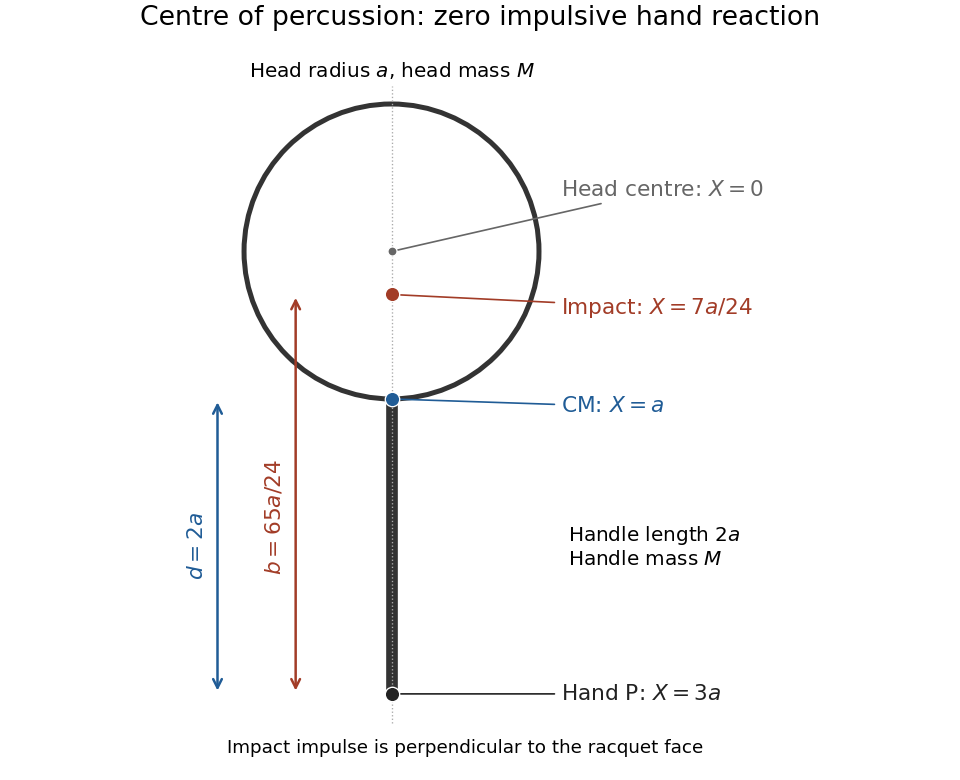
The centre of percussion lies inside the head, toward the handle
. The calculated geometry for equal head and handle masses and . The head centre is , the complete racquet's centre of mass is , and the hand is at . The zero-hand-impulse impact lies at . Details.
Articles by others on the same topic
There are currently no matching articles.