Source paper: Oxford public source archive. The archive member is named
2017/T/a10287w1.pdf, but the held cover identifies CP1, 4 June 2018; the year follows that cover. All Section B options are solved.For ordinary conservative classical mechanics, the Lagrangian is , where is the kinetic energy and the potential energy. More generally it is the function whose action satisfies the principle of stationary action. The canonical momenta and Hamiltonian areFor a regular Lagrangian, the first equations can be inverted to express the generalized velocities in terms of ; this defines the Legendre transform on phase space.
Along a solution of the Euler-Lagrange equations, . Taking a total time derivative givesThus an autonomous Lagrangian hasFor the usual time-independent mechanical coordinates and a velocity-independent potential energy, the kinetic energy is quadratic in the generalized velocities, so and . The conservation proof itself uses the Euler-Lagrange equations, rather than assuming this special expression for energy.
Take the rocket exhaust speed relative to the hovering ship, with exhaust directed vertically downward. If is the mass flow rate, the upward rocket thrust is . For example, over a short interval , the expelled mass acquires downward momentum , giving the opposite recoil to the ship. Balancing its weight requiresSolving this differential equation with yields the hovering rocket mass flowThe required mass flow rate decreases because the mass to support decreases. These expressions apply while fuel is available and remain constant. If the rocket dry mass is , hovering ends at ; the mathematical limit is not a model of an indefinitely fuelled physical ship.
Let be the displacement from the upward vertical and the speed of the ball's centre of mass. Its centre follows a circle of radius . The rolling without slipping constraint is , with the ball's spin angular velocity. The static contact friction does no work on the ball because the instantaneous contact point is stationary. Thus conservation of energy givesProject Newton's second law toward the hemisphere's centre. The inward component of gravity is and the normal force points outward, soAt contact loss . Eliminating gives the ideal sphere rolling off a hemisphere resultThe radius cancels, so replacing by under the stated small-ball approximation leaves the same answer.
Finite-friction qualification. This is an ideal rolling-constraint result. It does not describe uninterrupted pure rolling to detachment with any finite coefficient of static friction. The tangential force and torque equations giveso acts uphill, whereasConsequently the required ratio isFor a concrete example, a coefficient of static friction of one allows rolling only up to about , where , before sliding begins. A subsequent physical contact-loss angle needs a sliding-friction model. The boxed answers the source's expressly imposed no-slip idealization.
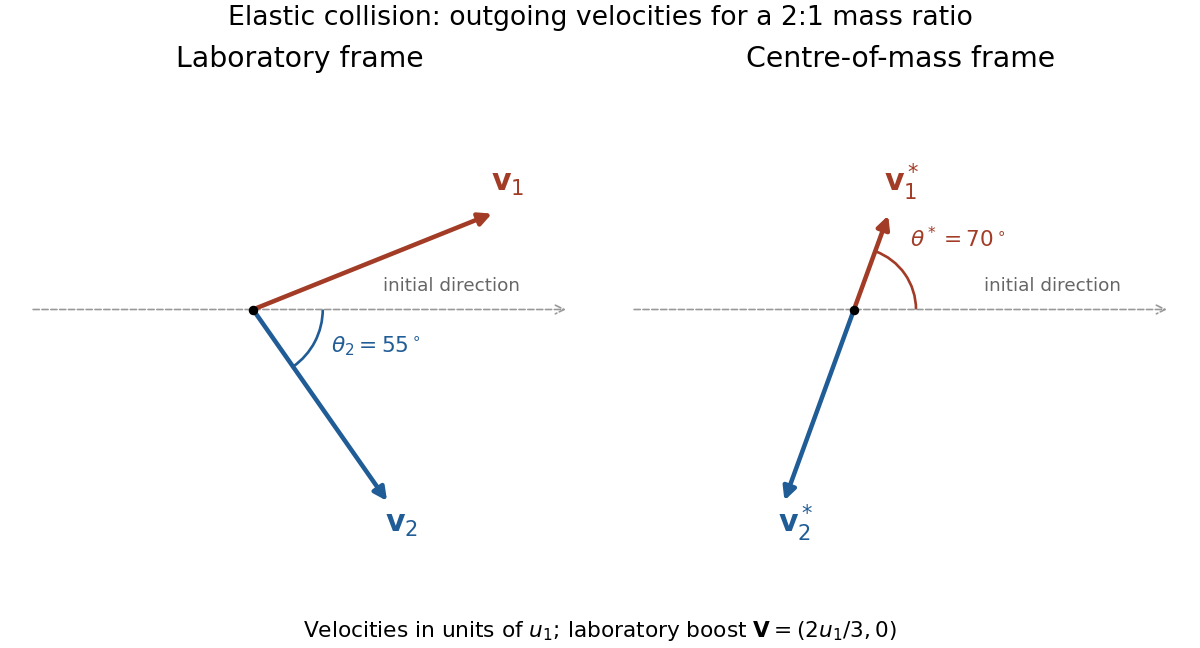
Choose the initial incident velocity as . The centre-of-mass velocity in the laboratory frame isIn the centre-of-mass frame, the initial velocities are and . Conservation of momentum and kinetic energy in an elastic collision preserves these two speed magnitudes. Let be the outgoing angle of particle 1 in that frame, measured from the initial positive direction. ThenAdding to transform back to the laboratory frame givesThe nonnegative laboratory recoil angle is measured below the incident axis in this choice of scattering plane. Hence the recoil angle in a two-body elastic collision obeysThe source identity therefore uses for the projectile's outgoing direction in the centre-of-mass frame. If instead it denotes particle 2's outgoing direction, the corresponding expression has in the denominator. A signed laboratory angle for the drawn target trajectory would carry a minus sign. At zero deflection the target remains at rest, so its direction is undefined; is a limit.

For a Lorentz transformation with moving at along relative to ,Differentiate along the object's trajectory and divide the spatial differentials by . Using and derives the relativistic velocity-addition formula:In the rest frame of ship A, take and the Earth-frame velocity of B as . Here and the common denominator is one, soThe required relative speed is the magnitude of this two-component velocity, not either component separately:The inverse Lorentz factor check is , which gives the same relative speed.
Interpret the quoted muon energy as total relativistic energy, and neglect energy loss in the atmosphere. The Lorentz factor, speed and Earth-frame travel time areThe muon decay law is exponential in proper time. Equivalently, time dilation makes the Earth-frame mean lifetime . The exponential survival probability over the flight isWith and , the elapsed proper time is . ThereforeThis uses the stated single incident energy and vertical trajectories. If the number were a kinetic energy, one would instead use ; the distinction is not silently absorbed into the rest energy.
The parallel axis theorem relates the moment of inertia about an axis through the centre of mass to that about a parallel axis a perpendicular distance away:To see the cross term vanish, write each perpendicular displacement as its displacement from the centre of mass plus the fixed offset. In the defining mass integral, the first moment about the centre of mass is zero.
For a thin planar rigid body in the plane, the perpendicular axis theorem sayswhere all three axes pass through the same point, lie in the plane, and is perpendicular to it. This follows directly from being the squared distance from the axis. The thin-planar condition and common intersection point are essential; the formula is not a general identity for three-dimensional bodies.
Let increase along the handle, with zero at the centre of the circular head. The ring has its centre of mass at . The rod occupies , so its centre of mass is at . The mass-weighted mean is thereforeThis uses the source diagram's rim-to-end handle length , not a rod beginning at the head's centre.
The moment of inertia of a uniform thin ring about its perpendicular central axis is . Its two in-plane diameters are equivalent by rotational symmetry, so the perpendicular axis theorem gives about either diameter. The central rod contribution about an axis perpendicular to its length is .
The requested axis is parallel to these central axes and passes through the whole racquet's centre of mass. Applying the parallel axis theorem separately givesAn equivalent reduced expression isBoth refer to the in-plane axis perpendicular to the handle; the ring contribution would be different for an axis normal to the racquet face.
With and , a gives , while the hand point is at . Thus the hand-to-CM distance is , and b givesModel the short impact with the hand point fixed but free to rotate about the in-plane axis perpendicular to the handle. Let be the ball's impulse on the racquet and its distance from toward the head. Angular impulse about gives . The fixed-pivot kinematics require the centre-of-mass velocity magnitude to be . The hand's signed impact impulse is consequentlyThe centre of percussion is where , henceSubtract this from the head-centre distance to obtain the requested position:It lies within the circular head. By symmetry its transverse displacement is zero, so the impact is on the head's central line along the handle. This cancels the impulsive hand reaction, not every force on the hand at later times; weight and any sustained grip torque lie outside the short-impact approximation.
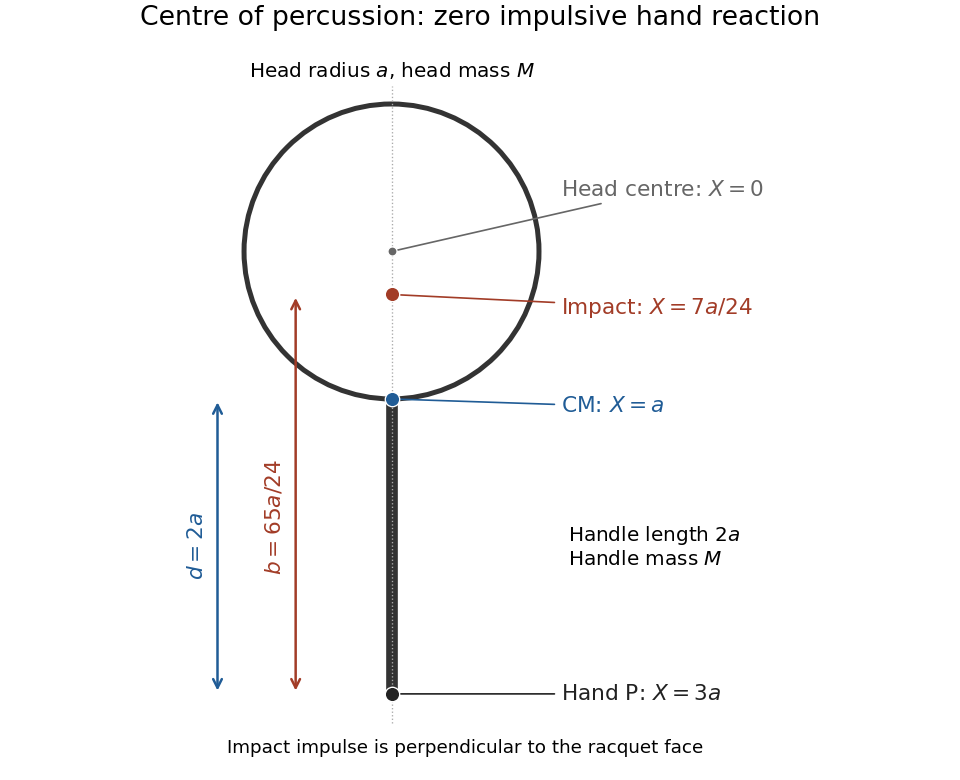
The centre of percussion lies inside the head, toward the handle
. The calculated geometry for equal head and handle masses and . The head centre is , the complete racquet's centre of mass is , and the hand is at . The zero-hand-impulse impact lies at . Details.
For a differentiable central potential, the force is . The angular momentum is , soThis proves conservation of angular momentum. For , the trajectory lies in the fixed plane perpendicular to . In plane polar coordinates, . Substituting this into the kinetic energy gives the radial energy equationThe second term is the centrifugal contribution to the effective potential. Its radial derivative reproduces . Purely radial motion is the case.
For the satellite, write , with Earth's mass and the satellite's mass. At apogee and perigee, the radial velocity is zero, so angular momentum conservation and conservation of energy giveEliminating yieldsFor an elliptic orbit, . Therefore the vis-viva equation at apogee isSubstitution into the orbital energy gives . The circular case follows by continuity, or directly from the radial force balance.
An instantaneous tangential retrograde burn at apogee leaves the position unchanged. For the speed change , the orbital energy change isDifferentiating gives to first order. Since , the vis-viva equation implies . HenceThe factor of two distinguishes the major axis from the semimajor axis. As a finite-change check, the new semimajor axis is exactlywithin the instantaneous-burn, unchanged-mass model. Expanding this expression gives the stated result.
A Lorentz invariant has the same value when the same physical system is described in any inertial frame. The components of its energy-momentum four-vector change, but their Minkowski norm does not. In particular the relativistic energy-momentum relation iswhere is the rest mass. Individual total energy and momentum are frame-dependent; the combination on the left is invariant.
For the fixed-target annihilation, the initial total laboratory energy is and its total momentum is the incident particle's , with . The centre-of-mass energy available for new-particle creation is thereforeIn the centre-of-mass frame the total momentum vanishes, so can supply the new particles' total rest energy at threshold. One does not subtract the annihilated particles' original rest energy. The excess laboratory energy beyond is associated with motion of the whole final system in the laboratory frame.
For the subsequent elastic collision, the equal and opposite transverse components of final momentum imply equal final momentum magnitudes, and hence equal final energies, for the two identical particles. By conservation of relativistic energy, each hasTheir final momentum magnitude and the incident momentum magnitude obeyLongitudinal momentum conservation gives . It follows that the equal-angle relativistic elastic scattering relation isThis derivation assumes nonzero incident kinetic energy and the stated symmetric outgoing paths. The angle between those paths is , which is evaluated in the two following parts.
For , the result in 9 givesThus the angle between the outgoing trajectories isThe two particles are strongly concentrated in the forward direction. This relativistic small-angle limit differs from the right-angle separation of equal-mass particles in the low-speed limit.
For , the ratio in 9 tends to , givingThis recovers the nonrelativistic equal-mass elastic collision result: momentum conservation gives , while conservation of kinetic energy gives . Subtracting the squared momentum relation leaves . Exactly at there are no outgoing nonzero velocities defining such angles; the result is the limit through positive kinetic energies.
Take positive downward and put zero gravitational potential energy at the spring's support. The mass is then a distance below that reference, so . Hooke's law gives the elastic potential energy . ThereforeThe constant term fixes the requested reference but does not affect the motion. The Euler-Lagrange equation isThis is exactly Newton's second law with gravity downward and spring force upward for positive extension. The static extension is .
For the elastic pendulum, set and measure from the downward vertical. In the vertical plane, Cartesian coordinates are and , with upward. Differentiating gives . Thus the Lagrangian isFor , the Euler-Lagrange equation givesFor , the canonical momentum is . Its Euler-Lagrange equation isor, for positive length,At an equilibrium, all time derivatives vanish, so and . Modulo full rotations, the two formal possibilities areThe lower configuration always has positive length. The upper one is a physical straight-spring configuration only if . For example, would give the purported upper state a negative length ; at its zero length makes the angular coordinate singular. Also, the straight compressed spring is an idealization; a real unsupported compressed spring can buckle.
The potential energy is . At either formal stationary point its mixed second derivative vanishes, whileBoth curvatures are positive at the lower state, making it a stable equilibrium; the upper state, when it has positive length, has negative angular curvature and is unstable.
To linearize about the stable state, define the small displacement , not itself, and . Products such as , and are second order, while and . The first-order equations of motion therefore decouple:There are two independent normal modes. The radial one is vertical simple harmonic motion with angular frequency . The transverse one is a simple pendulum oscillation at fixed, statically stretched length , with angular frequency . Their decoupling is a first-order small-oscillation result, not an assertion about the nonlinear motion of the elastic pendulum.
Articles by others on the same topic
There are currently no matching articles.