The differential vacuum Gauss's law isIntegrate over a volume with closed boundary . The divergence theorem converts the left side into outward electric flux:This is the integral form. Surface charge can be treated by a thin-layer limit or by the corresponding jump in the normal field; the enclosed charge then includes the charged sheet. The surface orientation must be outward, and the field entering the integral is the total field, not merely the field of the enclosed charges alone.
Choose at the sheet, positive upwards, so the uniformly charged slab occupies . Use the usual isolated-plane superposition convention, with no imposed uniform background field. The slab alone produces above it, while the negatively charged sheet produces there. ConsequentlySince , the field is upward, away from the net positive charge distribution, with magnitude . The equal halves in the separate infinite-sheet fields follow from their reflection symmetry before superposition.
Below the slab, its own field is downward, . The negative sheet attracts a positive test charge upwards and contributes . Adding the fields givesThe magnitude equals the above-sheet value, but the direction is downward. This equality of outside magnitudes describes the zero-background solution for the given infinite charge planes; adding an externally imposed uniform field would constitute extra boundary data not specified here.
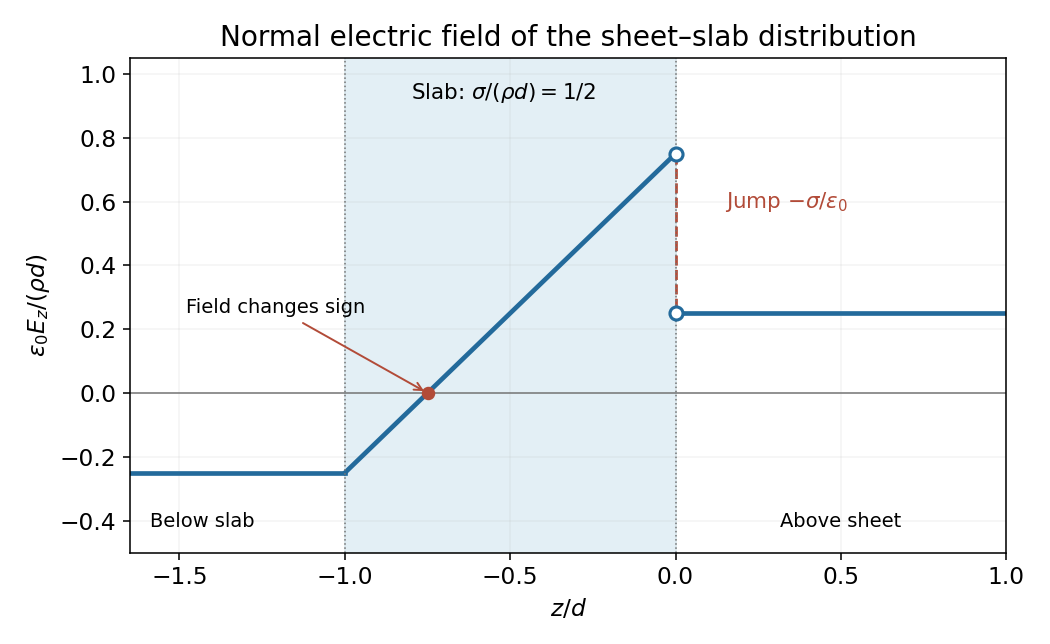
Inside the uniformly charged slab, its own electric field is : it vanishes at the slab's midplane and has derivative . Everywhere below the negative sheet, that sheet adds . ThereforeIts magnitude is the absolute value of this scalar coefficient. The field changes direction atFor it points downward; for it points upward, towards the negative sheet. Thus it is neither uniform nor directed upwards throughout the slab. The derivative and the field at the lower slab boundary also agree with Gauss's law and the previously found outside field.
The signed normal-field profile is constant and negative below , rises linearly through the slab, jumps down at the negative sheet, then remains constant and positive above. More explicitly,There is no surface charge at the slab's lower face, so the field is continuous there; only its slope changes. At the ideal sheet, the field jump isexactly the negative-sheet boundary condition. The ideal sheet itself has distinct one-sided fields rather than one common field value.

Articles by others on the same topic
There are currently no matching articles.