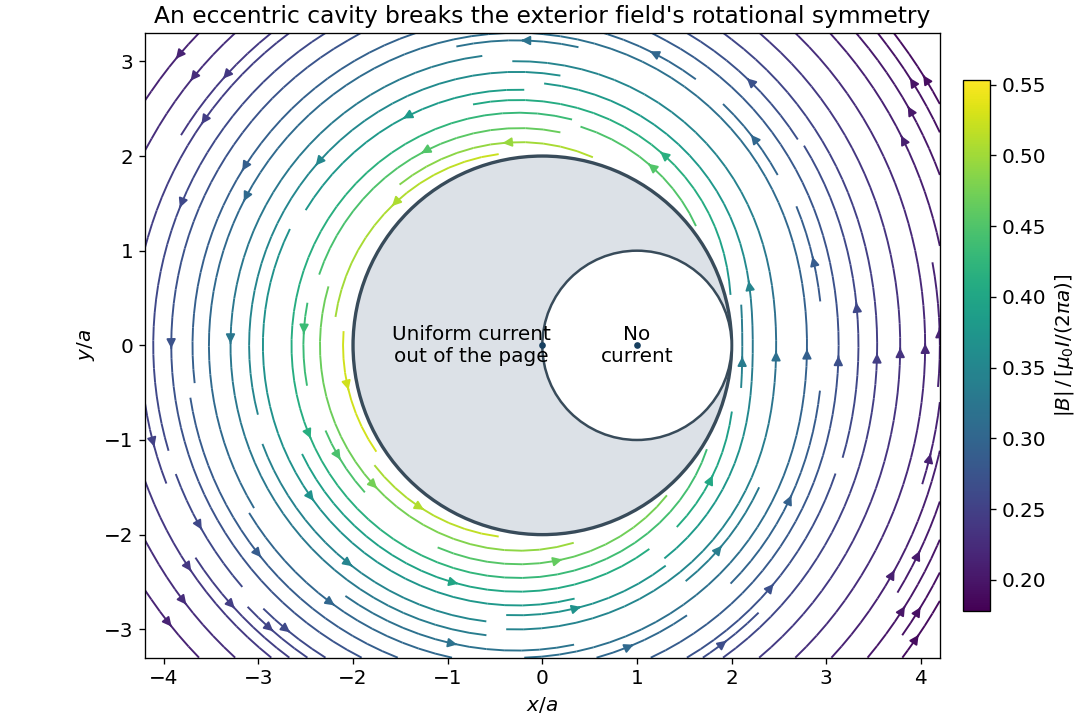
Use the geometric cross-section shown in the source: the outer cylinder has radius and centre , and the circular cavity has radius and centre . Let the electric current be in the direction. The conducting cross-sectional area is , so the uniform electric current density is .
To obtain the exterior magnetic field of a wire with an eccentric cylindrical cavity, apply the superposition principle to a full cylinder of electric current density centred at and a second cylinder of electric current density centred at . Their electric currents are and . This reproduces the actual electric current density everywhere, including zero in the cavity. Outside a long circular cylinder, Ampère's law gives . Every point outside the outer boundary is outside both component cylinders. Consequently, writing ,In Cartesian coordinates, the same magnetic flux density isThe cavity breaks rotational symmetry. Thus the magnetic flux density is generally neither constant in magnitude nor tangential on a circle centred at ; replacing its line integral by would be unjustified. Its line integral is nevertheless , as Ampère's law requires. At distances , the leading term becomes , with corrections of order .

Articles by others on the same topic
There are currently no matching articles.