Source: public archive, member
2015/CP2_June_2015.pdf. The held cover dates this sitting to 9 June 2015. Separate unlettered marked blocks are indexed a, b and so on; all four Section B options are answered.Take the electric potential to vanish at infinity. The distance from the centre to each point charge is half the diagonal of a polygon of the square, namely . The superposition principle for the electric potential therefore gives, for four charges ,Strictly, specifying only the magnitude of each electric charge leaves its sign undetermined. For signed charges , the general answer is . For example, two positive and two negative charges of equal magnitude give zero electric potential at the centre. The boxed result uses the usual interpretation that all four charges have the same positive sign.
Gauss's law states that the outward electric flux through a closed surface is the enclosed electric charge divided by the vacuum permittivity:In electrostatics, the electric field is the negative gradient of the electrostatic potential, . Substitution into the differential equation form of Gauss's law gives Poisson's equation . Consequently, in a region containing no charge density,which is Laplace's equation. Charges on the bounding conductors enter through the boundary conditions; they need not vanish for Laplace's equation to hold inside the empty gap.
Neglect fringing field near the edges of the parallel-plate capacitor. Put the plates at , with prescribed electric potentials . Translational symmetry parallel to a plane makes the electrostatic potential independent of the coordinates parallel to the plates. Thus Laplace's equation reduces to . Its general solution is , and the two boundary conditions determine both constants:The electric field is uniform and points toward decreasing electric potential. No plate voltages are specified, so a numerical electric potential cannot be fixed; choosing one plate as the reference only fixes the arbitrary additive constant.
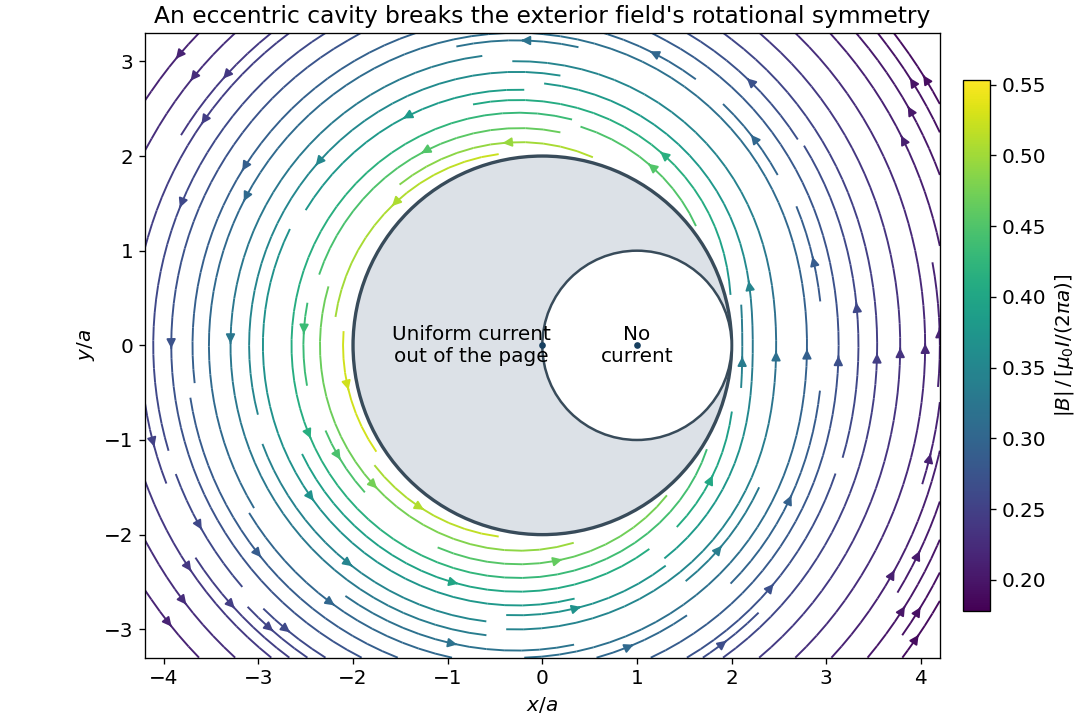
Use the geometric cross-section shown in the source: the outer cylinder has radius and centre , and the circular cavity has radius and centre . Let the electric current be in the direction. The conducting cross-sectional area is , so the uniform electric current density is .
To obtain the exterior magnetic field of a wire with an eccentric cylindrical cavity, apply the superposition principle to a full cylinder of electric current density centred at and a second cylinder of electric current density centred at . Their electric currents are and . This reproduces the actual electric current density everywhere, including zero in the cavity. Outside a long circular cylinder, Ampère's law gives . Every point outside the outer boundary is outside both component cylinders. Consequently, writing ,In Cartesian coordinates, the same magnetic flux density isThe cavity breaks rotational symmetry. Thus the magnetic flux density is generally neither constant in magnitude nor tangential on a circle centred at ; replacing its line integral by would be unjustified. Its line integral is nevertheless , as Ampère's law requires. At distances , the leading term becomes , with corrections of order .
Choose the entry point as , the initial velocity as , and the slit as , with . A magnetic field perpendicular to the page changes the direction of the velocity, while the Lorentz force does no work. For positive , an upward initial force requires the magnetic flux density to point into the page. The resulting circular motion has centre , since its initial tangent is horizontal.
The slit must lie on the circle, giving and hence . Equating the centripetal force to the magnetic part of the Lorentz force, , givesA negative electric charge requires the opposite direction of magnetic flux density. These expressions assume nonrelativistic motion and negligible energy loss through electromagnetic radiation.
For an opaque screen, reaching the slit must be the first encounter with . The velocity there has , so passage from left to right requires , as in the drawn arrangement. At the trajectory merely touches the screen. If , the same circle first meets the screen at height , where the particle is blocked; its later passage through does not solve the opaque-screen problem. This qualification distinguishes a geometric circle through two points from an accessible slit trajectory.
Take the divergence of the proposed Ampère's law. Since the divergence of a curl vanishes identically, it implies . However, local charge conservation requires the continuity equationFor example, electric current entering a charging capacitor accumulates electric charge on its plates, so the charge density is time dependent. The proposed equation cannot describe that process.
From Gauss's law, . Thus , which supplies precisely the missing divergence. Adding the displacement current density gives the Ampère-Maxwell equation:Its divergence now yields the correct continuity equation. Through a fixed surface, the associated displacement current is , where is the electric flux. In a vacuum capacitor gap, this equals the conduction electric current charging the plates, even though no charges cross the gap. Charge conservation fixes the required divergence of the correction; by itself it does not exclude adding a further divergence-free vector field.
Let denote the electric charge on the initially positive capacitor plate and define the discharge electric current by . Kirchhoff's voltage law for the series RLC circuit gives the damped harmonic oscillator equationThe initial conditions are and : the open switch initially prevents electric current, and finite inductance prevents an instantaneous jump in it. Put and . The two characteristic roots are . An oscillatory electric current requires a nonzero imaginary part, henceFor positive and nonnegative , this is the underdamped regime. The initial conditions giveAt equality there is critical damping, and above it there is an overdamped response, with no repeated changes of sign of the discharge electric current. A nonzero initial electric charge is understood; if , the stated initial conditions give no electric current at all.
Use Fraunhofer diffraction, appropriate to observation in the far field or in the focal plane of a lens, and uniform illumination across the slit. At observation angle , points separated by transverse coordinate acquire a phase difference , where is the wavenumber. The superposition principle for the coherent wave amplitudes givesThe intensity is proportional to the squared modulus of the wave amplitude, soThe limit at is one. The noncentral zeros satisfy for nonzero integers for which the angle is physically allowed. In the Rayleigh criterion, two mutually incoherent point images are just resolved when the central maximum of one diffraction pattern lies at the first minimum of the other. For single-slit diffraction this givesThe exact statement here takes one image on the slit normal; for nearby paraxial images the angular resolution is . The first propagating minimum exists only for . The numerical factor belongs to a circular aperture and does not apply to this slit.
For a linear element in sinusoidal steady state, the complex impedance is the ratio of the voltage phasor to the electric current phasor, . Use the convention that the physical signal is the real part of its phasor times . Then time differentiation becomes multiplication by .
For a resistor, Ohm's law gives . For a capacitor, gives . For an inductor, gives . HenceThe imaginary part encodes the relative phase of electric current and voltage: electric current leads voltage in an ideal capacitor and lags it in an ideal inductor.
Assume a passive linear electrical circuit in sinusoidal steady state, with transients absent and the peak voltage. Write . The electric current is , with . Average the instantaneous electric power over a full period. The double-frequency term averages to zero, leavingThereforeEquivalently, root mean square values give . The reactance exchanges stored electric field or magnetic field energy with the source, whereas the real part produces Joule heating. A purely imaginary complex impedance dissipates no mean electric power under these ideal assumptions.
Keep the source diagram's topology: the arm from the left supply node to contains and in series; the arm from to the right supply node is ; the arm from the left node to is ; and the arm from to the right node contains and in parallel. Their complex impedances areFor this capacitor bridge with series loss and a parallel standard arm, the detector carries no electric current at balance. Taking the right supply node as zero electric potential and the left one as the source voltage , the two voltage dividers give and . Equality of these complex voltages means equality at every time, rather than merely equality of their magnitudes. Cross multiplication yields . ThusEquating real and imaginary parts givesThe two adjustable standards determine the two components of the unknown complex impedance. Treating the lower-right arm as a series combination would give a different and incorrect balance equation for the source circuit. The result also gives the dimensionless dielectric loss tangent for the series-loss model.
The electric dipole moment is . By the superposition principle, the exact electric potential isFor , the binomial expansion gives each reciprocal distance as . The leading terms cancel because the total electric charge is zero. The next even terms also cancel between the two signs. ConsequentlyThis is the leading electric dipole term of the multipole expansion; it describes the far field, not the electric potential arbitrarily close to either point charge.
Apply the negative gradient to the leading far-field electric potential. In spherical coordinates,The electric field therefore has the coordinate-independent formFor the electric dipole along , use . Direct partial differentiation gives the vector componentsOn the positive axis the electric field points along the electric dipole moment; in the equatorial plane it points oppositely, providing a useful sign check.
First use the usual idealization of a grounded infinite conducting plane at , with the real point charge at . The method of images replaces the metal, for purposes of calculating the exterior electric field, by an image charge at . The exact electric potential in isIt vanishes on the plane, and the uniqueness theorem for the electrostatic potential identifies it with the physical exterior solution. The tangential electric field cancels on the plane, while the normal components add:The electric field inside the conductor is zero, so the electrostatic boundary condition gives . Integrating the surface charge density over the facing plane yieldsThe exact image expression is essential near the charge: using the far-field electric dipole approximation at comparable with would be invalid.
Electrical boundary condition. The source does not specify grounding or the initial total electric charge of the slab. The boxed total is the grounded infinite-plane answer and the large-plane approximation to the charge on its nearby face. An initially neutral, finite, electrically isolated slab retains zero total electric charge; an approximately accumulation near the real charge is then balanced by approximately on its remote face and edges. This gives a concrete counterexample to interpreting as the unconditional total charge of every large metal slab. The local image formula assumes the infinite-plane limit with no applied background electric field.
Faraday's law of induction states that the induced electromotive force around a material electrical circuit equals the negative rate of change of its linked magnetic flux:The surface orientation and direction around its boundary are related by the right-hand rule. Lenz's law supplies the physical meaning of the minus sign: the induced electric current produces a magnetic field opposing the change in linked magnetic flux. For a stationary contour the local form is ; for this moving wire, the magnetic Lorentz force term is also needed in the electromotive force.
Write the wire diameter as to distinguish it from other geometric labels. Its cross-sectional area is , and the total wire length is . From the electrical resistivity, its electrical resistance isWhile the loop straddles the boundary, let be the height of each vertical side remaining in the magnetic field. The linked magnetic flux has magnitude , with . Faraday's law therefore gives . Neglecting the loop's self-inductance, Ohm's law givesThe into-page magnetic flux is decreasing, so Lenz's law requires a clockwise electric current as viewed in the diagram. If the loop is wholly inside a uniform magnetic field, or wholly outside it, its magnetic flux is constant and this induced electromotive force is zero. During a rapid transient one should instead solve ; at the assumed steady speed the same boxed relation holds.
Use for the magnetic Lorentz force on each wire segment. Let point right, upward and out of the page, so . With clockwise electric current, the four magnetic forces areThe upper side carries electric current to the right and experiences an upward force, opposing the fall. The bottom side lies outside the magnetic field and has no magnetic force. On the right side the electric current is downward and the force is outward to the right; on the left it is upward and the force is outward to the left. Each side's in-field vertical length is , so these horizontal forces cancel in the net force on the loop.
The wire's total mass is . Uniform wire gives each side a downward weight . Internal mechanical forces at the corners transmit the unequal loads and maintain the assumed square shape; they cancel for the loop as a whole. The total external vertical force is therefore downward.
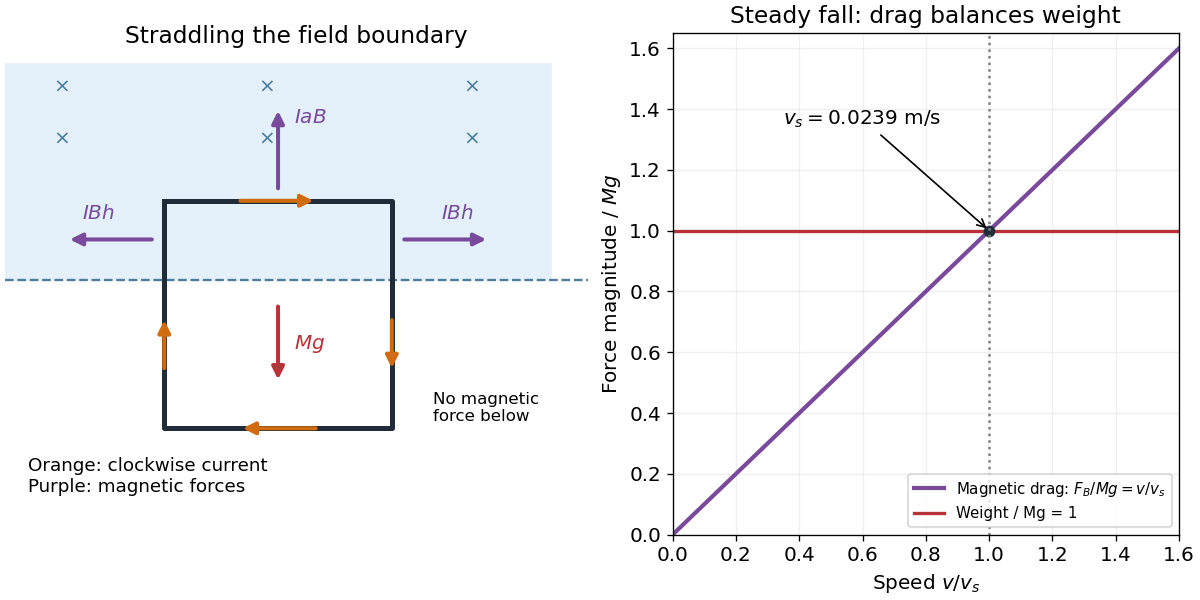
At terminal velocity, the upward magnetic force balances the weight. Substitute the electric current from the preceding solution:The geometric factors cancel, givingHere , , and . As numerical checks, the specified and give , and .
The gravitational power lost, , equals the Joule heating , consistent with energy conservation. This terminal velocity applies only while the top arm remains in the magnetic field; after it exits, the magnetic braking ceases, apart from any brief inductive transient.
Follow the branch of a light ray that undergoes one internal specular reflection in the spherical drop. At entry, refraction turns its direction by . The internal specular reflection turns it by , because the radius is the normal vector and the incidence and reflection angles are both . At exit the second refraction contributes another . Thus the total deviation angle isSnell's law at entry gives , taking the surrounding air's refractive index as one. The same internal angle at successive encounters follows from the isosceles triangles formed by each chord and the two radii. Internal specular reflection here need not be total internal reflection; the transmitted branch at that encounter does not belong to the one-reflection trajectory.
Regard the refraction angle as a function of the angle of incidence, . Implicit differentiation of Snell's law gives . Differentiating the deviation angle gives . An interior stationary point therefore satisfiesThe stationary deviation of a primary rainbow ray is a minimum: differentiating again and using Snell's law gives . At the stationary point, , and hence for a positive interior refraction angle. This minimum is responsible for the concentration of emerging light rays near the primary rainbow direction.
Square the stationary condition and eliminate the angle of incidence using Snell's law:Rearranging yields . Taking the positive root for a physical incident light ray,An interior minimum exists for , which includes water at visible wavelengths. For illustration, gives , and . The corresponding angle from the antisolar direction is . At the stationary solution reaches the endpoint, and for the displayed square root is not real; the water result is not a formula for every possible refractive index.
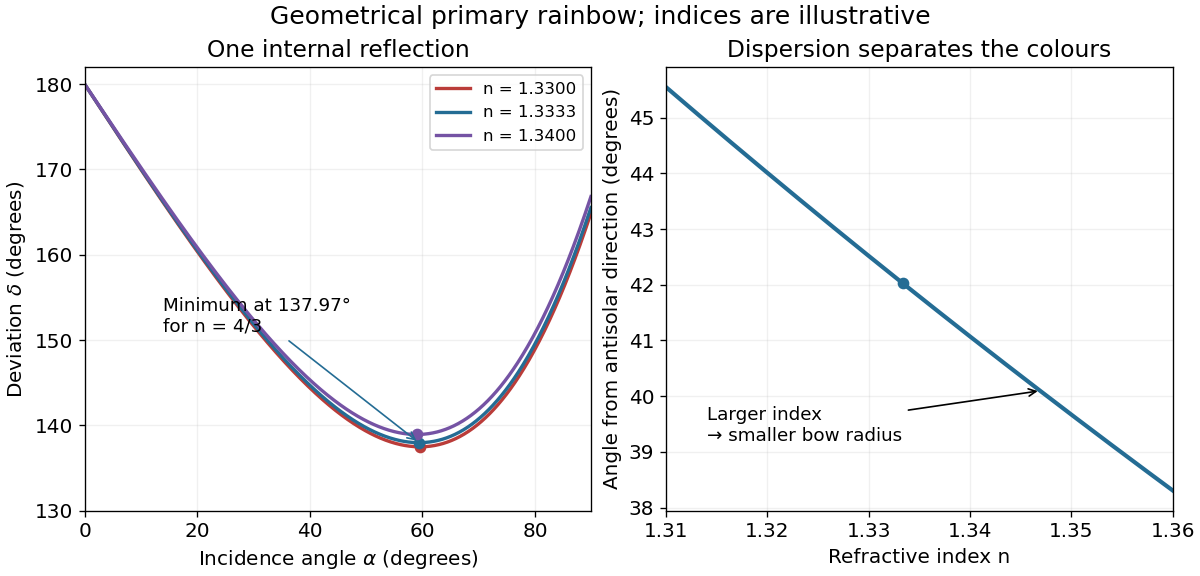


With the Sun behind the observer and raindrops ahead, the one-reflection branch sends many light rays toward directions close to the minimum deviation angle. Nearby values of the angle of incidence produce nearly the same outgoing direction there, forming a wave caustic. For water the resulting cone is approximately from the antisolar direction. The observer sees the intersecting drops as a circular rainbow, or the part of that circle visible above the ground.
Normal dispersion makes the refractive index larger for violet than for red light. At the minimum, increasing the refractive index increases the deviation angle, and therefore decreases the viewing angle . Red is on the outer edge of the primary rainbow, violet on the inner edge. The internal specular reflection is partial: with , the relevant is below the critical angle . Diffraction and the finite angular size of the Sun smooth the geometrical concentration; the physical intensity does not actually become infinite.
Articles by others on the same topic
There are currently no matching articles.