Adopt positive object and real-image distances and measured from a converging thin lens, with the object on the left. A ray through the lens centre is undeviated in the thin-lens approximation. For object height and signed image height , similar triangles give .
A second ray leaves the object parallel to the axis, reaches the lens at height and then passes through the far focal point. Its height at distance is . Equating the two descriptions givesThe signed transverse magnification is . Since a real image has for , : it is inverted. Its size relative to the object is .
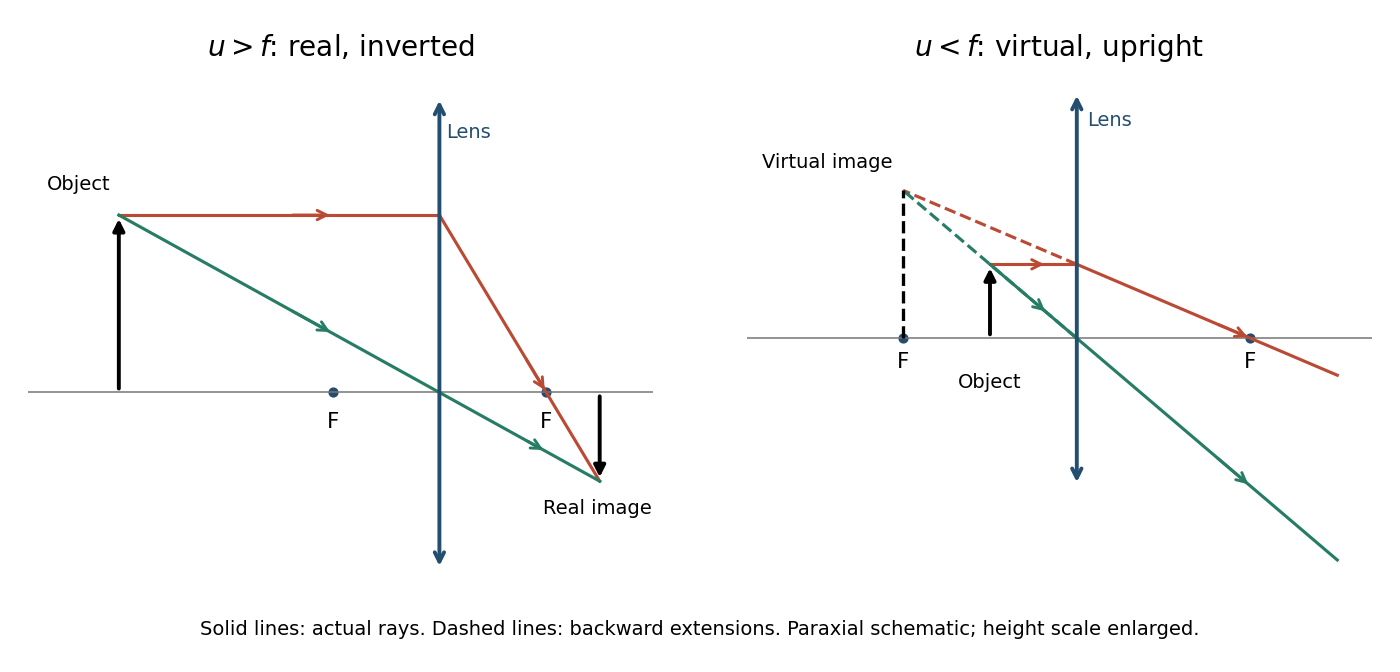

The derivation assumes the paraxial approximation, a negligible lens thickness and a focal length defined in the surrounding medium. The ray diagrams show actual paths as solid lines and backward extrapolations as dashed lines.
For a real image, and . The object-to-image separation isIts excess above factors into a nonnegative expression:ThereforeAt this minimum the image is inverted and has unit absolute magnification. The restriction to a real object and a real image matters: the positive separation used here is not the same quantity as a signed distance to a virtual image.
A real image is a point where the actual outgoing rays converge; a screen placed there can intercept the focused light. A virtual image is a point from which the outgoing rays appear to diverge: only their backward extensions intersect, so a screen at that apparent point does not receive a focused real image from the same rays.
For a converging thin lens with and a real object a distance away, the lens relation gives . If , then : the image is real, on the opposite side, and inverted. If , then : the image is virtual, on the same side as the object, upright and enlarged, with .
At , the emergent rays are parallel and the image is at infinity; there is no finite focused image. For an object very far away, from above. These are conditions for a real object in the stated lens convention, rather than claims about all systems with virtual incident objects.
For a lens between an object and a screen, and the thin lens relation requires . Eliminating gives the quadratic equationFor , both roots lie between and , and they exchange the object and image distances. Both therefore focus the image on the same screen, with reciprocal absolute magnifications. The distance between lens positions isThe existence qualification is essential: for the two roots coincide and there is only one distinct position; for there is none. For example, makes the discriminant negative, providing a concrete counterexample to an unconditional assertion of two positions. This is the basis of the Bessel lens displacement method, with when two distinct positions can be measured.
Articles by others on the same topic
There are currently no matching articles.