Spherical symmetry and the vacuum Gauss's law imply in the gap, where is constant. Integrating the electric field between the two equipotentials givesConsequentlyThe inner charge is , which reproduces the spherical capacitor capacitance . The radial direction is outward for positive and inward for negative ; the formula represents the signed field, not just its magnitude.
The electric field magnitude falls as throughout the vacuum gap, so its maximum occurs just outside the inner sphere:ThusInside the metal the electric field is zero. The one-sided gap value is the relevant value for dielectric breakdown; the ideal zero-thickness conducting boundary itself should not be assigned a single field value across its surface-charge discontinuity.
Inserting an independently biased conducting sphere makes two vacuum gaps, each with its own constant radial electric flux. Let and be the coefficients of . The two potential drops areThereforeThe middle conductor can carry net electric charge, so and need not be equal. Its charge is , consistent with the jump in the normal electric field. For both fields point outwards; outside that interval one of the gap fields reverses direction.
The largest field in each gap lies at that gap's smaller radius. Thus the quantity to minimize isFor positive , projecting any outside back to that interval reduces both absolute potential drops, so the optimum lies inside it. Within the interval, one candidate maximum decreases linearly with and the other increases linearly. Their maximum is minimized at their intersection, not by making the potential drops equal.
With , , and , the two maxima are and in . Equating them givesThe maximum is halved relative to the two-sphere system and is attained at both and . At and the optimized field is only about ; at the charged middle shell produces a jump.
For plotting, the two-sphere electric potential is . In the three-sphere system it isThe electric potential remains continuous at , while its radial derivative changes there. The graphs show both the continuous potentials and the one-sided gap fields; the marked endpoints identify all maxima.
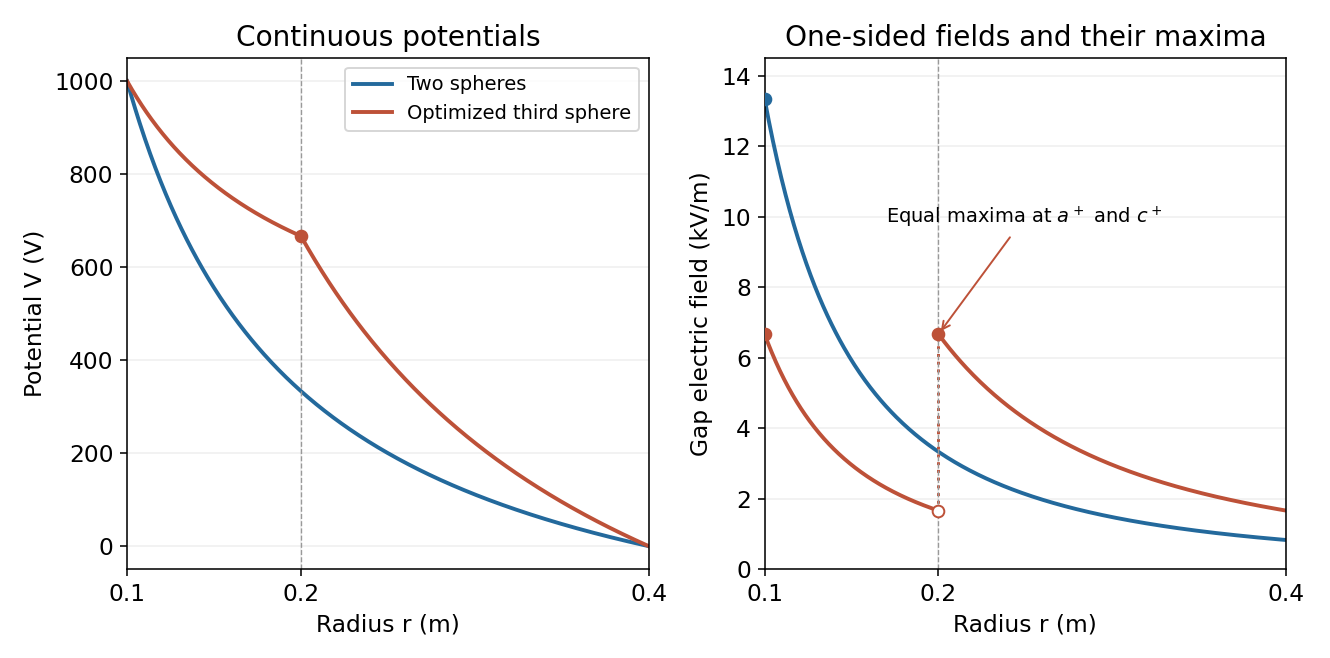
Potential and electric field before and after optimized intermediate-sphere bias
. Details. 
Articles by others on the same topic
There are currently no matching articles.