Let be the angle inside the prism relative to the inward normal of face A. For the entry position shown, below the midpoint of A, and , the transmitted ray first reaches face B. Its incidence angle there is . If , a transmitted ray leaves B according to Snell's law. If , it undergoes total internal reflection at B and then reaches C. At the equality, transmission is grazing.
On the reflected route through this equilateral prism, the incidence angle at C is , so permits emergence from C. The one-reflection path through an equilateral prism is drawn alongside the direct-transmission route.
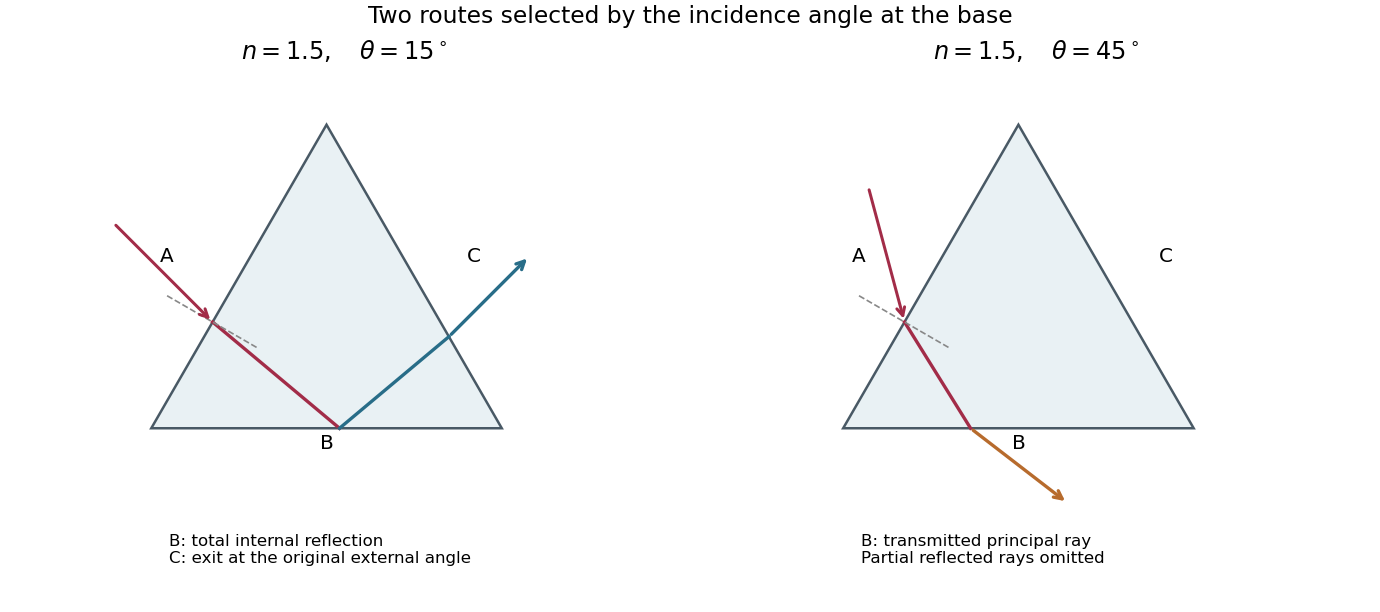
Principal transmitted ray paths through an optical prism: total internal reflection at B followed by exit at C, or direct refraction out of B
. Details. 
Real interfaces also produce partial Fresnel reflection below the critical angle; these additional weaker rays are omitted from the principal-path sketch. Which face a ray first reaches also depends on its entrance position, so the route statement uses the entrance geometry illustrated in the source.
Articles by others on the same topic
There are currently no matching articles.