The Huygens-Fresnel principle constructs a later wavefront as the envelope of secondary wavelets emitted from the earlier one. At a planar interface, take a time interval during which one point on the incoming front travels distance before reaching the interface, while the point that reached it first generates a wavelet of radius . The two right triangles share the interface segment, giving . Since the refractive index is , this yields Snell's law:The angles are measured from the interface normal. This geometric construction assumes homogeneous media and uses the propagation speeds at the given frequency.
Let be the angle inside the prism relative to the inward normal of face A. For the entry position shown, below the midpoint of A, and , the transmitted ray first reaches face B. Its incidence angle there is . If , a transmitted ray leaves B according to Snell's law. If , it undergoes total internal reflection at B and then reaches C. At the equality, transmission is grazing.
On the reflected route through this equilateral prism, the incidence angle at C is , so permits emergence from C. The one-reflection path through an equilateral prism is drawn alongside the direct-transmission route.
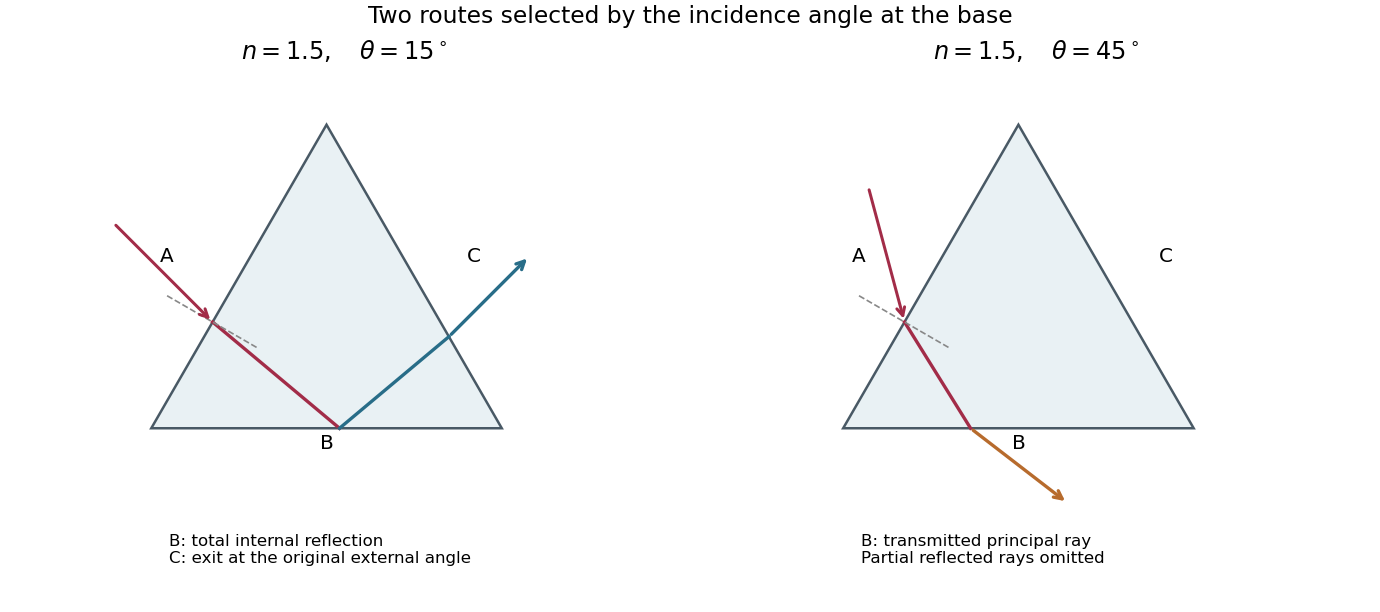
Principal transmitted ray paths through an optical prism: total internal reflection at B followed by exit at C, or direct refraction out of B
. Details. 
Real interfaces also produce partial Fresnel reflection below the critical angle; these additional weaker rays are omitted from the principal-path sketch. Which face a ray first reaches also depends on its entrance position, so the route statement uses the entrance geometry illustrated in the source.
For , the critical angle is . Here , so the condition at B is . At the threshold,Thus the requested positive-angle interval for strict total internal reflection isAt the upper equality the transmitted ray is grazing; normal incidence also gives total internal reflection at B if the endpoint is included. The distinction follows the question's positive-angle convention.
Take the positive horizontal direction along B. The initial direction is . Reflection at the horizontal face B reverses the vertical direction. At C, symmetry of the equilateral geometry gives internal incidence , so Snell's law makes the emerging angle to C's normal equal to . Its direction is therefore . Subtracting the incoming direction givesThis is the smaller angle between the incident and emergent propagation directions in the requested reflection interval. The cancellation of occurs because the entry and exit refraction angles have equal magnitudes; refractive index still determines whether the reflected route exists and where it exits.
Assume normal dispersion, so shorter visible wavelengths have larger refractive indices. At fixed external angle , the relevant criticality parameter iswhich increases with on this route. Thus shorter-wavelength blue light is totally reflected at B and reaches C, while longer-wavelength red light can transmit through B; green lies at the critical threshold. The prism separates the routes by wavelength near the green cutoff.
The totally reflected rays emerging from C have the same external deviation despite their different refractive indices; their exit positions can differ. Red light also has a partially reflected component by the Fresnel equations, so C is not a mathematically perfect colour cutoff. The observation concerns total versus partial reflection, with the transmitted B rays spread by wavelength. Anomalous dispersion, if present, would require the actual instead of the normal ordering assumed here.
Articles by others on the same topic
There are currently no matching articles.