With a positive charge magnitude e, the relaxation-time equation for electrons is . Steady drift is opposite the field, , so the positive electron mobility and electrical conductivity areThis is the weak-field Drude model; the mobility is a magnitude, not the signed velocity-to-field ratio.
For an intrinsic nondegenerate semiconductor, . Equal electron and hole masses give and intrinsic chemical potential midway between the band edges. At300K, the exponential is . Using the later supplied mass givesThis is many orders below a typical metal's carrier density. Since , ordinary finite carrier mobilities leave its intrinsic conduction negligible on a metallic scale; the gap alone does not specify an exact conductivity without the mobilities.
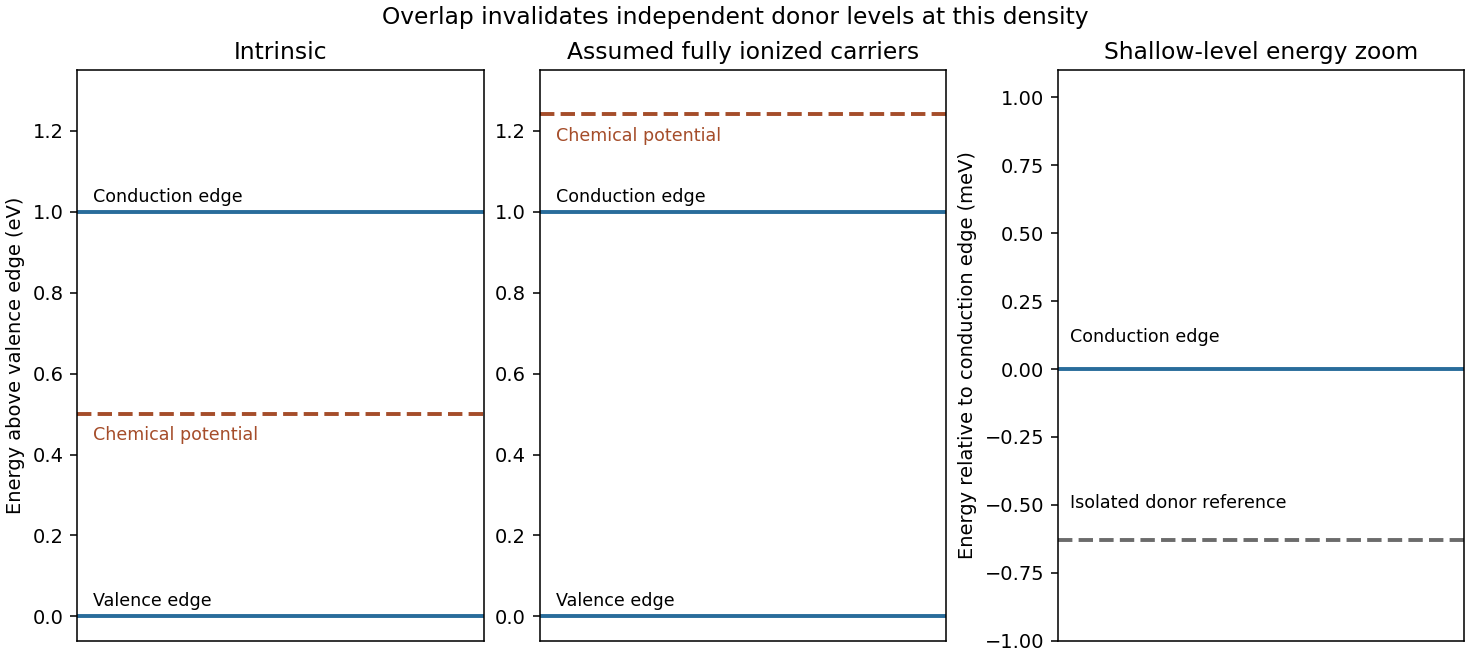
Under the explicitly stipulated full donor ionization, and the supplied mobility is . ThereforeThe band diagram places the intrinsic chemical potential at midgap and a shallow isolated donor level just below the conduction edge. The doped chemical potential moves upward. Quantitatively, the degeneracy test for a fully ionized light-mass donor gas gives , so a nondegenerate logarithmic chemical-potential formula is inconsistent. The parabolic-band zero-temperature estimate is ; its300K value is about0.241eV. The diagram accordingly shows the doped chemical potential inside the conduction band, not between an isolated donor level and the edge.
The hydrogenic donor state scaling using the supplied hydrogen values isThe binding is much smaller than , indicating a shallow donor on the isolated-state estimate. However, the mean donor spacing is only , well below the orbit radius. The donor-state overlap estimate invalidates an independent isolated-level ionization model at this concentration. Shallow binding supports abundant mobile carriers, but the full ionization versus isolated donor occupation distinction means full ionization cannot be justified solely by comparing binding with temperature while simultaneously retaining isolated levels and a degenerate chemical potential. The conductivity above follows the question's carrier-density assumption; an overlapping impurity/conduction-band description is needed for a self-consistent microscopic account. [ref]
University Physics Volume 3 by Samuel J. Ling and others. §9.6, donor levels and semiconductor doping; isolated-level picture distinguished here from the high-density limit

Articles by others on the same topic
There are currently no matching articles.