One instrument is a diffraction grating spectrometer. Its principal maxima satisfy at normal incidence. N coherently illuminated grooves give a narrow principal peak; applying the Rayleigh criterion to the next wavelength yields the resolving power of a diffraction gratingHigher order and more illuminated grooves improve resolution, but finite entrance-slit width, aberrations, detector sampling and overlap between spectral orders limit useful resolution. Angular dispersion is distinct from the ability to resolve two finite-width peaks.
A second instrument is a Fabry–Pérot interferometer. For plate spacing L, refractive index n and internal angle theta, transmission resonances satisfy . Multiple coherent reflections produce an Airy transmission profile. For identical lossless mirrors of intensity reflectivity , the high-finesse limit givesThe frequency free spectral range is approximately for nondispersive n. A larger optical spacing narrows a line but also shrinks the unambiguous frequency interval; nearby orders need sorting. Mirror flatness, absorption, alignment and aperture broadening lower the effective finesse. This resolving-power formula assumes separated narrow lines and a stated line-separation convention, rather than equating transmission peak spacing with peak width.
The transient is the homogeneous part of a damped harmonic oscillator, . Define and . Its characteristic roots are .
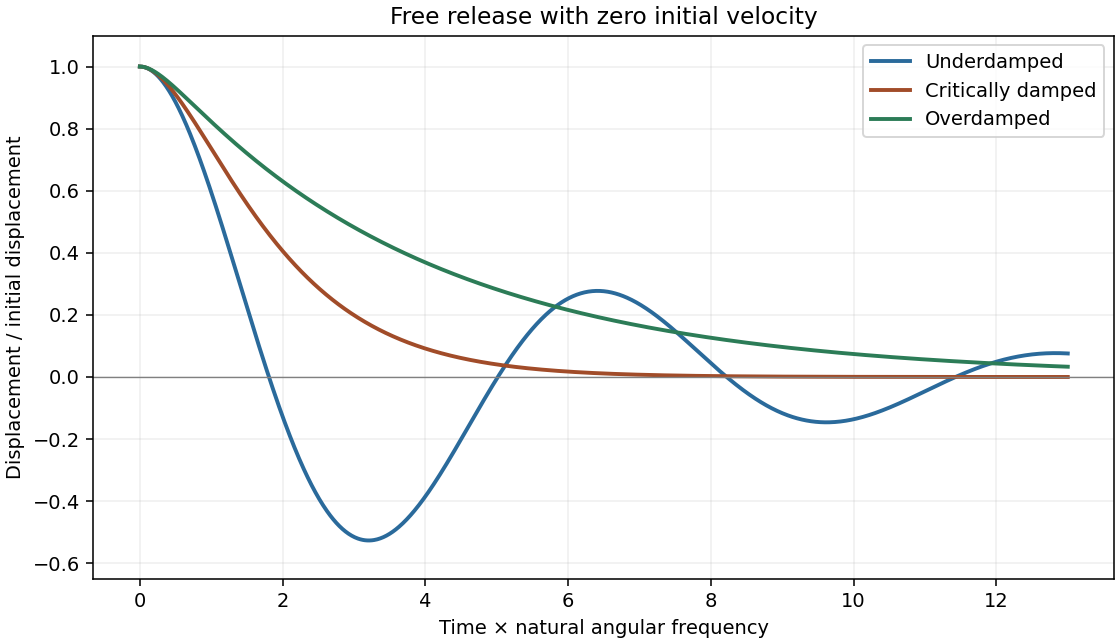
- For , the underdamped response is , with . The displacement oscillates with a decaying envelope.
- At critical damping, . It has a repeated root, so two identical exponentials are not an independent pair of solutions.
- For , two real negative exponentials produce an overdamped return without sustained oscillation. In the strong-damping limit the slow decay rate is approximately , not .
Initial position and velocity determine A,B. For an imposed force or support motion, the full solution is a particular response plus this transient, which decays for b>0 and k>0. The mechanical energy obeys . In light damping its cycle-averaged envelope decays as , with . Initial conditions can still produce an overshoot in a nonoscillatory regime; the damping category describes the roots rather than every possible trajectory.
Oscillator transients
. Dimensionless release from unit displacement and zero velocity for three damping regimes. Source. Details.
Small sound disturbances in a gas couple density, pressure and longitudinal velocity. Linearizing mass conservation and the pressure-gradient force about a uniform state givesEliminating velocity yields . When local heat exchange is negligible over an oscillation, . For an ideal gas,The adiabatic index is ; an isothermal disturbance instead has . Pressure and velocity in a progressive plane wave are in phase and obey , with average energy flux . Particle oscillation speed is not the sound propagation speed. Viscosity, heat conduction and molecular relaxation dissipate sound; changes in active internal degrees of freedom can cause dispersion. The continuum acoustic model requires wavelength large compared with the molecular mean free path and small fractional perturbations.
Articles by others on the same topic
There are currently no matching articles.