One instrument is a diffraction grating spectrometer. Its principal maxima satisfy at normal incidence. N coherently illuminated grooves give a narrow principal peak; applying the Rayleigh criterion to the next wavelength yields the resolving power of a diffraction gratingHigher order and more illuminated grooves improve resolution, but finite entrance-slit width, aberrations, detector sampling and overlap between spectral orders limit useful resolution. Angular dispersion is distinct from the ability to resolve two finite-width peaks.
A second instrument is a Fabry–Pérot interferometer. For plate spacing L, refractive index n and internal angle theta, transmission resonances satisfy . Multiple coherent reflections produce an Airy transmission profile. For identical lossless mirrors of intensity reflectivity , the high-finesse limit givesThe frequency free spectral range is approximately for nondispersive n. A larger optical spacing narrows a line but also shrinks the unambiguous frequency interval; nearby orders need sorting. Mirror flatness, absorption, alignment and aperture broadening lower the effective finesse. This resolving-power formula assumes separated narrow lines and a stated line-separation convention, rather than equating transmission peak spacing with peak width.
The transient is the homogeneous part of a damped harmonic oscillator, . Define and . Its characteristic roots are .
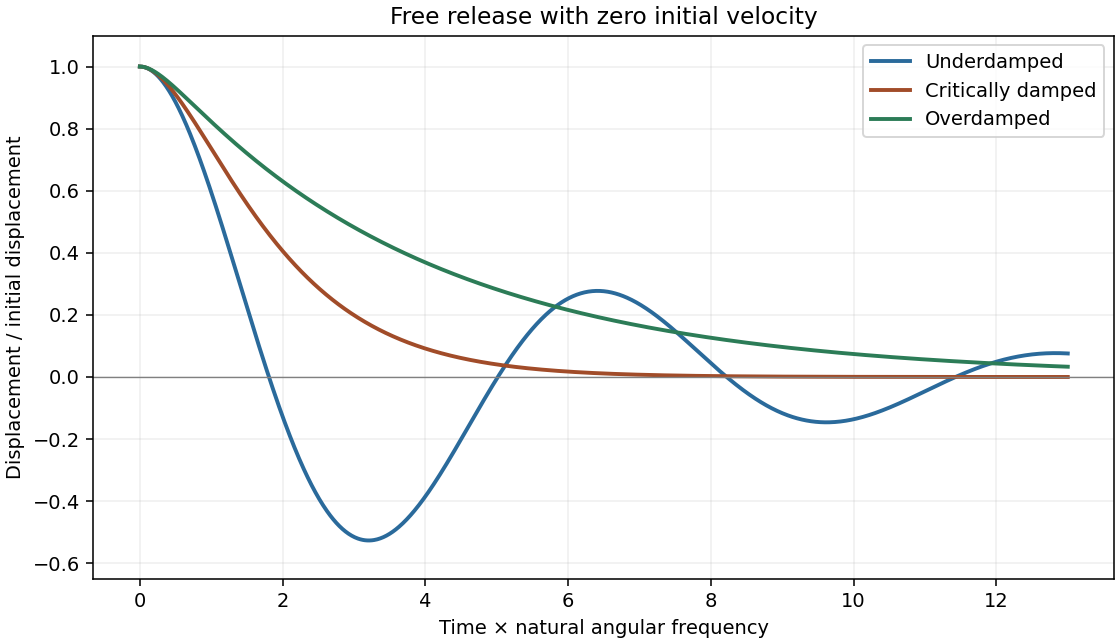
- For , the underdamped response is , with . The displacement oscillates with a decaying envelope.
- At critical damping, . It has a repeated root, so two identical exponentials are not an independent pair of solutions.
- For , two real negative exponentials produce an overdamped return without sustained oscillation. In the strong-damping limit the slow decay rate is approximately , not .
Initial position and velocity determine A,B. For an imposed force or support motion, the full solution is a particular response plus this transient, which decays for b>0 and k>0. The mechanical energy obeys . In light damping its cycle-averaged envelope decays as , with . Initial conditions can still produce an overshoot in a nonoscillatory regime; the damping category describes the roots rather than every possible trajectory.
Oscillator transients
. Dimensionless release from unit displacement and zero velocity for three damping regimes. Source. Details.
Small sound disturbances in a gas couple density, pressure and longitudinal velocity. Linearizing mass conservation and the pressure-gradient force about a uniform state givesEliminating velocity yields . When local heat exchange is negligible over an oscillation, . For an ideal gas,The adiabatic index is ; an isothermal disturbance instead has . Pressure and velocity in a progressive plane wave are in phase and obey , with average energy flux . Particle oscillation speed is not the sound propagation speed. Viscosity, heat conduction and molecular relaxation dissipate sound; changes in active internal degrees of freedom can cause dispersion. The continuum acoustic model requires wavelength large compared with the molecular mean free path and small fractional perturbations.
A solid's atoms do not travel freely through it, but its phonons and mobile electronic quasiparticles carry energy between scattering events. In a near-equilibrium isotropic diffusive regime, their transport can therefore use a kinetic thermal-conductivity approximation. Carriers moving along the local temperature gradient sample energies characteristic of their last scattering position. Linearizing that temperature difference and averaging squared directional cosines givesHere C is the contributing carrier heat capacity per unit volume, c its group speed and ell a transport mean free path. More accurately, the formula is a mode/energy-weighted sum of heat capacities times , not a product of arbitrary separately averaged values. Anisotropic crystals require a tensor, and ballistic samples or strongly nonquasiparticle regimes need a different description.
Lattice energy is transported by phonons; long-wavelength acoustic modes usually dominate low-temperature conduction. Their speed is set by elastic wave propagation. In the Debye model their volumetric heat capacity grows as at low temperature and approaches the classical lattice limit at high temperature. With boundary-limited mean free path, this gives a low-temperature conductivity; increasing phonon scattering can instead produce a peak and a declining high-temperature trend.
In metals, electrons near the Fermi surface carry both heat and charge. Their heat capacity is linear in T and their typical transport speed is the Fermi velocity, not a classical gas thermal speed. Degeneracy restricts the active thermal fraction but the large speed and long mean free path can make electronic heat conduction dominant. Insulators have few mobile electrons, so phonon conduction usually dominates. The approximate parallel-channel sum is ; which channel dominates is material- and temperature-dependent. [ref]
Phonon paths are limited by boundaries, defects, isotopes and phonon–phonon interactions; electrons scatter from impurities, defects, boundaries and lattice vibrations. At low temperature a clean sample can be boundary-limited, while residual electronic impurity scattering survives as phonons freeze out. In a quasiparticle relaxation-time approximation, independent resistive rates are sometimes added, , but this is not an exact rule for every coupled process.
Umklapp scattering transfers crystal momentum by a reciprocal lattice vector and can relax a heat current. The normal phonon collisions and heat-current relaxation distinction is that a normal phonon collision conserves the total crystal momentum of the phonon distribution; it is not automatically a resistive thermal-scattering event in the same way. Normal collisions can redistribute populations or establish hydrodynamic flow, with boundaries and other momentum-relaxing processes then setting resistance. Likewise, different angular scattering kernels distinguish a single-particle lifetime from a transport lifetime. These qualifications explain why estimating ell requires physical scattering information, not simply a collision count.
The Wiedemann-Franz law relates the electronic part of thermal conductivity to electrical conductivity:For degenerate electrons with elastic scattering and a transport function smooth over , a Sommerfeld expansion makes the same Fermi-level transport factor appear in charge conduction and in heat conduction. Their ratio cancels that factor and leaves the displayed Lorenz number. Heat conductivity is defined at zero electric current, so thermoelectric subtraction is part of the precise transport expression.
The law does not relate total solid heat conductivity to charge conductivity when phonons contribute substantially. Strong inelastic scattering, sharp energy dependence, nondegenerate carriers or nonstandard electronic regimes can change the ratio. Low-temperature residual elastic-scattering transport is a common setting where the standard value is recovered. The unit W·ohm/K² follows because contains one extra inverse temperature beyond thermal conductivity itself.
Articles by others on the same topic
There are currently no matching articles.