For weak damping, the ringdown comparison bound for two resonator modes gives . Interpreting the stated loudness comparison as an intensity comparison,Therefore the information gives an upper bound, not a unique value:Equality would describe equal intensities at two seconds; the stated strict inequality allows every smaller positive consistent with the weak-damping model.
By linear scalar diffraction theory, complementary aperture transmissions and give under identical illumination. In Fraunhofer diffraction, away from the direct forward beam , so : the complementary screens have identical off-axis diffraction intensities. This is Babinet's principle. Their complex amplitudes, rather than their intensities, add. The direct beam is the exception; real conducting-edge vector effects are outside this ideal scalar statement.
For source and screen distances , the paraxial optical path excess at aperture radius is . The outer boundary of Fresnel half-period zone has excess , henceThis is the outer radius of the second zone, measured from the axis.
A conventional body-centred cubic cell contains two atoms, so its edge obeys . Taking gives . The neighbour shells of a body-centred cubic lattice have eight nearest neighbours that are at ; the six next-nearest neighbours lie along the cell axes. Thus the next-nearest-neighbour distance is .
For a free-electron Fermi circle in a square lattice, include two spin states per wavevector. A square cell of side supplies electrons per unit area; counting the disk of occupied states givesThe first Brillouin zone is . For , , so the circular Fermi surface lies wholly inside this square and encloses half its area. The figure uses the stated free-electron approximation; the lattice symmetry alone does not prescribe an exact circular surface.
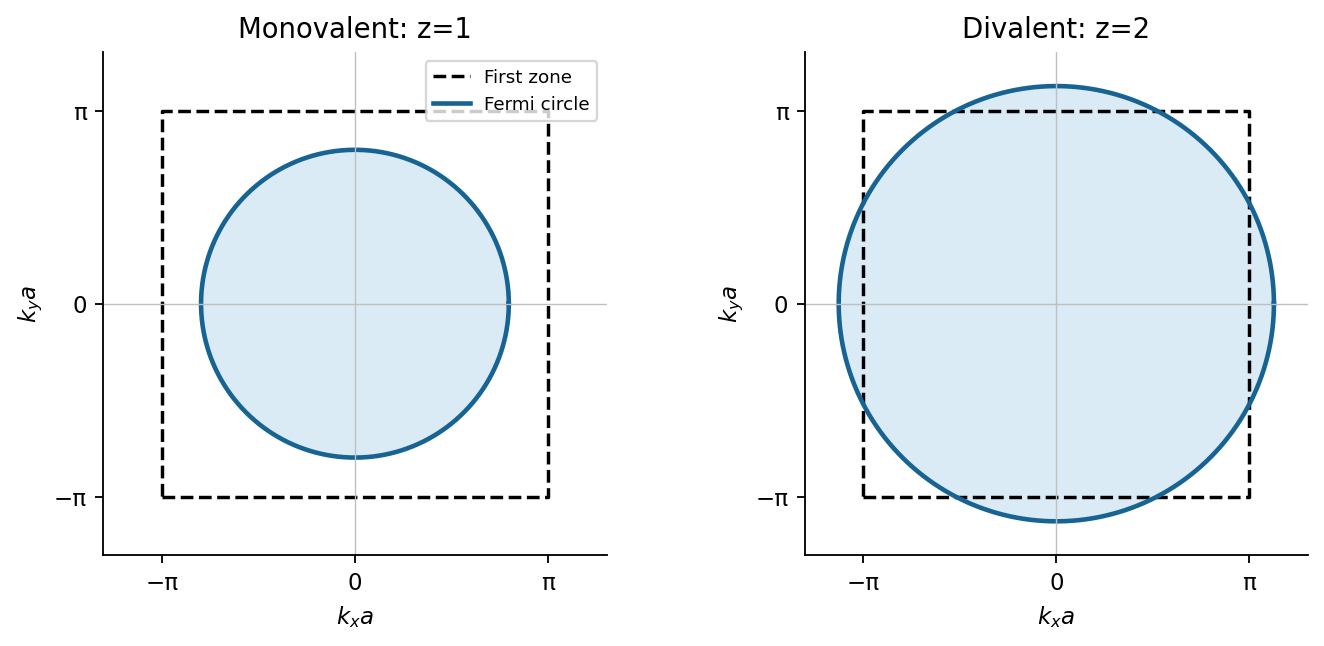

For , . The circle encloses one whole zone's area, crosses each face because , and misses the corners because . In a reduced Brillouin zone, fold the portions outside the square into neighbouring band branches. A weak periodic potential opens band gaps at crossings and deforms these pieces; divalence alone does not establish a band insulator.
Articles by others on the same topic
There are currently no matching articles.