At screen coordinate , the propagation length from aperture coordinate is . Its expansion has a constant term, a term linear in giving the observation angle, and a quadratic term of order . For , the quadratic wave phase is at most of order . Requiring it to be much smaller than one gives the sufficient condition ; higher terms are then smaller in the paraxial geometry. In the lens arrangement, put the source at the first lens's front focus, illuminate the grating with its collimated output, and put the screen at the second lens's back focal plane. This obtains the angular Fraunhofer diffraction pattern without a physically very distant screen.
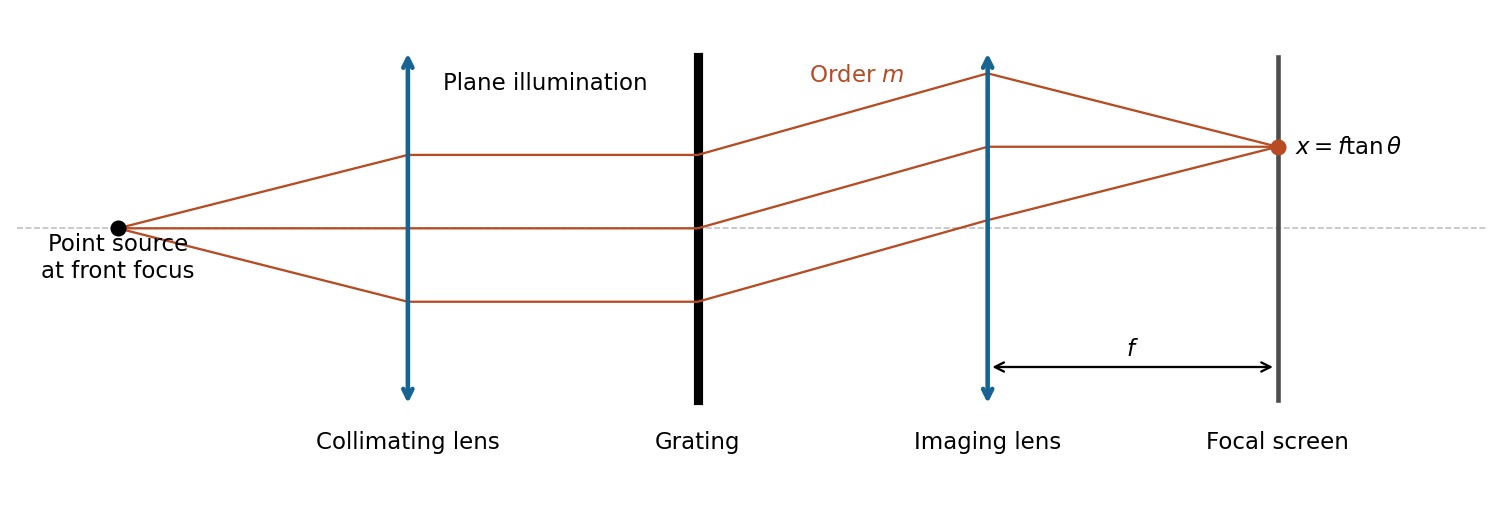

The slit pitch is . Normal-incidence maxima satisfy . Thus and, using rectilinear focal-plane geometry,The paraxial result is a roughly 4% lower approximation; an actual wide-angle lens's mapping depends on its design. The angular result does not depend on that convention.
For uniformly illuminated equal slits of width , the diffraction intensity has the formHere is unchanged when the incoming intensity is fixed. The broad single-slit diffraction envelope multiplies the narrow grating orders. At a principal maximum,The fixed-illumination grating peak change with slit width gives the changes from to areThe central peak increases by 125%, while the third-order peak decreases by about 89.4%. Separate normalizations to each central peak would hide this effect. The following width-specific solutions and profiles use a common incoming normalization.
With the order positions are unchanged from the grating equation, and the envelope's first zeros satisfy . Equivalently the first missing integer orders are . The third-order peaks remain appreciable. The displayed order-coordinate places all principal maxima at integers.
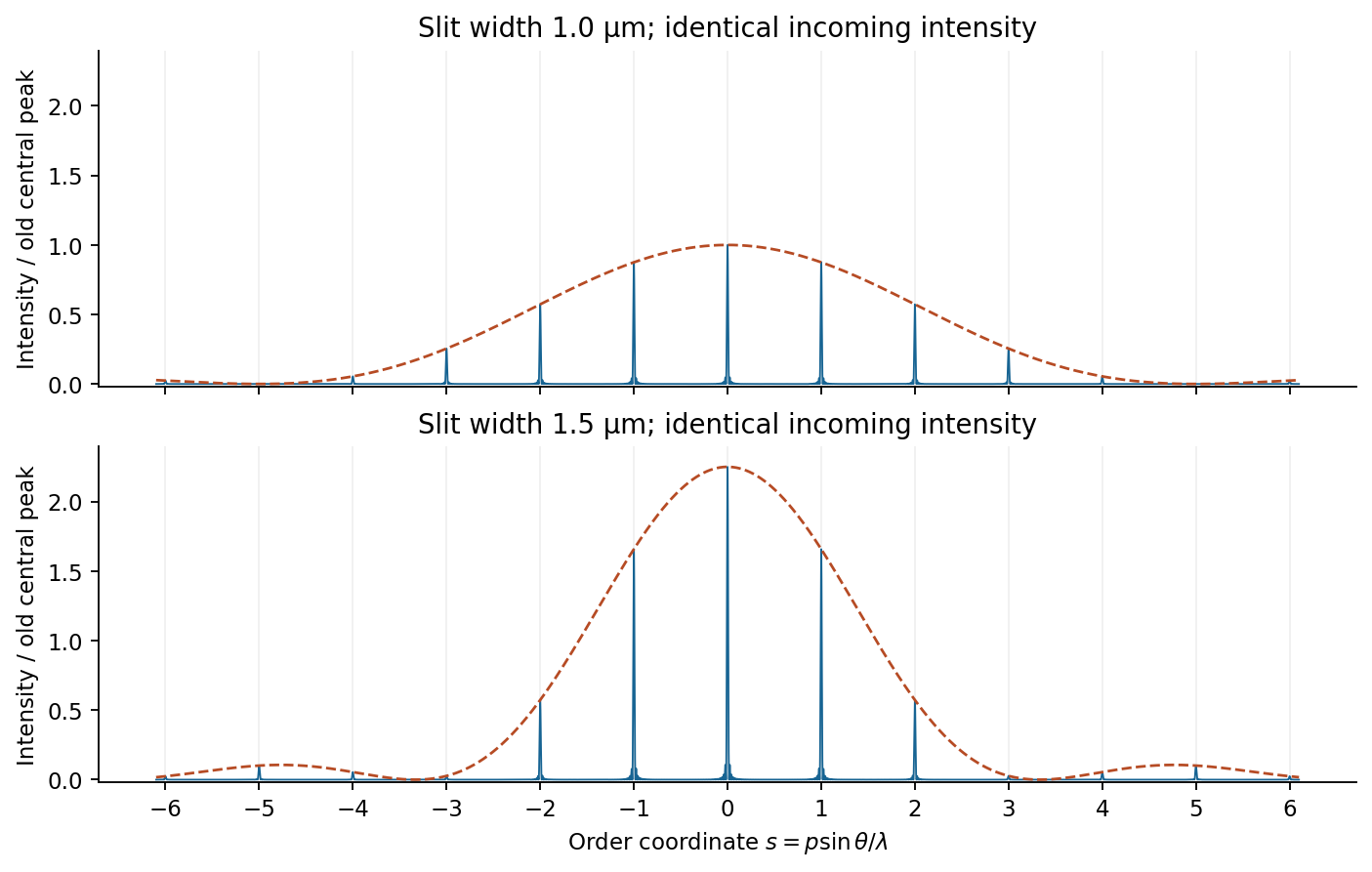
Slit-width envelopes on a common incident-intensity scale
. Original finite-array model with an illustrative 60 illuminated slits to make the peaks visible. Dashed lines show single-slit envelopes; the supplied slit pitch and widths set the peak ratios independently of this illustrative slit count. Details.
With the same principal maxima sit inside a narrower envelope, whose first zeros are at . The third order is now close to a zero and is strongly suppressed, whereas the central peak is taller. The first exact missing nonzero integer orders are ; is suppressed rather than identically missing.
A beam illuminates slits. The resolving power of a diffraction grating in order is , corresponding to a Rayleigh criterion separation . The separation therefore gives two well separated main peaks. The finite-grating incoherent doublet profile adds the mutually incoherent lamp intensities, not their amplitudes.
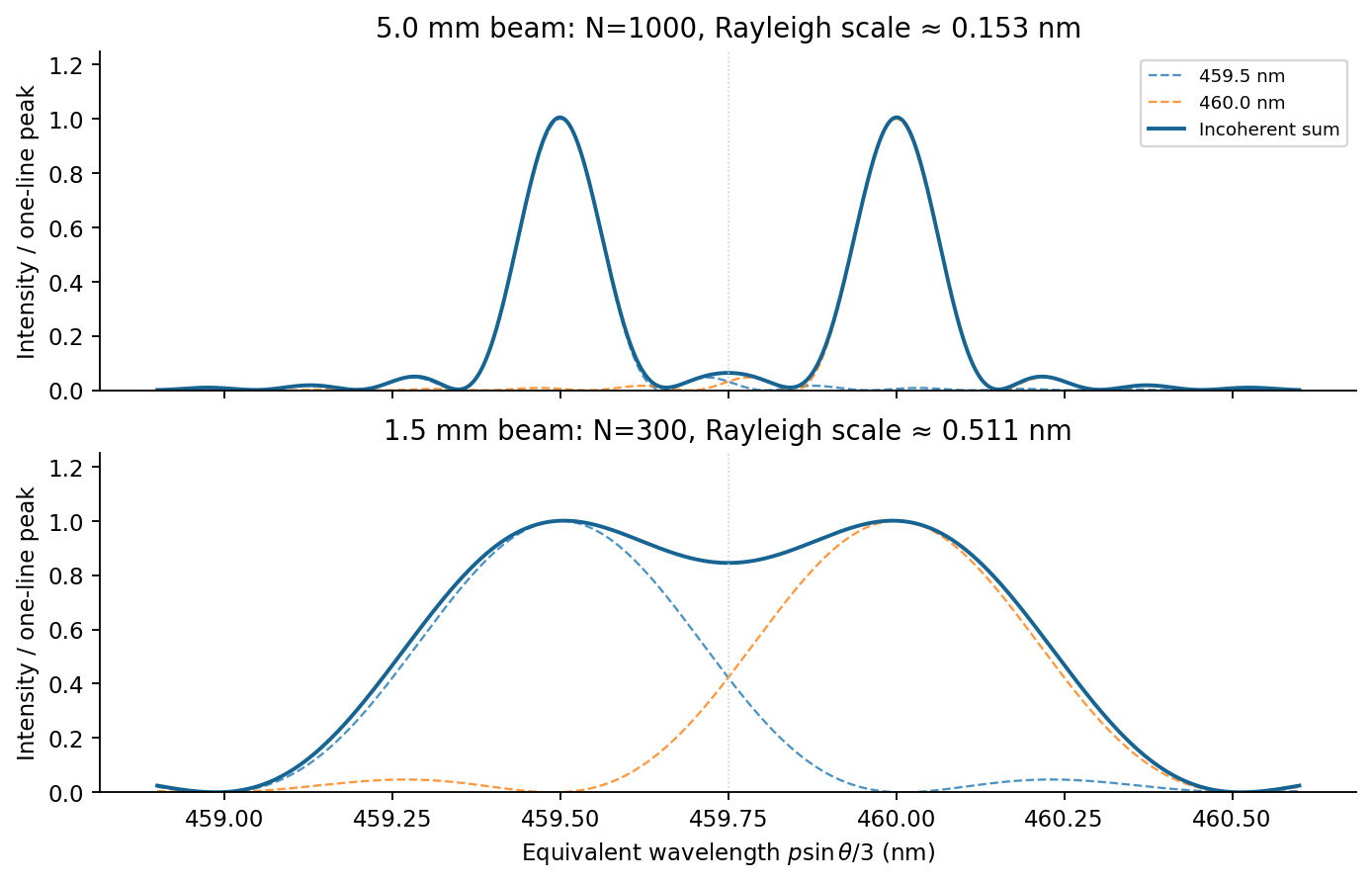
Third-order doublet for two illuminated grating widths
. Original finite-N intensity sums, with equal line strengths and narrow slits. The horizontal coordinate is the wavelength inferred from the third-order grating equation. Each component is dashed and their incoherent sum is solid. Details.
A beam illuminates only slits, giving and . The two main lobes broaden by compared with the wider beam. Their separation is slightly below the stated Rayleigh threshold: marginally unresolved by that criterion. This is not an assertion that the profile has only one maximum: the ideal equal-line sum still has two maxima and a modest central dip, as plotted. Inference from real data also requires adequate signal-to-noise ratio and a known instrumental profile.
Articles by others on the same topic
There are currently no matching articles.