Joining p-type and n-type regions initially allows majority carriers to diffuse across and recombine. Exposed negative acceptor charge on the p side and positive donor charge on the n side form a depletion region. Its electric field points from n to p and balances diffusion at equilibrium. The Fermi level is then spatially constant, while the conduction and valence band edges bend across the built-in potential; this equilibrium barrier cannot supply continuous power to a load.
forward bias makes p positive relative to n, reducing the barrier from to . electrons enter p material and holes enter n material, becoming minority carriers whose diffusion and recombination sustain the current. reverse bias enlarges the barrier and leaves a much smaller minority-carrier current until breakdown. The ideal diffusion model gives , the Shockley diode equation; depletion-region recombination, series resistance and breakdown limit this approximation. Minority-carrier injection on both sides is essential to the junction theory.[ref]
The Theory of p-n Junctions in Semiconductors and p-n Junction Transistors by William Shockley. 1949, pp.435–436: rectification, electron and hole currents, and injection
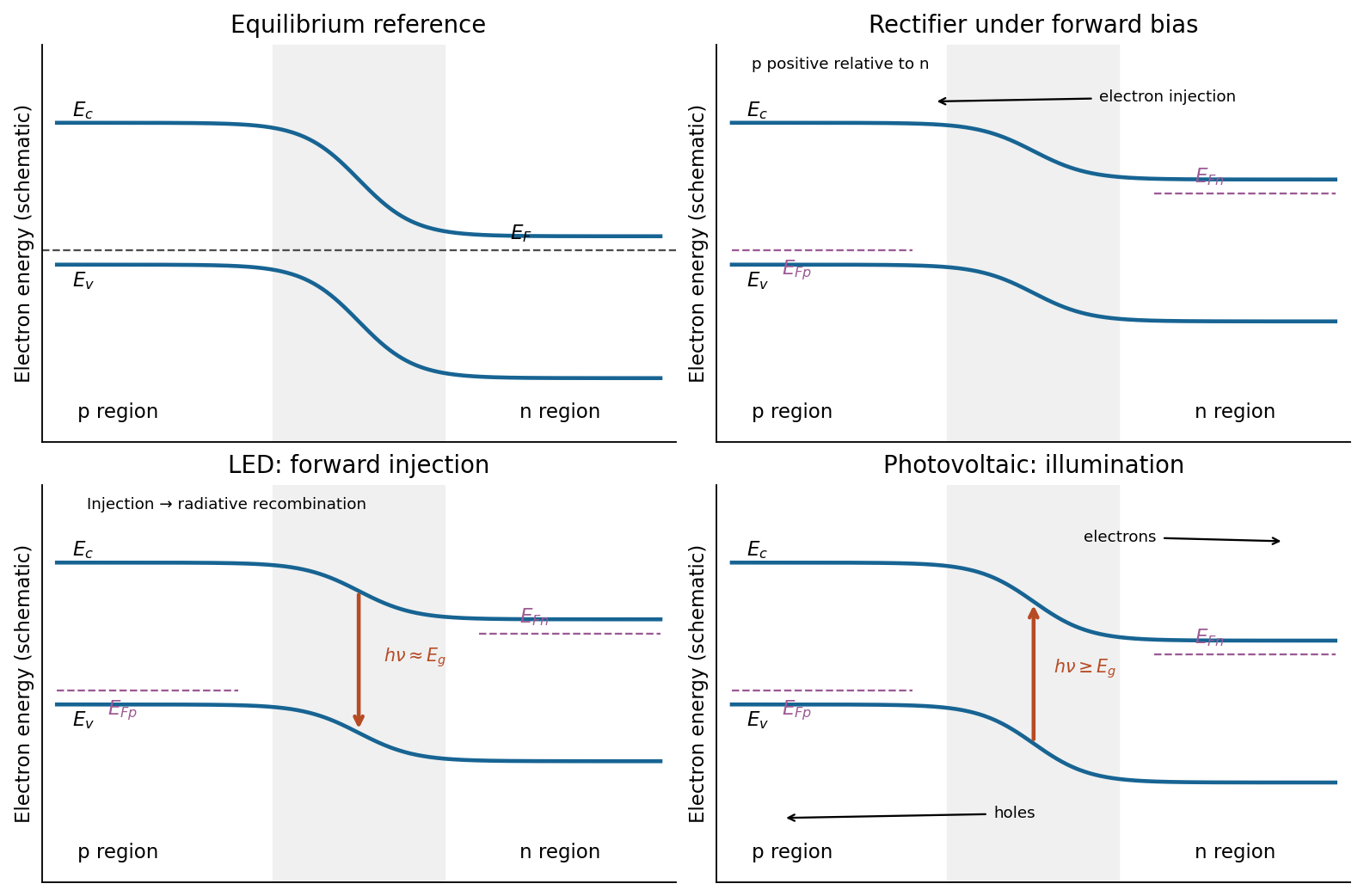
Junction band bending and three device functions
. Original schematic electron-energy diagrams, not quantitative band solutions. Equilibrium has one flat Fermi level; biased and illuminated panels indicate separate carrier quasi-Fermi levels. The photon arrows distinguish LED emission from solar-cell absorption. Details.
Articles by others on the same topic
There are currently no matching articles.