In Fourier transform spectroscopy, a scanning Michelson interferometer measures intensity against optical path difference rather than selecting one narrow wavelength at a time. After subtraction of the constant background, an ideal stationary source gives an interferogramA cosine Fourier transform recovers the spectral power density after instrumental calibration. A mirror displacement changes the round-trip path by ; the zero-path-difference burst aligns the scan, and a reference laser can calibrate the displacement.
Finite maximum path difference multiplies the interferogram by a window and convolves the recovered radiation spectrum with that window's Fourier transform. Thus is of order ; precise factors depend on scan range and resolution convention. Uniform path samples of separation need to avoid aliasing without bandpass information. interferogram apodization reduces sidelobes at the price of broader lines. The broad accepted optical throughput can be advantageous; the multiplex signal-to-noise advantage depends on detector noise and is not universal in photon-noise-limited measurements. Source drift during a scan, finite beam divergence, imperfect sampling and wave phase errors require control. The finite-window reasoning is the delay-range resolution in Fourier transform spectroscopy.[ref]
Introduction to Fourier Transform Spectroscopy by Julius Cohen. NBSIR 86-3339, chapters 13–16, printed pp.51–80: basic equation, apodization, resolution and sampling
A finite optical pupil spreads a point into a point spread function. In incoherent imaging an extended intensity distribution is convolved with that function; its Fourier transform is the optical transfer function, which attenuates and ultimately removes high spatial frequencies. For an ideal circular pupil the point response is an Airy disk. The Rayleigh criterion for two equally bright incoherent points isA microscope's object-space scale is of order , with the numerical factor depending on illumination and the criterion; measures the accepted ray cone. A larger pupil or shorter wavelength improves the diffraction scale. Aberrations, defocus, detector pixel sampling, motion, background and photon noise can worsen practical performance. Merely magnifying the same blurred image adds no information. Coherent sources require amplitude superposition instead of the incoherent intensity rule. Rayleigh resolution is a convention for separating a pair, distinct from the precision of localizing one isolated point; information does not abruptly vanish below it.
Boundary conditions quantize the transverse wavevector of an electromagnetic waveguide. For an ideal hollow rectangular conducting guide of sides , filled with a nondispersive medium of wave speed , a transverse electric mode of a rectangular waveguide or transverse magnetic mode of a rectangular waveguide obeysThe allowed integer pairs differ: TE permits one zero index, but not both; TM requires both positive. Here is the longitudinal propagation constant. Below cutoff is imaginary, so the mode is evanescent. Above cutoff,The positive branch approaches the straight line far above cutoff, while near cutoff its slope tends to zero. Different frequencies acquire different group delays and a pulse can spread. A wave phase speed above does not convey superluminal information; in this ideal guide energy transport follows the group velocity. A single hollow conductor cannot support a TEM mode; two-conductor guides can have a zero-cutoff TEM branch. Material dispersion, dielectric fibres and lossy boundaries require their actual dispersion relation and need not preserve the product rule.
Joining p-type and n-type regions initially allows majority carriers to diffuse across and recombine. Exposed negative acceptor charge on the p side and positive donor charge on the n side form a depletion region. Its electric field points from n to p and balances diffusion at equilibrium. The Fermi level is then spatially constant, while the conduction and valence band edges bend across the built-in potential; this equilibrium barrier cannot supply continuous power to a load.
forward bias makes p positive relative to n, reducing the barrier from to . electrons enter p material and holes enter n material, becoming minority carriers whose diffusion and recombination sustain the current. reverse bias enlarges the barrier and leaves a much smaller minority-carrier current until breakdown. The ideal diffusion model gives , the Shockley diode equation; depletion-region recombination, series resistance and breakdown limit this approximation. Minority-carrier injection on both sides is essential to the junction theory.[ref]
The Theory of p-n Junctions in Semiconductors and p-n Junction Transistors by William Shockley. 1949, pp.435–436: rectification, electron and hole currents, and injection
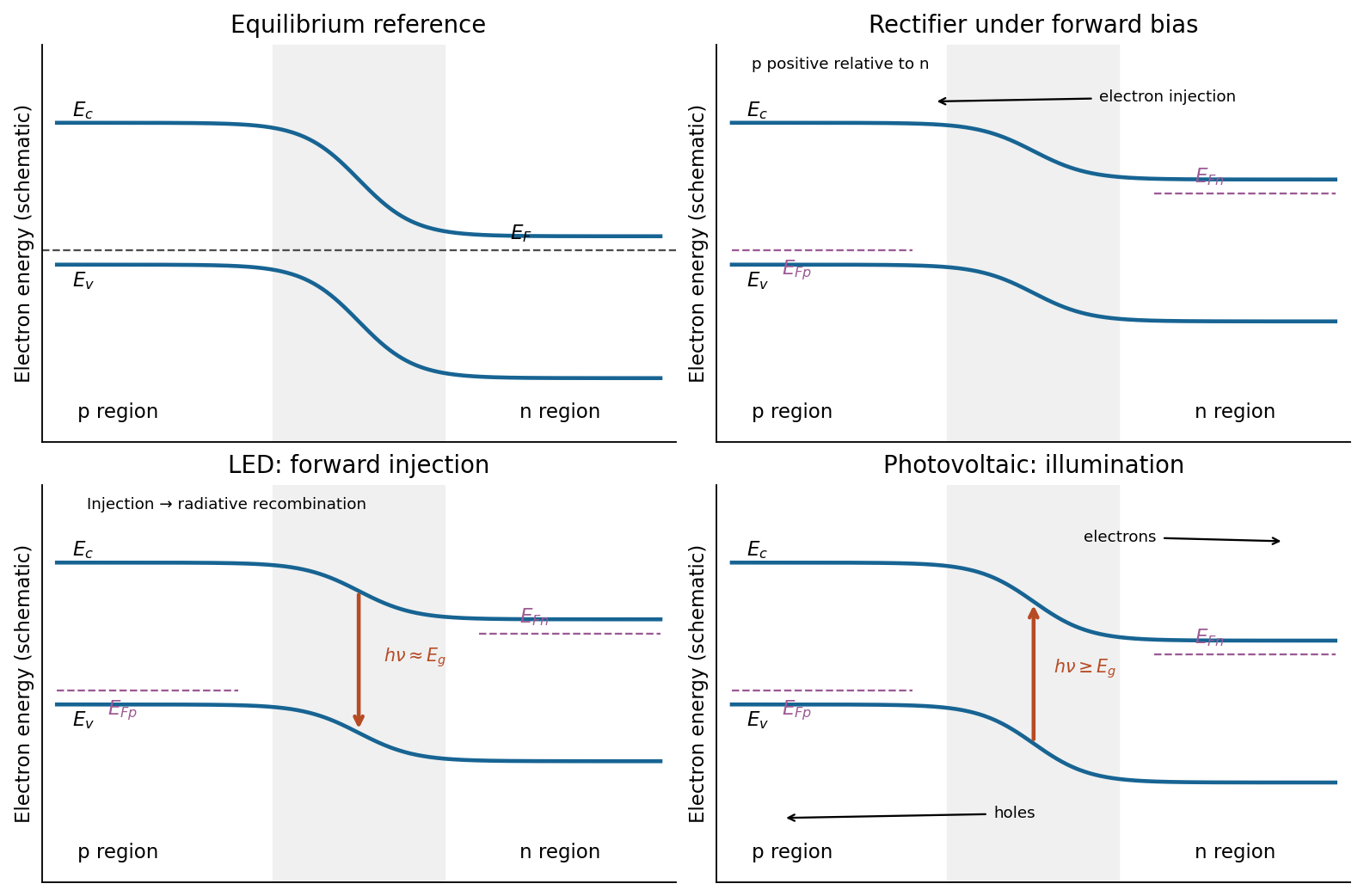
Junction band bending and three device functions
. Original schematic electron-energy diagrams, not quantitative band solutions. Equilibrium has one flat Fermi level; biased and illuminated panels indicate separate carrier quasi-Fermi levels. The photon arrows distinguish LED emission from solar-cell absorption. Details.
forward bias injects electrons and holes into a common active region. Their electron-hole recombination can emit a photon as an electron falls from a conduction-band state into an empty valence-band state, with approximately the band gap near the band edges. A direct band gap makes this radiative transition much more probable than an indirect gap requiring simultaneous phonon participation. Carrier confinement improves their overlap; nonradiative recombination and photon trapping reduce the external efficiency. This is spontaneous electroluminescence and does not require population inversion. The biased carriers have separate quasi-Fermi levels, rather than one global equilibrium Fermi level. The band-diagram downward arrow shows photon emission. As a concrete implementation, an InGaN/AlGaN double heterostructure was used for a bright blue junction LED.[ref]
Absorption of photons with creates electron-hole pairs, the upward band-diagram arrow. In the depletion region the built-in field drives electrons towards n material and holes towards p material; diffusion also delivers carriers generated within a diffusion length outside that region. Selective contacts collect the two signs. Illumination maintains a nonequilibrium quasi-Fermi-level splitting, allowing a voltage and useful current through an external load; it is the light, rather than the equilibrium barrier, that supplies the energy.
Taking forward diode current as positive, an ideal illuminated junction haspower is delivered where in this convention. Reflection, below-gap transmission, carrier thermalization, recombination and resistive losses limit real conversion; even an ideal single junction has radiative detailed-balance limits.[ref]
Detailed Balance Limit of Efficiency of p-n Junction Solar Cells by William Shockley and Hans-Joachim Queisser. 1961, Journal of Applied Physics 32, pp.510–519: radiative detailed-balance limit
Articles by others on the same topic
There are currently no matching articles.