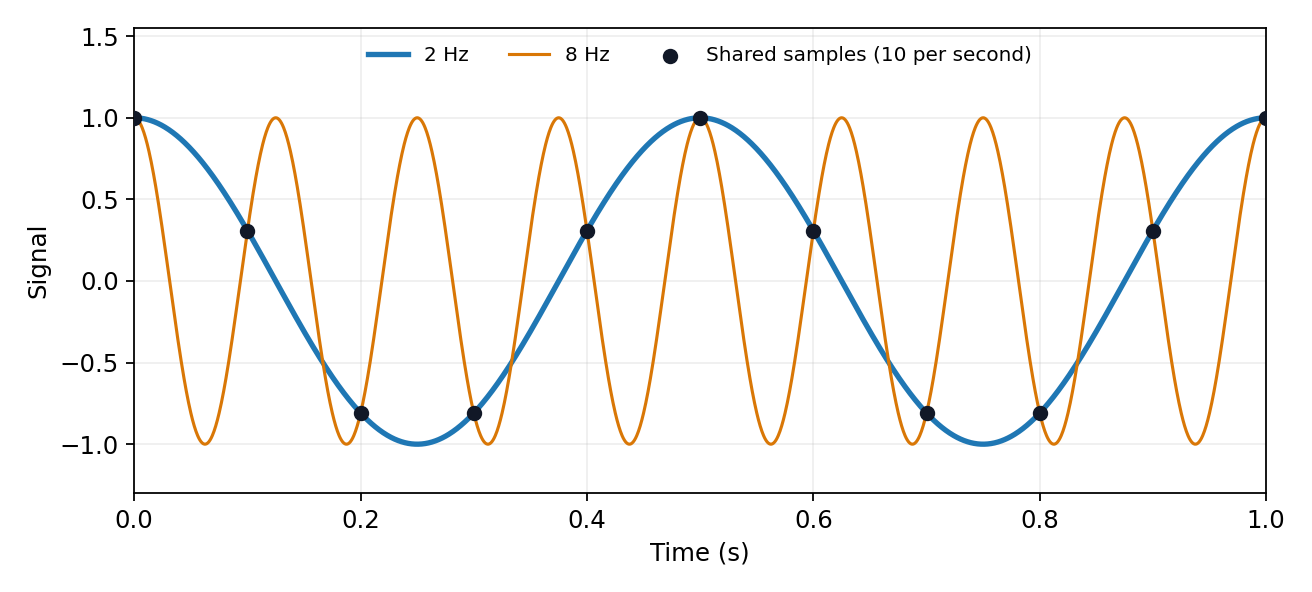
Uniform samples at cannot distinguish frequencies separated by integer multiples of :For a real cosine, opposite frequencies also coincide. Thus an unknown high-frequency component can appear in the sampled record at its folded frequency . For example, 2 Hz and 8 Hz cosines give identical samples at 10 samples per second. This ambiguity is aliasing, rather than uniform quantization error.

The Nyquist–Shannon sampling theorem permits reconstruction of an ideally bandlimited function of bandwidth when . Use an analogue anti-aliasing filter before conversion and allow a transition band between the desired passband and the frequencies that fold into it. Sampling faster relaxes the filter requirement. Digital filtering after undersampling cannot separate already identical sample sequences. Finite observation time, clock jitter, noise and imperfect filter rejection impose further practical limits.
Articles by others on the same topic
There are currently no matching articles.