An ideal operational amplifier has infinite differential open-loop gain, infinite input impedance, zero output impedance and unlimited bandwidth and output capability, and zero input offset voltage and input bias current. In a stable negative-feedback circuit operating linearly, its input currents vanish and . This equality is a feedback consequence, not a rule for a saturated or open-loop amplifier. Here the grounded non-inverting input makes the inverting node a virtual earth.
The inverting two-pole band-pass filter has a series resistor and capacitor input, while the feedback arm is a parallel resistor and capacitor. With Laplace variable ,Kirchhoff's current law at virtual earth gives the minus sign. Substituting yieldsIt vanishes at zero and infinite frequency, with low-frequency and high-frequency . Differentiation gives the single maximumFor , the broad interval has . For , the interval instead has . The same rising and falling asymptotes apply outside either plateau.
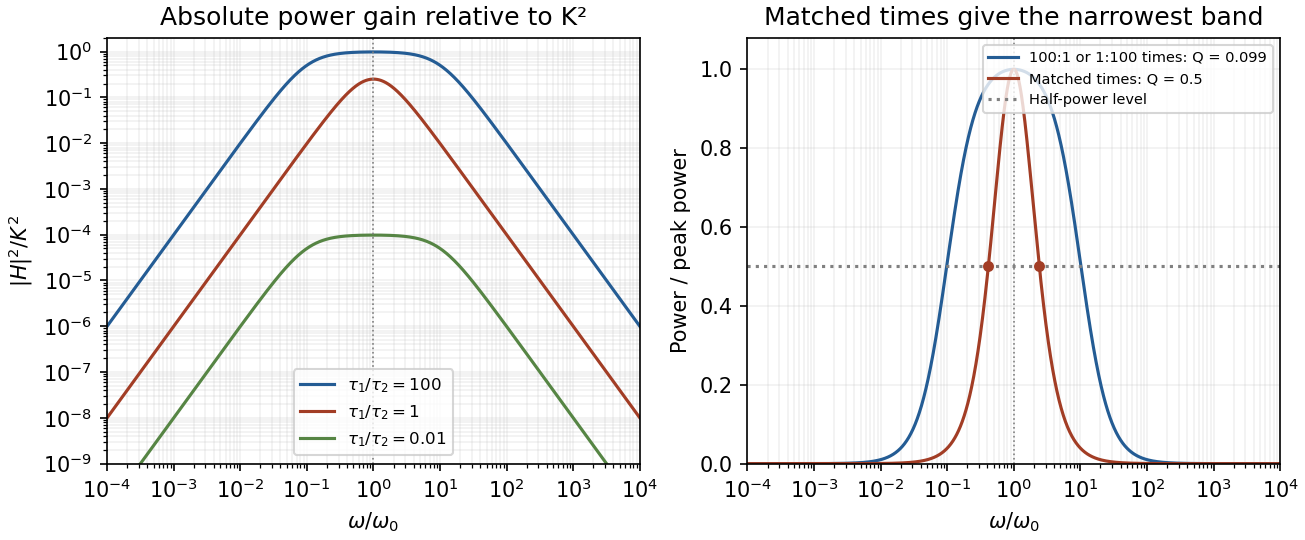
Original ideal filter power gains for different time-constant ratios, showing the finite selectivity limit
. Details. 
Writing and , the half-power frequencies and quality factor areEqual time constants give the narrowest fractional pass-band achievable here, with andThis topology cannot make a genuinely sharp, high- band-pass. Its poles are real, and the selectivity bound for a two-real-pole band-pass prevents arbitrarily narrow selection. A more selective resonant filter needs additional circuit structure. The gain above answers the component-ratio question for the sharpest available setting without assuming an impossible limit.
Real amplifiers have finite frequency-dependent gain and phase lag, so virtual earth becomes inaccurate, the response changes and stability must be checked. Gain-bandwidth limits, slew rate for large signals, output loading and amplifier saturation also matter. Component tolerances move the corners; capacitor parasitics, stray capacitance, resistor noise and input noise become significant. The ideal high-frequency tail should not be extrapolated beyond the amplifier and lumped-component operating ranges.
Articles by others on the same topic
There are currently no matching articles.