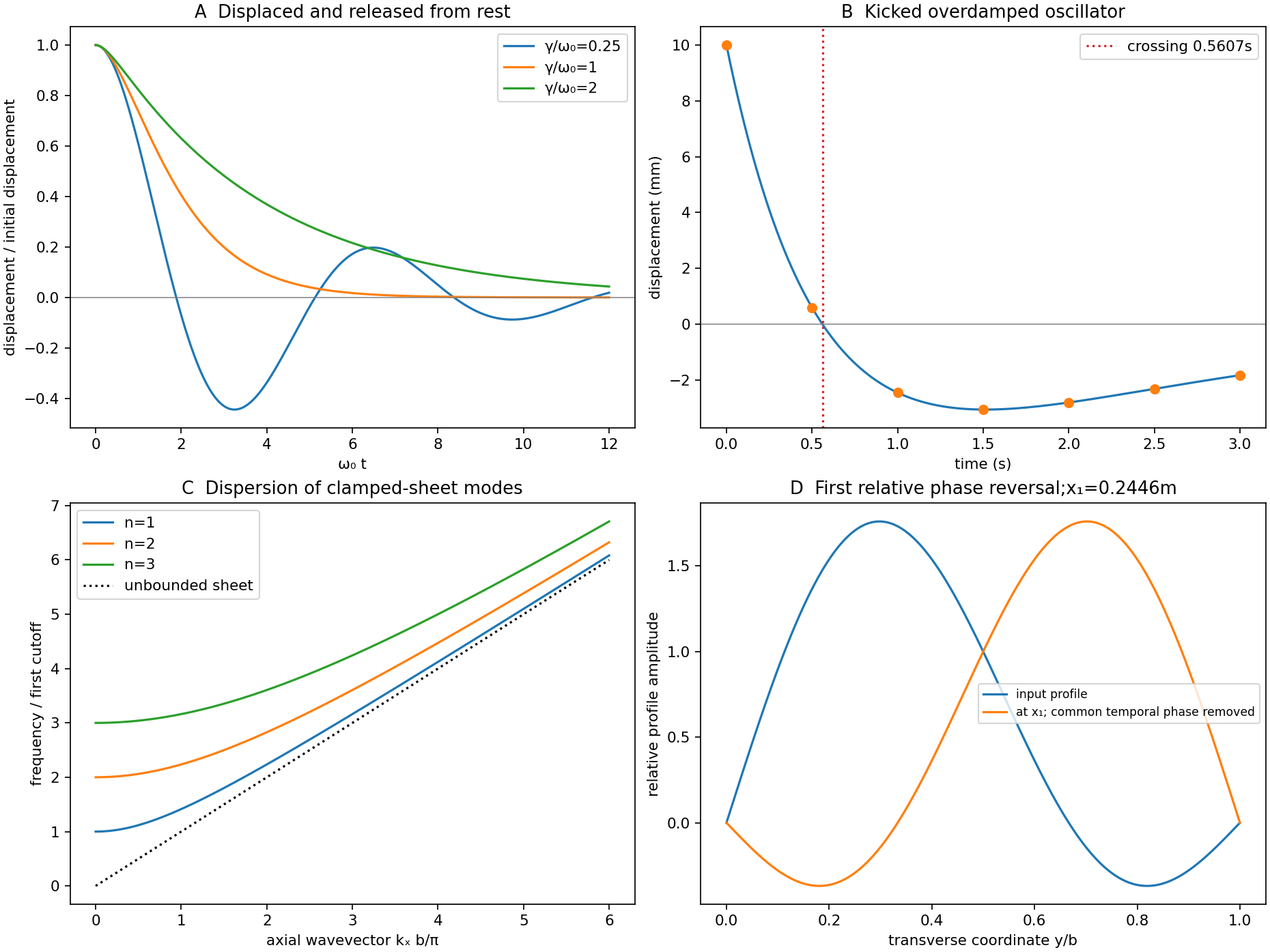
Put and . The characteristic roots are . For release from rest at displacement , the three regimes areunderdamping produces decaying oscillations; critical damping is the repeated-root boundary; overdamping has two real decay rates. The critical and overdamped curves from rest approach equilibrium without crossing it. All three initially have zero slope and negative acceleration. A sufficiently strong initial kick can cause a single crossing even without an oscillatory mode.
For the critical oscillator with initial velocity , the repeated-root solution isIts exponential is positive at finite time. Therefore the bracket has a positive-time zero precisely whenEquality gives a pure positive exponential and no finite-time crossing.
For the specified numerical oscillator, and , verifying overdamping. Its two roots are and in inverse seconds. The initial conditions givewith in seconds. The slow component has a negative coefficient; the fast positive component initially dominates.
The values for the requested plot areThe curve crosses near and then returns toward zero from below. The exact expression provides a check on the graphical estimate:

Articles by others on the same topic
There are currently no matching articles.