Fresnel diffraction is interference during propagation when curvature of the optical path across an aperture matters. It provides a continuous account of fringes near geometric edges and their evolution into the far-field pattern. A screen that is many aperture widths away is not automatically in the Fraunhofer diffraction limit; wavelength also enters the comparison.
For plane-wave illumination of a transmission at , the Huygens-Fresnel principle in the scalar paraxial approximation givesIt follows by expanding the propagation distance as while treating the amplitude prefactor as slowly varying. Small propagation angles justify dropping higher path terms. Finite coherent illumination, vector edge fields and very small apertures can require a more complete theory. The Fresnel number , with a clearly declared aperture scale , measures whether the aperture's quadratic phase is significant. When it is negligible, the remaining linear phase produces the aperture Fourier transform.[ref]
Interactive Optics by Sander Konijnenberg, Aurèle J.L. Adam and H. Paul Urbach. Scalar Diffraction Optics, Fresnel Approximation and Fresnel and Fraunhofer Approximations, equations381–392
Define the optical Fresnel integralsTheir limiting values are , with odd continuation to negative arguments. The Cornu spiral plots : the field contributed by a finite interval is proportional to the chord between its endpoints. Intensities require squared chord lengths; summing zone intensities would lose the cancellation mechanism.
For an opaque straight edge transmitting and all , let , so is the geometrically illuminated side. Integrating in the unrestricted transverse direction and using the half-line in the other giveshenceFar into the shadow, ; far into the illuminated region, . At the geometric shadow boundary, , not half the incident intensity: the field is halved there. On the illuminated side, alternating constructive and destructive contributions give bright and dark fringes whose contrast declines away from the edge. Their positions scale with and are not equally spaced. A finite detector averages fine fringes and tends to recover the geometric-optics step. In a controlled experiment, translate a straight edge through a broad collimated beam, scan a small photodetector across the screen and normalize against an unobstructed reference; vary to test the square-root scaling. Source size, spectral bandwidth, edge roughness and detector aperture wash out contrast and must be distinguished from a failure of the propagation law.
For a rectangular aperture of full widths , defineThe two transverse integrals separate:andA long slit leaves only one varying Fresnel factor. For a square centred on axis, and giveOpposite edge contributions overlap; changing aperture size or propagation distance changes their relative phase. Consequently a geometrically illuminated centre can brighten or darken, rather than remaining a fixed top-hat plateau. The original rectangular-aperture map shows fringes parallel to both edges and their crossing structure. Outside the geometric rectangle the wave also extends into the shadow.
At large Fresnel number an interior region approaches geometric illumination while edge fringes remain on a scale . At intermediate values the opposite-edge fringes interact across the whole aperture image. In the far field, the formula tends to the product of sinc-squared factors,The far-field lobe scale grows linearly with , unlike the local near-edge scale. The transition is controlled by the neglected phase, not an abrupt physical boundary.
To test the main effect, record normalized profiles at several distances, calculate the Fresnel integral with the measured aperture dimensions and compare fringe positions before fitting a free intensity scale. Use the same transverse coordinate origin and check that the incident beam is sufficiently uniform. Babinet's principle relates complementary aperture and obstruction fields through ; their near-field intensities are not generally equal, because the unobstructed field remains present and interferes with the diffracted field. This is why a far-field obstruction argument cannot simply be carried over as equality of Fresnel intensities.
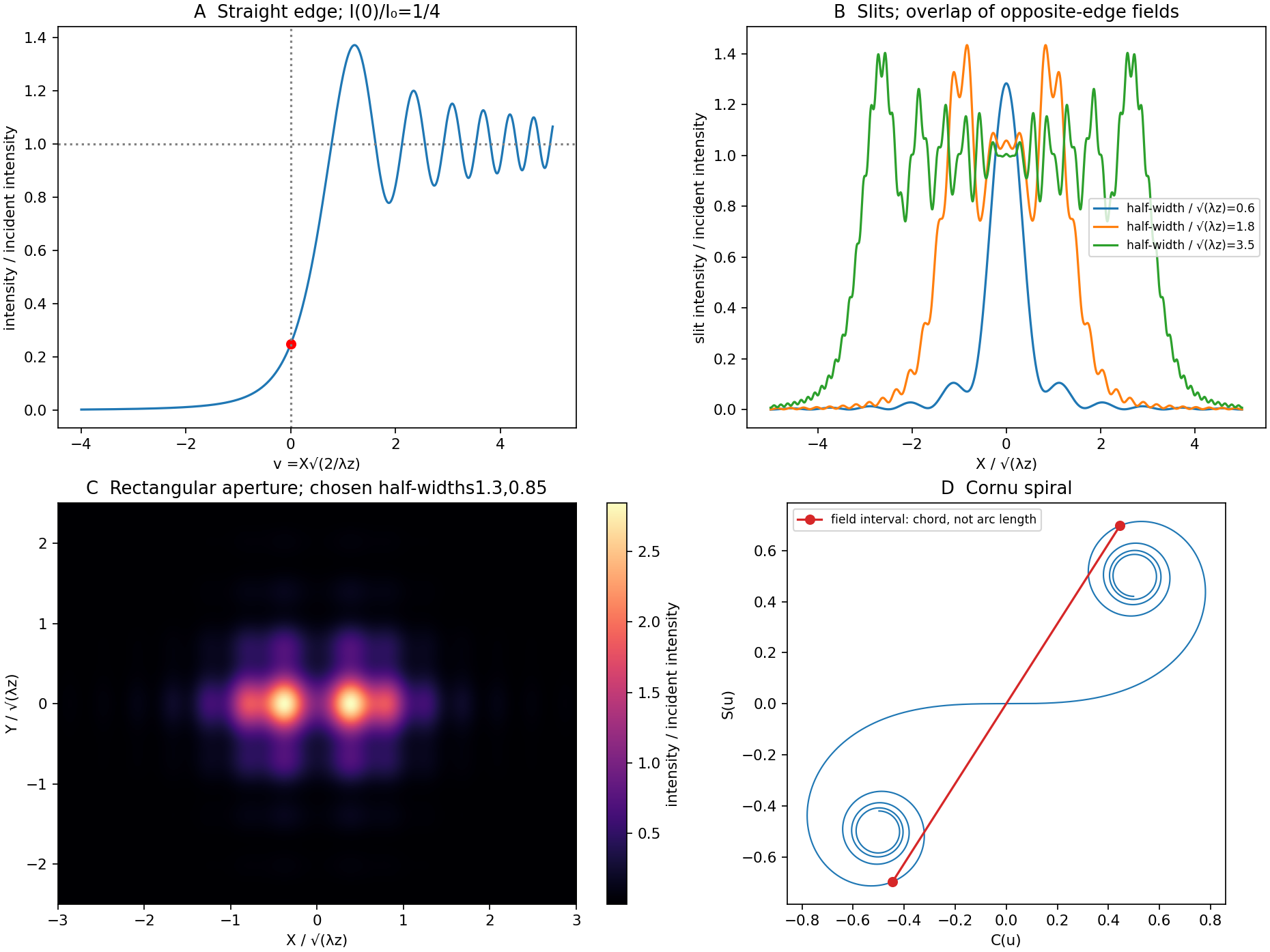
Original Fresnel-integral calculations for a straight edge, slits, rectangular aperture and Cornu spiral
. The plots use the stated scalar paraxial model and chosen dimensionless aperture parameters. The straight-edge boundary value is one quarter. The aperture panels show quadratic-phase propagation and the Cornu panel identifies field amplitudes as chords rather than summed intensities. Details.
Articles by others on the same topic
There are currently no matching articles.