Let the first ray reflect at the upper surface and the second traverse the film, reflect below, and emerge at a laterally displaced point. Its internal round-trip geometric length is , but the external path to a common outgoing wavefront must also be included. The lateral separation is , whose projection along the external ray is . The net optical path difference is thereforeusing Snell's law . Multiplying by the vacuum wavenumber givesFor the usual index ordering , including the stated later value , both reflections are towards higher refractive index and both reverse the electric-field sign. Their relative reflection phase is therefore zero; is also their total relative phase modulo . A different index ordering or polarization-dependent reflection phase would require that additional term.
At the same output in air, use incident intensity . The two specified output amplitudes, including their common reflection sign, give the thin-film interference resultThe output is a cosine with mean , period , and extremaThe unequal amplitudes prevent a dark minimum; their interference visibility is . This is the stipulated two-beam model: the supplied amplitudes already include propagation and transmission factors, and internal re-reflections are excluded by the stated assumption. They need not be recomputed from the later index value.
Eliminate the internal angle using Snell's law:Neighbouring bright fringes differ in phase by . The local angular fringe spacing of a transparent film therefore givesWith , , and ,The data specify a local spacing near , so differentiating is appropriate; choosing particular neighbouring fringe angles slightly shifts this approximate result. The phase decreases as incidence angle increases.
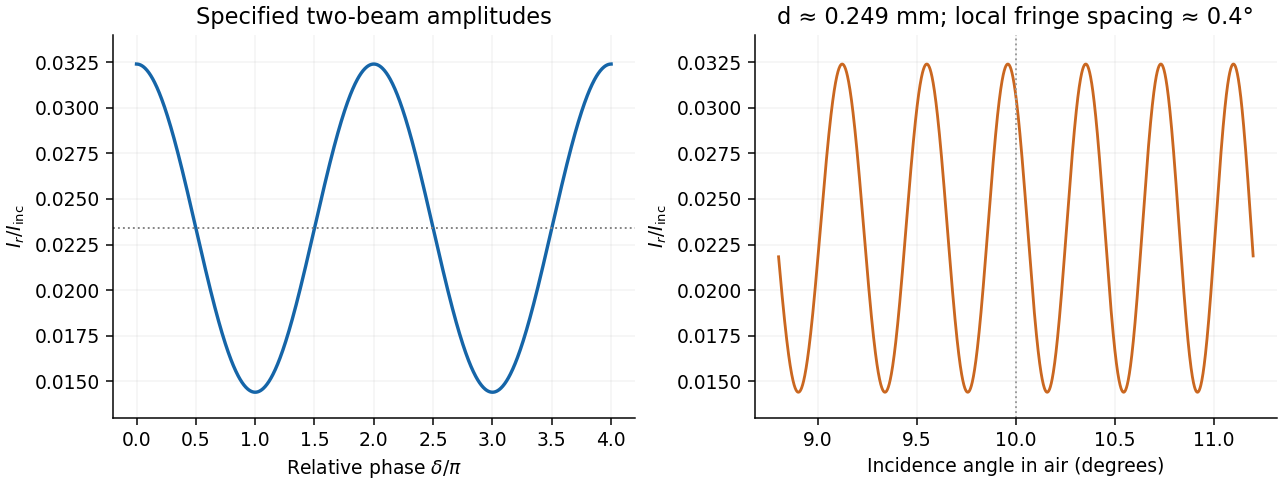
Two-beam reflected intensity versus phase and angular fringes for the inferred film thickness
. Details. 
At normal incidence, the propagation phase is . Different film thicknesses therefore produce bright and dark contours of equal thickness, with adjacent same-type fringes differing by . Under monochromatic illumination these are intensity variations of the incident colour, rather than a rainbow.
For the usual case , reflection at air-oil reverses phase while reflection at oil-water does not. The additional relative makes reflected minima occur at and maxima at . If the oil index were below the water index, the phase-reversal pattern would change and these conditions would interchange. The thinnest regions need not be completely dark because the two reflected amplitudes need not match; at vanishing thickness the residual reflection approaches that of the air-water boundary. Surface motion changes the thickness contours and moves the fringes.
Articles by others on the same topic
There are currently no matching articles.