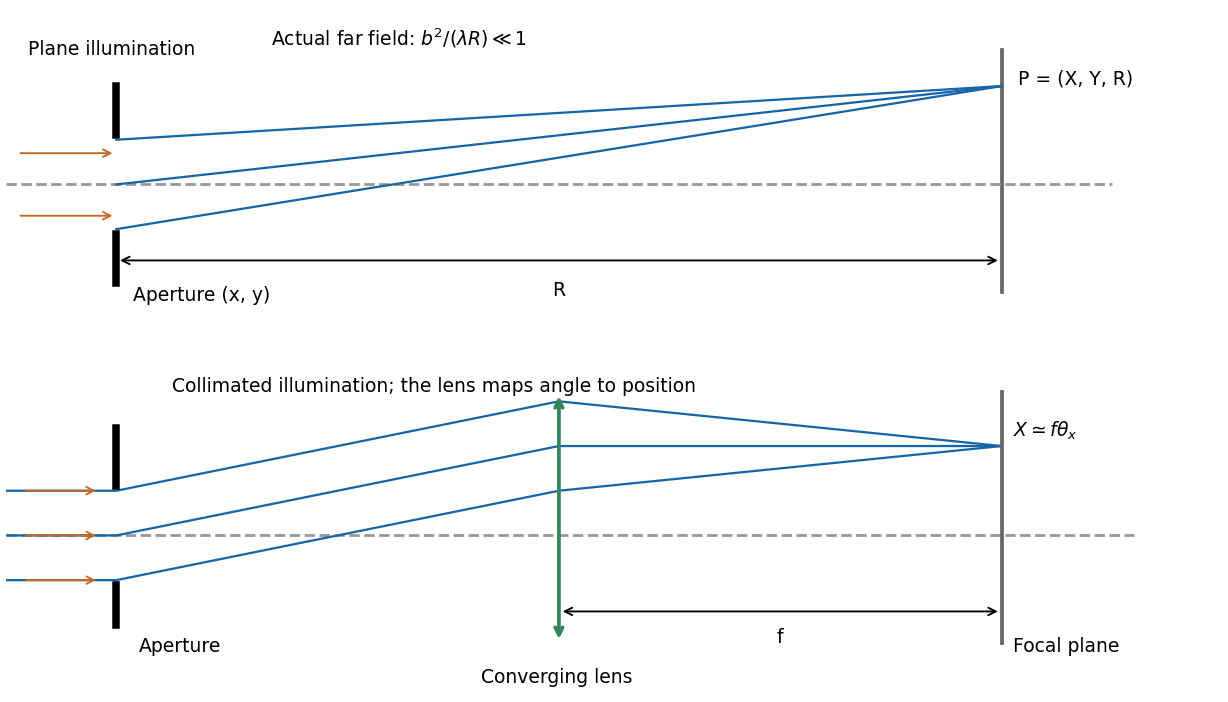
In Fraunhofer diffraction, the relative propagation phase across the aperture is linear in aperture coordinates. If is its largest transverse size, the neglected quadratic path term must be small: for an observer at distance ,For a finite-distance point source a distance away, also require if the illumination is to be treated as a plane wave. Numerical factors depend on whether is a radius or full width and on the permitted phase error; the condition expresses a small Fresnel number.
One can place both source and screen sufficiently far away, or collimate a point source with a lens and observe the aperture in the back focal plane of a second lens. In the latter arrangement rays of each outgoing direction focus at one point, with ; the lens removes the need for a physically distant screen. A laser beam approximately uniform across the aperture can supply the incident plane wave. The sketches distinguish an actual far field from its focal-plane equivalent.

Articles by others on the same topic
There are currently no matching articles.