In division of amplitude, one incident beam is split into two or more parts at a partially reflecting interface; they follow distinct paths and are recombined. The Michelson interferometer and thin-film interference use this principle. In division of wavefront, spatially distinct parts of the same wavefront are selected and allowed to overlap, as in double-slit interference. Both require adequate optical coherence; wavefront division particularly exposes the need for spatial optical coherence between the selected regions.
The beam splitter sends transmitted and reflected portions into perpendicular arms. Each mirror returns its beam to the splitter, where the two returning fields recombine towards the detector. A collimating lens provides approximately plane illumination. A compensating plate of the same glass thickness as the beam splitter can equalise the dispersive glass paths, which matters especially for broadband light.
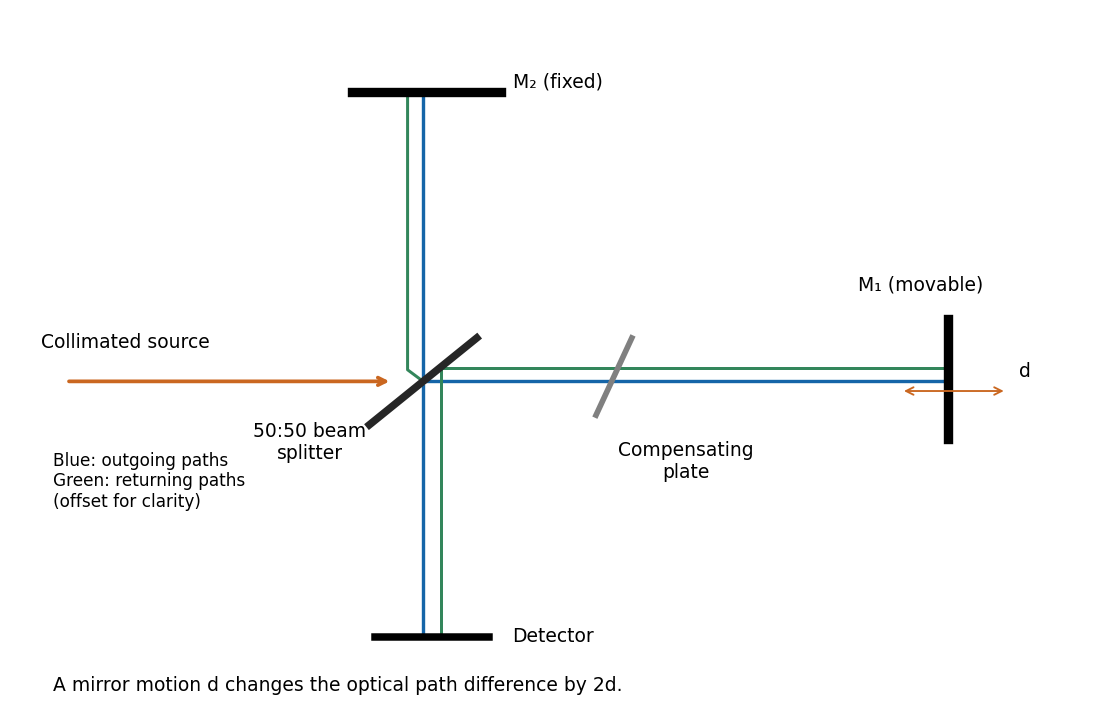
If the arm lengths are , the geometric optical path difference in air is , up to a chosen constant and any additional material paths. Moving one mirror by changes by . Fixed reflection phases can be absorbed into the reference position of a bright or dark fringe.
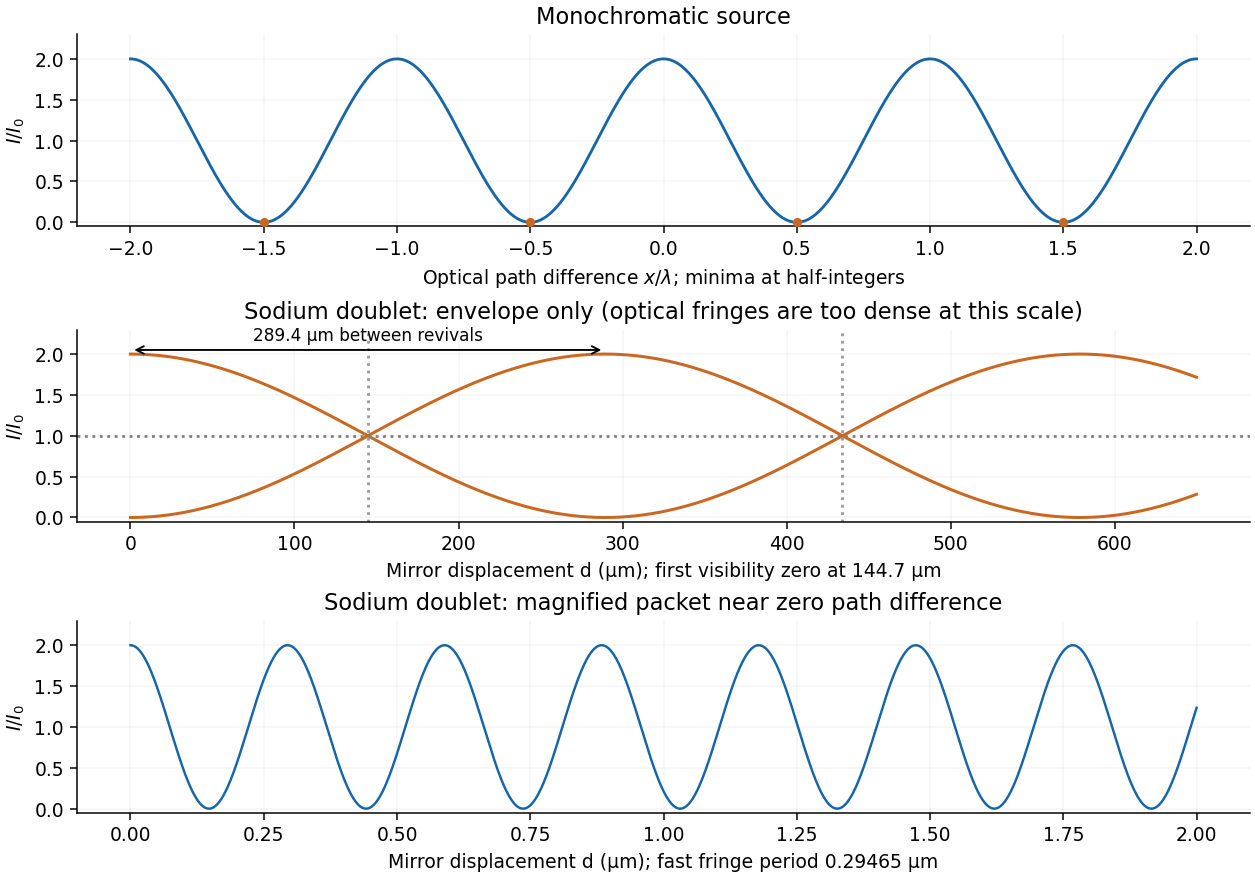
Take the two interfering complex amplitudes to have equal intensities and relative phase . The interference cross term then givesThus the mean intensity is , the maximum is , and the minima areThe optical path difference period is and the mirror-displacement period is . The assumed equal intensities refer to the two fields at the chosen output, with matching polarization of waves and full optical coherence. They set the normalization; they should not additionally be interpreted as all incident light entering that output port. A physical lossless Michelson interferometer has a complementary second output.
The two sodium lines are distinct optical frequencies, so their rapidly oscillating mutual cross terms average to zero at the detector. Assuming equal line strengths and negligible individual linewidths, add their separate interferograms. Write and . With the total mean output intensity,For mirror displacement this becomesThis is spectral doublet from Michelson visibility revivals. Since , . Numerically,The first interference visibility zero occurs at , with further zeros at odd multiples of that distance. Visibility is restored at integer multiples of . The signed envelope has period : alternate high-visibility packets have opposite fringe phase. Unequal line strengths leave a nonzero minimum visibility, and finite linewidths introduce a further decaying envelope; the wavelength data alone specify neither effect.


For mutually incoherent spectral components, the detected intensities add. If describes the mean output spectral intensity, the interferogram isSubtract the constant background, scan the mirror with a calibrated displacement, and take the Fourier transform with respect to delay . This is Fourier transform spectroscopy. The transform recovers the spectrum subject to detector response, finite scan length and any window function. Sampling the displacement finely enough to resolve the shortest optical fringes avoids aliasing.
Using the usual reciprocal-maximum-delay resolution estimate, , and , givesThe mirror displacement is measured from zero optical path difference. This delay-range resolution in Fourier transform spectroscopy is a conventional estimate: a specified window and resolution definition introduce a numerical factor. For example, a symmetric rectangular delay window has its first instrumental zero at , which would give under that particular criterion. The paper does not specify a line-profile criterion; the standard estimate states its convention explicitly.
Articles by others on the same topic
There are currently no matching articles.