The integral field equation. The Ampere-Maxwell law is . Apply Stokes theorem to any fixed oriented surface bounded by the chosen contour:The added displacement current is required for compatibility with electric charge conservation. Taking a divergence and using gives .
Field geometry. Choose the upper plate positive and let increase upward. In the long-plate, slow-discharge approximation, . Conventional wire current runs downward from the positive plate. The magnetic field intensity circulates clockwise as viewed from above. The Poynting vector points radially toward the resistive wire.
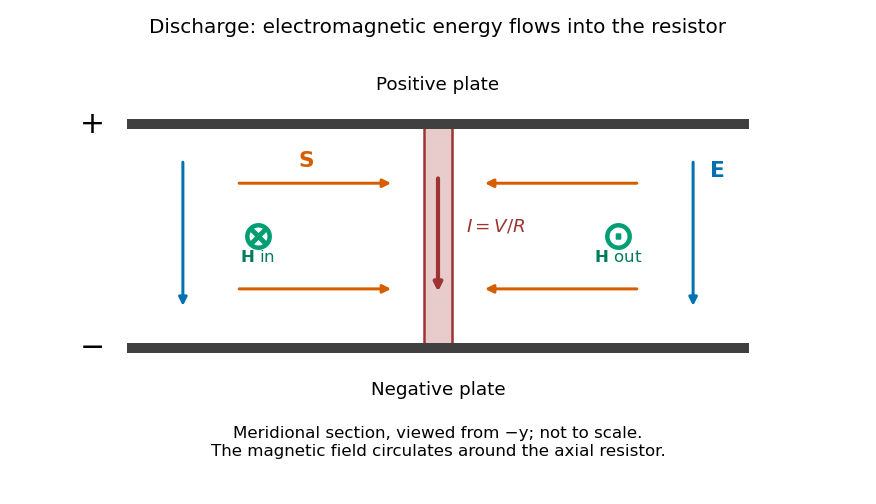
Original meridional section of the discharging capacitor; electric field and wire current point down, magnetic field circles the wire, and electromagnetic energy flows inward
. Details. 
Wire and displacement currents. The capacitance and discharge law areBecause decreases, points upward, opposing the downward wire current. Through a disk of radius between the plates its magnitude isThe effective downward current enclosed by the circular contour is therefore . The Ampere-Maxwell law givesThis is the magnitude; with the stated coordinates, . The factor expresses cancellation between conduction and displacement currents. The approximation requires distances outside the thin wire and away from detailed electrode-edge fields.
Energy flux and power. Since ,Its units are watts per square metre. Integrating over the cylinder's side area , the signed outward power is negative:There is no leading axial flux through the cylinder's ends in this ideal field geometry.
Where the energy goes. The Poynting flux in a centrally discharged parallel-plate capacitor carries field energy through the dielectric space into the resistor, where it becomes Joule heating at rate . Inside radius the stored electric energy isHenceThe resistor receives the inward flux from outside that cylinder plus the field energy released inside it. As approaches the wire radius, essentially all its power arrives as radial electromagnetic flux. Over the whole capacitor, . The Poynting theorem thus accounts for the complete discharge without treating energy as transported only along the conducting wire. High resistance makes the quasistatic electric-field approximation and neglect of changing magnetic energy consistent.
Articles by others on the same topic
There are currently no matching articles.