Across a uniformly illuminated slit, the phase difference between its edges is . Integrating the complex amplitude across the slit gives the single-slit diffraction factorThus in the small-angle amplitude expression. The first noncentral zero has , so . At the stated approximate subsidiary maximum,The exact first side maximum solves , giving and intensity ratio ; the requested approximation need not be mistaken for the exact maximum.
A virtual object is a point toward which incident rays are already converging and would meet if the lens were removed. With real-is-positive object/image distances it has . The thin-lens equation gives ; as , , so a distant virtual object images in the rear focal plane.
Without the lens, puts the central maximum at zero and the first dark fringes at . Subsequent zeros are integer multiples, and weaker subsidiary maxima lie between them.
For the finite-distance pattern compression, take the old screen as the prospective image plane at , with , and the new screen at . ThenThe plane surface has infinite radius of curvature. The transverse scale is , yieldingThe finite-distance scaling can also be checked without treating an intensity pattern as a collection of geometrical point objects: the slit-to-screen Fresnel integral after a thin lens has quadratic coefficient and linear term . It therefore reproduces the old diffraction pattern at transverse coordinate , up to an overall amplitude and phase. If the old far-field plane is treated as infinitely distant, the equally useful leading approximation is , ; the finite-distance correction is only .
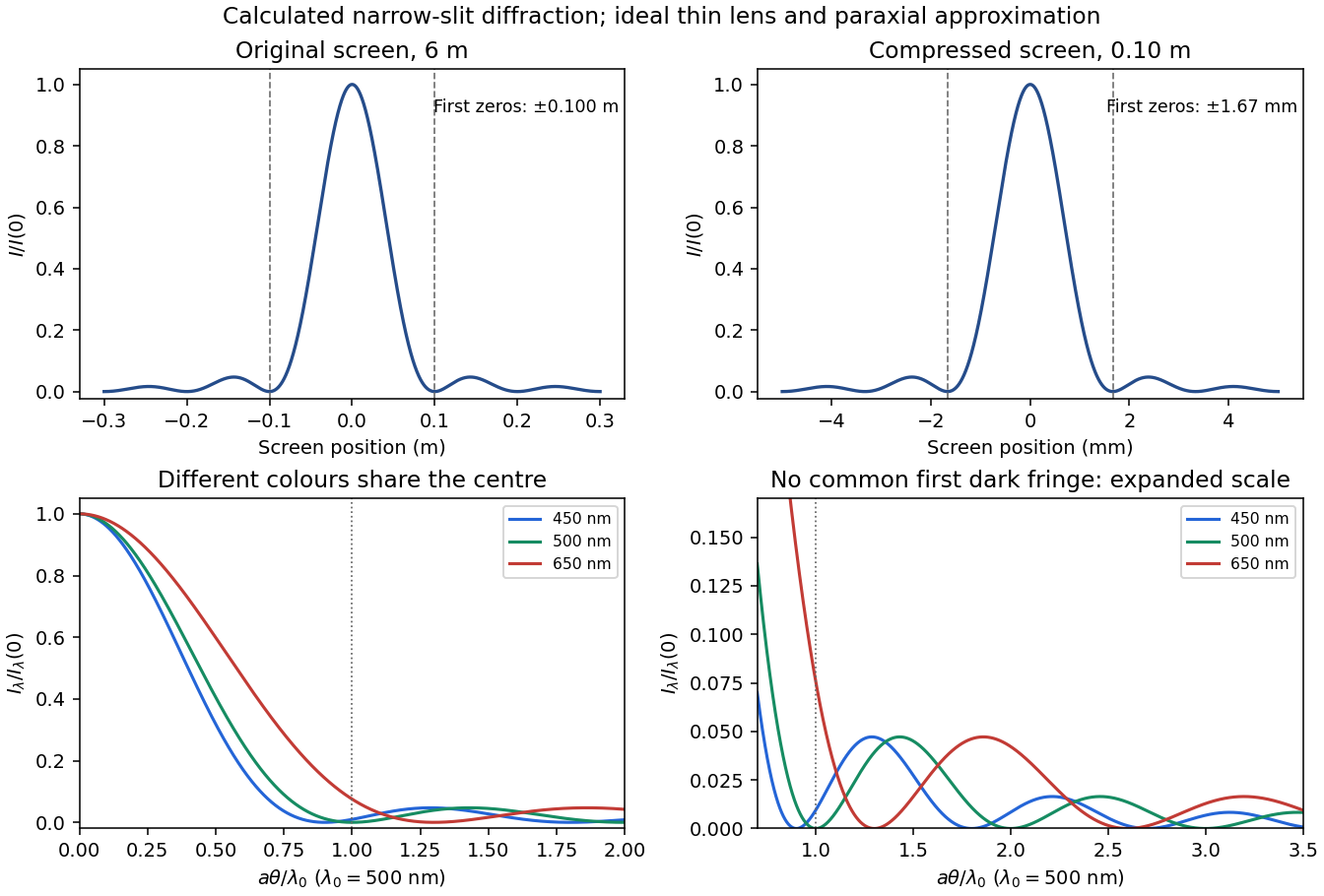
Original single-slit intensity plots at the original and compressed screens, and wavelength-dependent angular patterns for three representative visible colours
. Details. 
The colour discussion below assumes a smooth white incident spectrum and neglects lens dispersion when comparing the ideal diffraction patterns.
At zero angle every slit element is in phase for every wavelength. Their central maxima coincide, so the centre is bright white. Shorter wavelengths have narrower central maxima; farther from the axis their contributions fade sooner, giving the central band reddish outer edges for a smooth white spectrum.
The first zero of each colour is at . Blue therefore reaches its first zero closer to the axis than the reference green wavelength, and red reaches it farther away. At the reference colour is absent, while other wavelengths remain: there is no common black first minimum in white light. Adjacent regions change hue as different colour minima pass through them; wavelengths longer than the reference are still in their central maxima and tend to dominate near its first zero. The exact hue depends on the incident spectrum and spectral response.
Farther out, successive maxima and zeros occur at different angles for each wavelength. Many colour bands overlap, so the pattern becomes faint with increasingly washed-out colour contrast, rather than retaining a single sharp monochromatic fringe system. The overall single-slit intensity falls with an approximately inverse-square angular envelope.
Articles by others on the same topic
There are currently no matching articles.