Original paper: Public original PDF, physical pages 11–22; cover on page 11, blank page 12, questions on pages 13–22.
The de Broglie wavelength fixes the same momentum , but the nonrelativistic electron has :Here , consistent with the stated nonrelativistic approximation. The photon energy and electron kinetic energy are not interchangeable.
For equal mean mass densities, . Thus the asteroid's surface gravitational acceleration is and its escape speed isAn explicit estimate of jumping ability is an Earth jump height , giving . ConsequentlyThis is an order-of-magnitude estimate, scaling with assumed take-off speed; no unique human jump speed is supplied. A spherical nonrotating asteroid and negligible atmosphere are assumed.
Convert both radii to metres before evaluating the moment of inertia:Its linear differential isFor independent standard uncertainties, add the three contributions in quadrature:If the quoted errors are instead bounds, their first-order absolute contributions add, giving . Their statistical interpretation is not specified; the two conventions should remain distinct.
Spherical symmetry makes the electric field radial and constant in magnitude on each concentric Gaussian surface. The enclosed charge isGauss's law therefore givesThe direction is outward for and inward for ; the field vanishes at the centre. No exterior boundary condition changes this spherically symmetric interior result.
Write . Matching dimensions to givesThe dimensionless factor cancels when the same confinement geometry and state are scaled. HenceUsing gives this value. It remains small compared with the proton rest energy, so the nonrelativistic mass-radius scaling is self-consistent.
The laboratory mean lifetime is dilated to . Multiplying by the laboratory speed givesThis is the mean of the exponential decay-distance distribution, not a fixed distance travelled by every pion.
In the centre-of-momentum frame the two equal masses have opposite velocities. Conservation of kinetic energy in an elastic collision fixes their common speed, so scattering changes their directions only. For incoming laboratory velocities and , the frame velocity is and the incoming relative velocities are . If the outgoing relative velocities are , then and the laboratory velocities are . Their dot product is zero: nonzero outgoing laboratory velocities are perpendicular.
For this smooth equal-disc oblique collision, let point from A to B at contact. The impulse acts only along ; the tangential velocity of A is unchanged. With , equal masses exchange their normal velocity components:ThereforeNo rotation about a disc centre is generated by these central impulses. At exactly head-on impact A stops, so its outgoing direction is undefined; the angle formula then denotes a limiting direction.
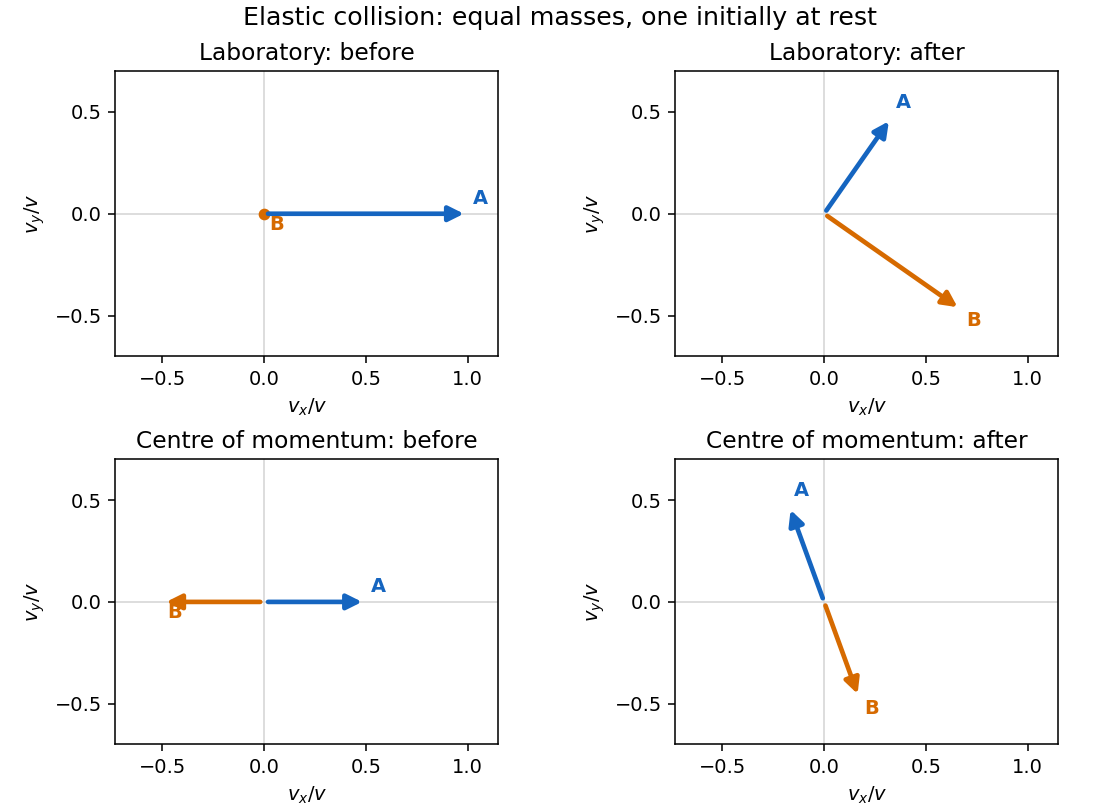
Original velocity-vector construction for an equal-mass elastic collision, before and after impact in the laboratory and centre-of-momentum frames
. Details. 
For this adhesive collision of two equal discs, use the parallel axis theorem about the midpoint of the touching centres:Its magnitude is . Linear and angular momentum conservation giveThe rotation has the sign of , clockwise for the printed geometry. The energy loss is . After impact the midpoint translates uniformly and the rigid pair rotates uniformly about it: there are no external horizontal forces or axial torques.
Rough unglued edges can transmit a tangential impulse and generate angular momentum about the individual disc centres. The centre-of-mass velocity and total angular momentum still have the values above, but individual translational speeds, angular velocities and energy loss require a friction/contact law and normal restitution. Roughness alone does not imply permanent sticking or the adhesive result.
Take inertial axes parallel, with frame moving at relative to and origins coincident at zero time. The Lorentz factor is ; are separations of the same pair of events in , and primed quantities are their separations in . The transverse coordinates are unchanged. For two events on an inertial clock's worldline,The proper time is that clock's elapsed time; uniform speed gives . Coordinate intervals between spatially separated events must instead be Lorentz-transformed with their spatial separation included.
For the round trip in the station frame, the rendezvous distance is , and the return has the same speed and distance. Thus . Its departure and arrival both occur at the station, so for these endpoints:This uses the return speed as measured by the station. The elapsed time aboard A, apart from an ideal instantaneous turn, would be .
For the crash, A's station-frame velocity components are , while B's are . Here and . Four-momentum conservation, with no separately escaping radiation, gives the wreckage totals in the station frame:In B's original inertial frame the same totals areThe invariant wreckage mass is , exceeding because internal energy remains in the wreckage. Its momentum cannot be specified without naming a frame; both natural frames have been given.
Put the station at and take B's initial position to be . Interception after time requires A to cover displacement at speed :The required launch components are and .
Between launch and interception, . The time-coordinate Lorentz transformation therefore givesThis is an elapsed coordinate time in B's inertial frame, not the travel time on A's clock. The latter would be .
For a fixed rotation axis with constant moment of inertia, the axial torque obeys , with . For a point mass at radius , the tangential equation is ; multiplying by gives , as required. Radial forces have zero moment about the axis.
Take increasing in the direction of the clapper's initial fall and let the contact force oppose that tangential motion. Initial equilibrium of the clapper givesWhile contact persists the bell and clapper rotate together. Their respective offsets from the upward vertical are and . Summing external gravitational moments eliminates their internal contact force:The clapper alone satisfies . Hence for ,A nonadhesive contact cannot exert tension. The first zero of this expression on the released trajectory is the loss-of-contact angle. Write . ThenThe second-quadrant root is reached from ; selecting the principal negative arctangent would choose the wrong branch. Indeed the exact contact force before taking is , so its zero is unchanged.
Measure from the static equilibrium position, so the constant gravitational force has already cancelled the equilibrium spring force. With stationary oil, Newton's second law gives . The characteristic exponents are , whereFor the stipulated phase of the damped cosine,At , the velocity is not zero: . ThusExpanding at small gives the requested light-damping loss . The exact instantaneous energy also satisfies .
From the static extension, ; the instantaneous drag measurement gives . Consequently and . Two successive downward equilibrium crossings are one damped period apart, so the same energy ratio applies. At the first crossing . ThereforeThe speed has decreased by . These values use the exact decay factor, not the first-order approximation.
In series the same current passes through both resistors, while their voltage drops add: . In parallel the same voltage drives currents and , which add. Thus and .
Use phasors proportional to . Then and . The printed diagram places C in parallel with the series RL branch, so the input admittance isIts nonzero zero-phase frequency exists for :At zero frequency, and . At , , givingFor , , so current lags voltage. At very high frequency, , so current leads by . Zero phase need not coincide exactly with the minimum current magnitude in this lossy network.
The three measured limits determine the components in order:For the changed resistance, the quoted is an ordinary frequency, so . Keeping L and C fixed gives
Across a uniformly illuminated slit, the phase difference between its edges is . Integrating the complex amplitude across the slit gives the single-slit diffraction factorThus in the small-angle amplitude expression. The first noncentral zero has , so . At the stated approximate subsidiary maximum,The exact first side maximum solves , giving and intensity ratio ; the requested approximation need not be mistaken for the exact maximum.
A virtual object is a point toward which incident rays are already converging and would meet if the lens were removed. With real-is-positive object/image distances it has . The thin-lens equation gives ; as , , so a distant virtual object images in the rear focal plane.
Without the lens, puts the central maximum at zero and the first dark fringes at . Subsequent zeros are integer multiples, and weaker subsidiary maxima lie between them.
For the finite-distance pattern compression, take the old screen as the prospective image plane at , with , and the new screen at . ThenThe plane surface has infinite radius of curvature. The transverse scale is , yieldingThe finite-distance scaling can also be checked without treating an intensity pattern as a collection of geometrical point objects: the slit-to-screen Fresnel integral after a thin lens has quadratic coefficient and linear term . It therefore reproduces the old diffraction pattern at transverse coordinate , up to an overall amplitude and phase. If the old far-field plane is treated as infinitely distant, the equally useful leading approximation is , ; the finite-distance correction is only .
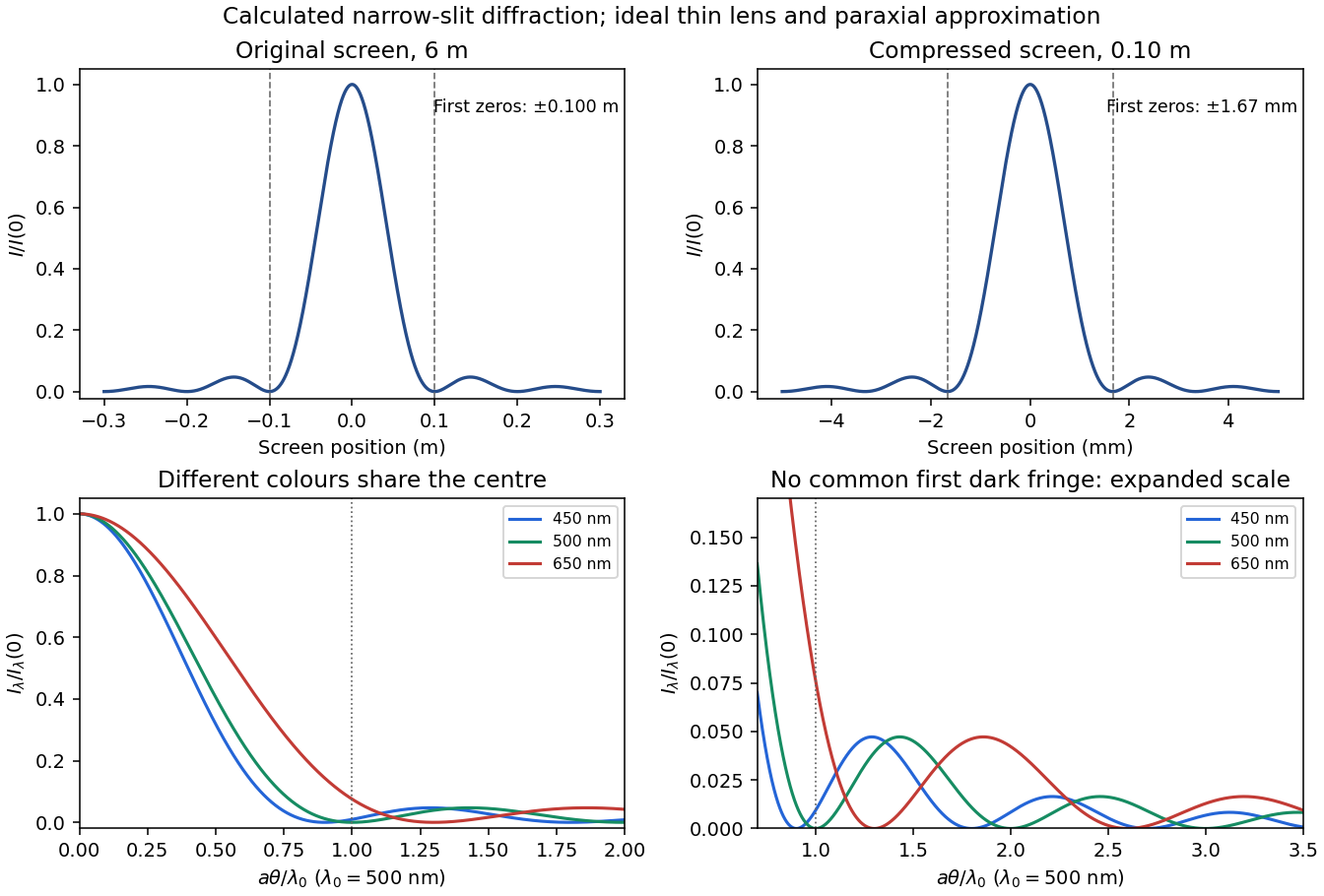
Original single-slit intensity plots at the original and compressed screens, and wavelength-dependent angular patterns for three representative visible colours
. Details. 
The colour discussion below assumes a smooth white incident spectrum and neglects lens dispersion when comparing the ideal diffraction patterns.
At zero angle every slit element is in phase for every wavelength. Their central maxima coincide, so the centre is bright white. Shorter wavelengths have narrower central maxima; farther from the axis their contributions fade sooner, giving the central band reddish outer edges for a smooth white spectrum.
The first zero of each colour is at . Blue therefore reaches its first zero closer to the axis than the reference green wavelength, and red reaches it farther away. At the reference colour is absent, while other wavelengths remain: there is no common black first minimum in white light. Adjacent regions change hue as different colour minima pass through them; wavelengths longer than the reference are still in their central maxima and tend to dominate near its first zero. The exact hue depends on the incident spectrum and spectral response.
Farther out, successive maxima and zeros occur at different angles for each wavelength. Many colour bands overlap, so the pattern becomes faint with increasingly washed-out colour contrast, rather than retaining a single sharp monochromatic fringe system. The overall single-slit intensity falls with an approximately inverse-square angular envelope.
Substitution into the wave equation gives and . Therefore . The fixed edges at zero are automatically satisfied by the sine factors; the opposite edges requireNeither integer may vanish, because that would make the entire displacement zero.
The element's mass is , and its speed is . Squaring and multiplying by half its mass gives the requested energy density. The two sine-squared spatial integrals are and , soThere is no dissipation. The total mechanical energy equals the maximum kinetic energy, givingEquivalently, integrate the small-slope tension energy and use the dispersion relation.
For , the two lowest modes are and :The fundamental has one antinode at and no interior nodal line. The next mode has a node along and opposite-sign antinodes at and . Every boundary is a node.
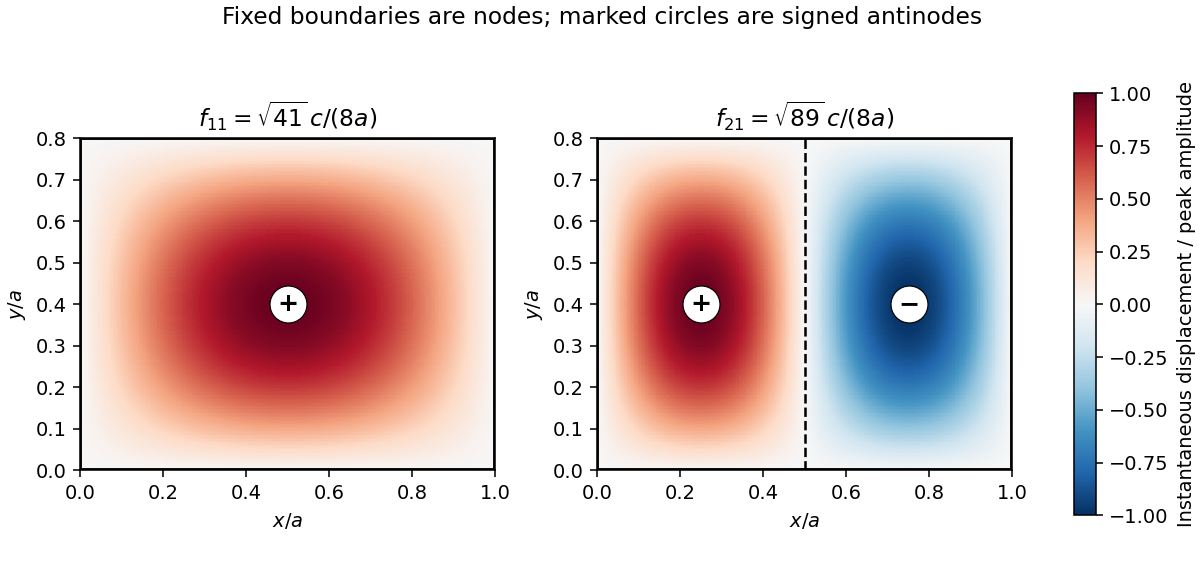
Original displacement maps for the two lowest modes of a rectangular membrane, showing nodal lines and signed antinodes
. Details. 
The square fundamental has . Equating it to givesAt the same peak displacement amplitude and frequency, time-averaged kinetic energy is proportional to membrane area. ThereforeThe reciprocal ratio is if the rectangle is placed first.
In magnetostatics Ampère's circuital law is . Its general vacuum version adds on the right. Faraday's law is for a fixed loop. A circular Amperian path around a long straight wire giveswith direction given by the right-hand rule. The force on a wire element is ; its magnitude is and its direction follows this cross product.
Choose the straight-wire current rightward and the square below it, as printed. Its positive magnetic field there is into the page. With an into-page loop normal, the magnetic flux linkage isHere denotes mutual inductance, not a mass. Choose positive coil current to produce an out-of-page field. Then its induced current in the resistance-dominated approximation isThis reproduces the specified sign with the declared orientation. It neglects coil self-inductance, requiring , as implicit in the requested expression.
The nearest side contains N parallel current segments and is at a uniform distance , so its force magnitude isThe two sides perpendicular to the wire have opposite currents and equal magnetic fields at corresponding distances; their forces cancel pairwise. The far side opposes the near-side force and has the smaller field. ThusWhen and have the same sign under the chosen conventions, the near-side coil current opposes the straight-wire current and the total force is away from the wire; otherwise it is toward it. In particular the signed force alternates with . The coil is fixed, so these forces do no mechanical work on it. The mean Joule heating is
A gravitational field is force per unit test mass, . Newton's law of universal gravitation gives the field of a point mass M:The potential is potential energy per unit mass, with zero at infinity for an isolated mass. Fields and potentials superpose. The potential difference fixes the work per unit mass, and a conservative gravitational field has zero circulation around a closed path.
For a continuous mass distribution, the gravitational Gauss law is . A spherical body therefore has the same exterior field as a point mass at its centre. Inside a uniform sphere of density ,The field is continuous at its surface and vanishes at its centre. An empty spherical shell has zero interior field but a nonzero constant interior potential. Near a small region of Earth's surface one may approximate as uniform and the potential change as . Farther away its spatial gradient produces tidal relative accelerations. Escape to infinity from radius R requires speed when rotation and other bodies are neglected.
The Lorentz force determines the trajectory:Thus a magnetic field changes momentum direction but does no work; an electric field can change the particle's kinetic energy. In a uniform electric field with negligible magnetic field and nonrelativistic speed, is constant. A transverse initial velocity then gives a parabola.
In a uniform magnetic field, the parallel velocity is unchanged and the perpendicular motion is circular. Nonrelativistically,the combined trajectory is a helix, with circulation reversed when the charge sign reverses. Relativistically and the gyrofrequency is .
For perpendicular uniform fields in the magnetic-dominated case, the drift velocity is , which obeys . A particle at this velocity is undeflected: the crossed-field velocity selector selects speed in the appropriate direction, independent of mass and charge. Radiation reaction and collisions are neglected in these ideal trajectories.
In vacuum the electric and magnetic field energy densities areFor example, charging a capacitor requires . A parallel-plate capacitor with and then gives , identifying the electric field energy density. Similarly an inductor stores ; applying this to a long solenoid yields times its interior volume.
Electromagnetic energy is transported by the Poynting vector . Poynting's theorem,expresses local energy conservation and transfer to matter. In a vacuum plane wave , so the two energy densities are equal and the energy flux has magnitude . For nondispersive linear media the corresponding reversible expressions are and ; they must not be applied unchanged to arbitrary dispersive or hysteretic materials.
Articles by others on the same topic
There are currently no matching articles.