Classically, a particle with is completely reflected and never enters the raised region. In quantum mechanics the wavefunction penetrates the classically forbidden side as an evanescent wave. Define the tunnelling decay constantBoundedness at positive infinity excludes , soMatching the wavefunction and its derivative givesThe reflected probability amplitude has unit modulus, hence quantum reflection probability one. The decaying tail carries zero probability current: this semi-infinite potential step has no transmitted beam at infinity, unlike a finite potential barrier. The sketch shows an exact matched example rather than attempting to assign a single real value to a complex wavefunction.
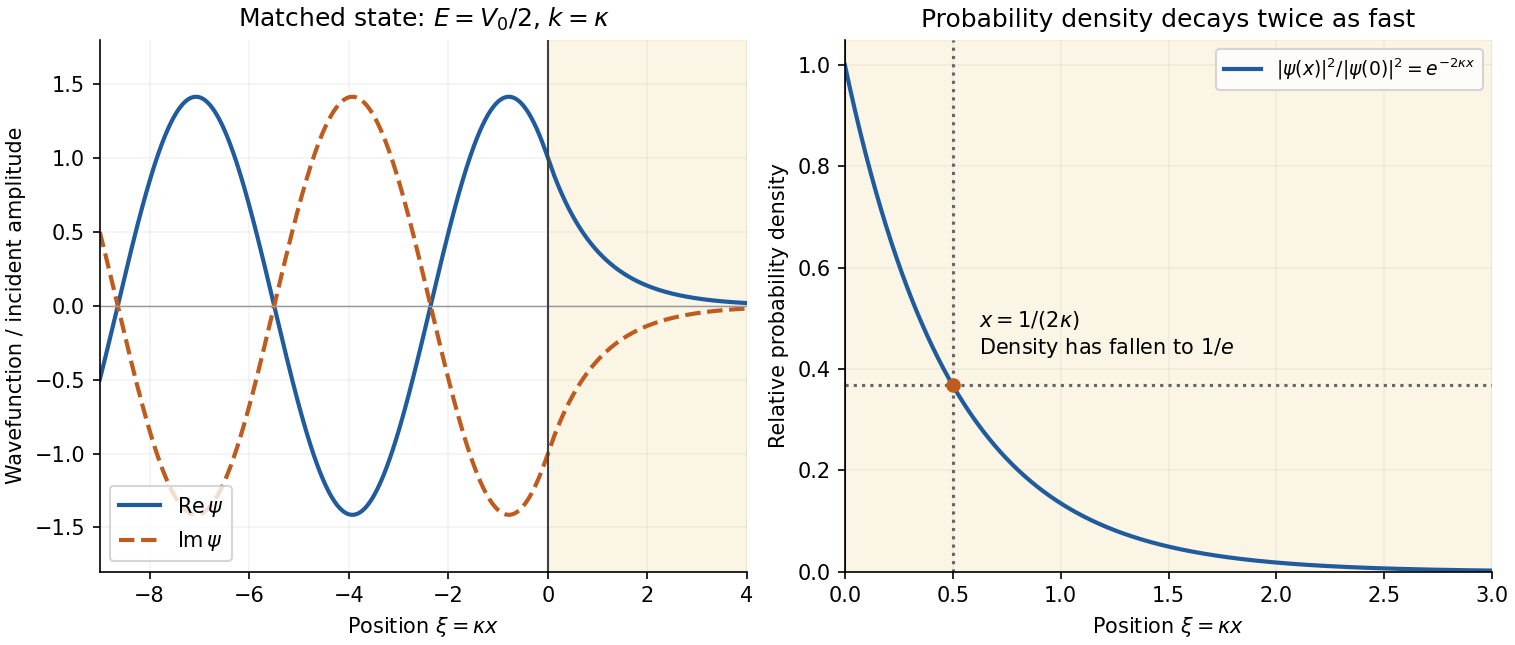
Real and imaginary components of a matched wavefunction at a potential step, with exponential decay of the probability density
. Details. 
Because the probability density decays as , the requested penetration distance isFor a proton, take , and . ThenThe wavefunction amplitude decay length is twice this value. The nonrelativistic equation supplied in the paper is appropriate for this estimate since is small compared with the proton rest energy, approximately . If the original PDF's unbarred is instead read literally as the Planck constant, the displayed differential equation gives . This is a valid calculation for that literal coefficient, but is the physical estimate using the standard Schrödinger equation.
Articles by others on the same topic
There are currently no matching articles.