The Time-independent Schrödinger equation is the energy eigenvalue equation for a particle of mass . The Hamiltonian operator is the sum of the kinetic operator and the prescribed potential energy . Here is the reduced Planck constant. A corresponding stationary state is . The Born rule identifies as probability density for a state with wavefunction normalization ; integrating it over an interval gives a position probability. A plane wave scattering state is not a normalizable wavefunction on the whole line, but its probability currents give the reflection and transmission fractions of an incident wave packet.
There is a notation discrepancy in the sources: the original PDF prints an unbarred in the kinetic term, whereas the local TeX uses . The standard physical equation uses the reduced Planck constant , where is the Planck constant; that convention is used below. Reading the printed literally as the Planck constant would scale all lengths in this model by relative to the standard answers, but would leave the amplitude ratios unchanged.
For , both sides allow oscillatory wavefunctions. A classical particle always crosses the potential step and slows because its kinetic energy falls from to . In quantum mechanics there is generally both reflection and transmission even though the particle is above the step. Define the positive wavenumbersWith no wave incident from the right, writeA finite potential step with constant mass makes both the wavefunction and its first derivative continuous. The two boundary conditions at areSolving gives the reflected and transmitted wavefunctionsFor the specified Electron energies, , so the relative probability amplitudes areThe transmitted probability amplitude exceeding one is compatible with conservation of quantum probability, since the outgoing speed is smaller. In fact the probability current givesThese are the quantum reflection probability and transmission probability, which must be distinguished from the requested relative amplitudes.
Classically, a particle with is completely reflected and never enters the raised region. In quantum mechanics the wavefunction penetrates the classically forbidden side as an evanescent wave. Define the tunnelling decay constantBoundedness at positive infinity excludes , soMatching the wavefunction and its derivative givesThe reflected probability amplitude has unit modulus, hence quantum reflection probability one. The decaying tail carries zero probability current: this semi-infinite potential step has no transmitted beam at infinity, unlike a finite potential barrier. The sketch shows an exact matched example rather than attempting to assign a single real value to a complex wavefunction.
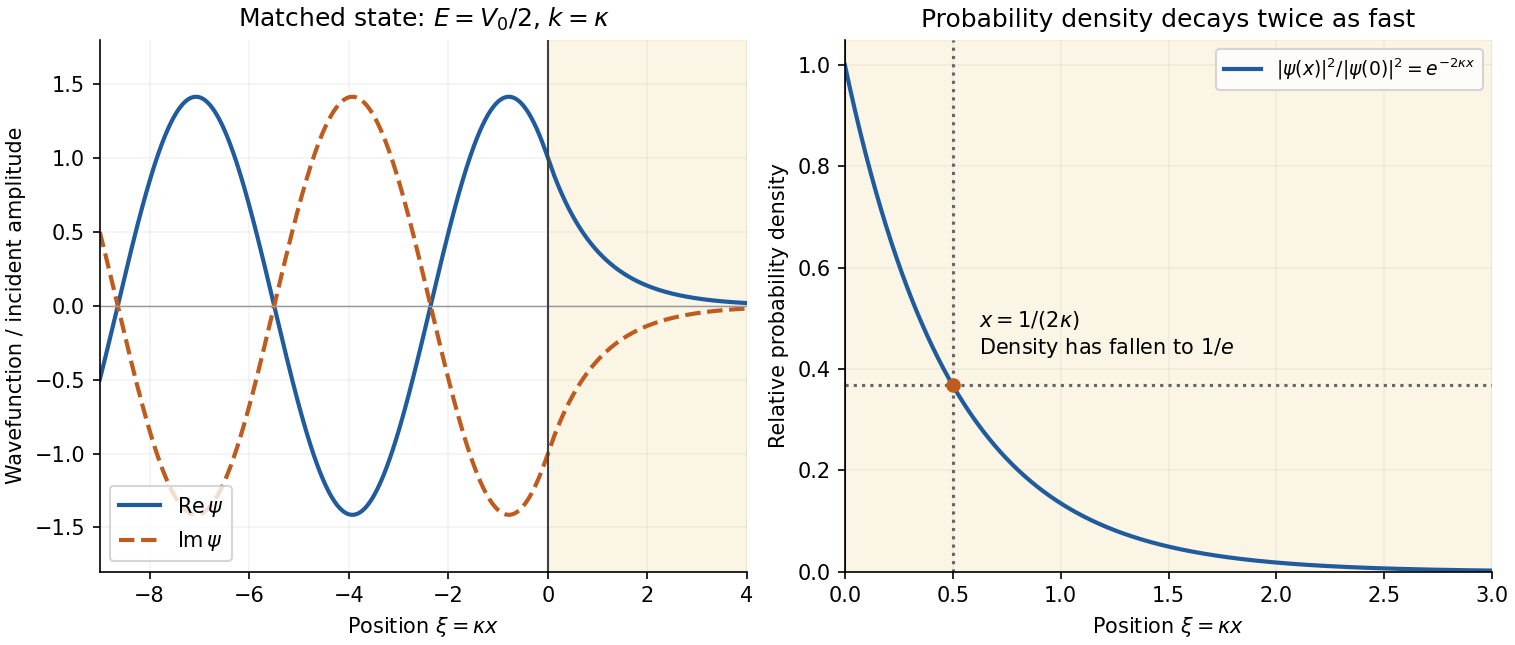
Real and imaginary components of a matched wavefunction at a potential step, with exponential decay of the probability density
. Details. 
Because the probability density decays as , the requested penetration distance isFor a proton, take , and . ThenThe wavefunction amplitude decay length is twice this value. The nonrelativistic equation supplied in the paper is appropriate for this estimate since is small compared with the proton rest energy, approximately . If the original PDF's unbarred is instead read literally as the Planck constant, the displayed differential equation gives . This is a valid calculation for that literal coefficient, but is the physical estimate using the standard Schrödinger equation.
A scanning tunneling microscope brings a tip and surface, both electrical conductors, close enough to leave only a small vacuum gap. An applied electric potential difference makes occupied Electron states on one side able to feed unoccupied states on the other. Although the gap is a classically forbidden potential barrier, quantum tunnelling through its finite width produces an electric current.
For an approximate rectangular potential barrier of gap width , the transmission probability, and thus the electric current at fixed small bias, varies approximately as . This strong distance dependence makes the device sensitive to changes in separation on the scale of a chemical atom. Feedback control moves the tip vertically to keep the electric current constant during a scan; the required height changes form an image of the surface, with contrast also depending on its electronic states. The finite gap permits transmitted probability current, whereas the semi-infinite step in part (b) does not.
Articles by others on the same topic
There are currently no matching articles.