A normal mode is a motion in which all generalized coordinates oscillate at one frequency with fixed amplitude ratios. Small oscillations about stable equilibrium in a time-independent conservative system give , with positive mass matrix and symmetric stiffness matrix, allowing a generalized normal-mode eigenproblem.
For the three-to-one mass double-pendulum modes, the angles are absolute displacements from vertical, as printed. To quadratic order,For and , the determinant isThusThe low mode has the strings leaning together, with the lower angle twice as large; the high mode has opposite angular signs. Both reverse together after half their respective periods.
For the specified release, decompose . Thereforeand the lower mass's horizontal displacement isThis is the supremum of two incommensurate harmonic modes, conventionally described as the maximum-amplitude estimate. Strictly, is irrational, so the opposite cosine extrema are approached arbitrarily closely but never coincide at a finite time. The quoted value is a supremum of the ideal linearized motion.
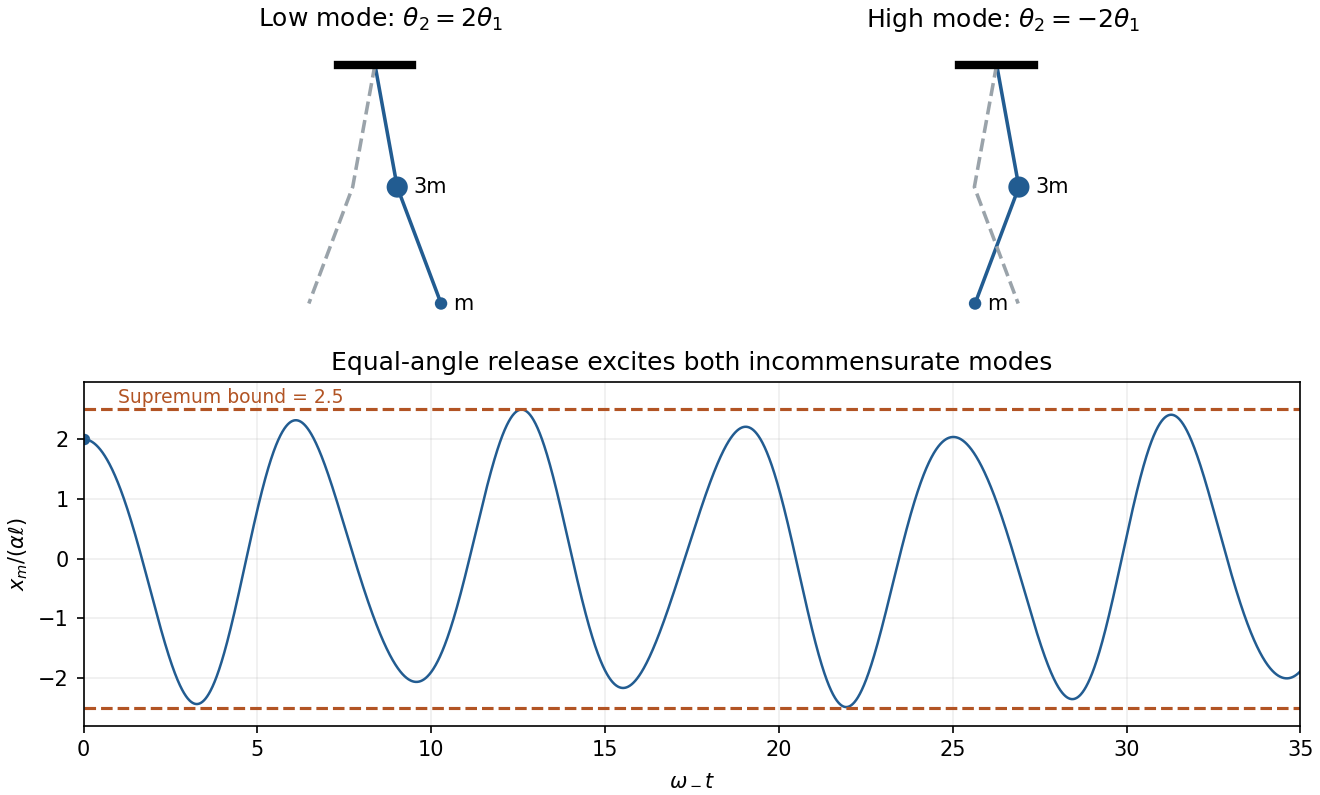
Original normal-mode motion sketches and the lower-mass displacement after equal-angle release, with the limiting amplitude bound marked
. Details. 
Articles by others on the same topic
There are currently no matching articles.