For a finite step in a one-dimensional potential and constant mass, the stationary Schrödinger equation requires continuity of the wavefunction and its first derivative. A discontinuous derivative would introduce a delta-function term in its second derivative, unsupported by a merely finite step. A discontinuous wavefunction is still more singular. A delta-function potential has a different derivative jump condition; an infinite wall instead imposes zero wavefunction and does not require matching to an exterior zero derivative.
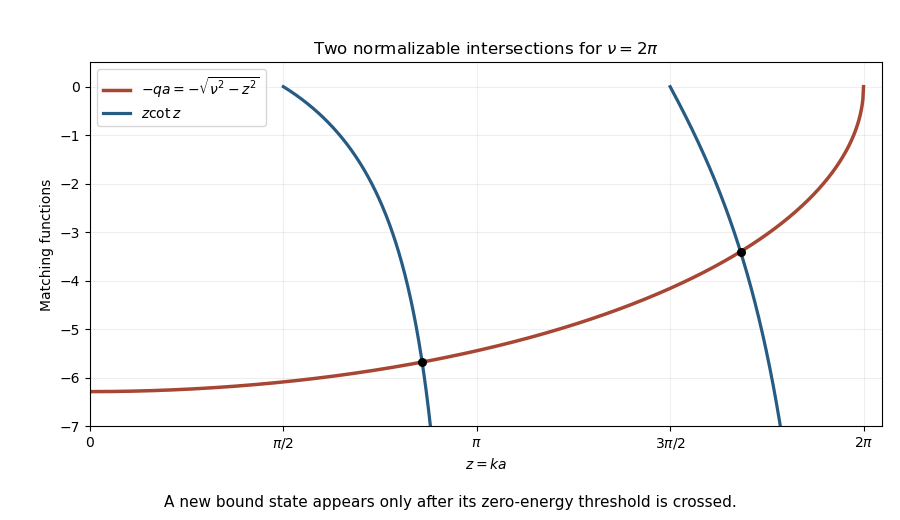
For a bound state of the half-well, . The wall at zero excludes a cosine term, and square integrability excludes exponential growth outside. WriteContinuity at gives and . HencePut , , and . Matching becomes with , . The negative branches of occur on . There is one bound-state intersection in the th interval exactly whenAt equality the new level has , so its outside tail is constant and not normalizable: it is a threshold state, not a bound state. Thus no bound state exists for , including the strict inequality asked in the question.
Exactly two negative-energy bound states require the second threshold to have been crossed and the third not crossed:The lower endpoint is excluded and the upper endpoint included precisely because a zero-energy threshold state does not count as bound. This half-line finite-well bound-state count differs from an unrestricted symmetric one-dimensional well, which has no hard wall at its centre.

Articles by others on the same topic
There are currently no matching articles.