Meridional overturning circulation links relatively warm upper-ocean transport to a colder return flow at depth, with exchanges among basins and vertical branches. Surface heat loss and salinity changes alter water density; sufficiently dense water can sink and spread along deep pathways. Freshwater input lowers salinity and can inhibit dense-water formation. Winds, particularly in the Southern Ocean, and energy supplied to mixing are also important to the global return and upwelling pathways. The circulation is not powered by surface density forcing alone in an otherwise closed, unmixed ocean.
The Atlantic meridional overturning circulation carries heat northward, helping regulate ocean-atmosphere heat exchange and regional climate. Overturning also ventilates the deep ocean and redistributes carbon, oxygen and nutrients. Changes in its strength can alter regional sea-surface temperatures, air-sea heat release and atmospheric circulation. They need not eliminate every western-boundary current or every source of European warmth: wind-driven ocean circulation and atmospheric heat transport are distinct, interacting contributions. The two-box model below isolates a density/salinity feedback rather than representing all these mechanisms.
Illustration TODO. The source's two-volume circulation sketch on page 4 is unavailable. Its exact arrows and layout cannot be recovered. The surviving flow law, salinity/temperature definitions and printed steady polynomial allow the calculation below under an explicit freshwater sign convention; no unavailable diagram values are invented.
Use , , and let positive be the thermally driven state with cold box 1 denser than warm box 2. Take positive to freshen box 1, represented in a fixed-volume salt budget by an equivalent salt removal from that box and addition to the other reservoir. This is the freshwater convention compatible with the printed and positive . It can represent a compensating saline volume transfer or the usual virtual-salt-flux approximation. The exact pipe assignment is not claimed to have been read from the missing illustration.
Exchange in either circulation direction reduces a salinity difference at rate proportional to . Steady salt balance therefore givesThe supplied linear equation of state givesEliminating yields the two-box overturning model equationHere and both have transport units when do, while and are dimensionless. Although the source calls a mass flow, its stated Sverdrup units are volume per time; the common reference density cancels in the Boussinesq salt/volume approximation. At , cannot be a finite-salinity steady state in this model. At , zero flow needs separate treatment instead of division by .
The circulation weakens when freshwater freshens the cold reservoir, and the weaker circulation removes the resulting salinity contrast less effectively. This salt-advection feedback is the mechanism behind multiple steady states, not an additional externally imposed switch.
Use all coefficients exactly as printed and use Sv consistently for transports. The present salt contrast and density-driven friction coefficient areThusThe large numerical value of reflects division by a small dimensionless density contrast, about with the supplied effective expansion coefficients. It is not the actual overturning transport, which remains Sv.
For , the steady equation is a quadratic with rootsThe critical freshwater forcing in a two-box overturning model occurs where the two roots coalesce:There is also a negative-flow branch for every :At the present forcing, the three roots are , and Sv. The prescribed present state is therefore the upper positive branch, not an arbitrary choice among the roots.
Stability needs a salinity evolution law, not just the algebraic steady equation. For fixed temperature contrast and reference salinity, the standard salt-contrast dynamics can be writtenwhere summarizes the reservoir volumes. The linear slope at a positive root is : the upper branch is stable and the lower branch unstable. At a negative root it is , so the reversed branch is stable. The two stable states below the fold have different attraction basins, demonstrating bistability. Their stability is conditional on this fixed-temperature, fixed-reference-salinity closure.
As forcing increases quasistatically from Sv, the normal branch weakens and reaches a saddle-node bifurcation at . Beyond it no positive steady circulation remains, so the reduced dynamics move toward the stable reversed branch. The reversal is salinity dominated: the fresh cold reservoir is no longer the denser one. Recovery under a later forcing change can depend on the system's state and feedback history.
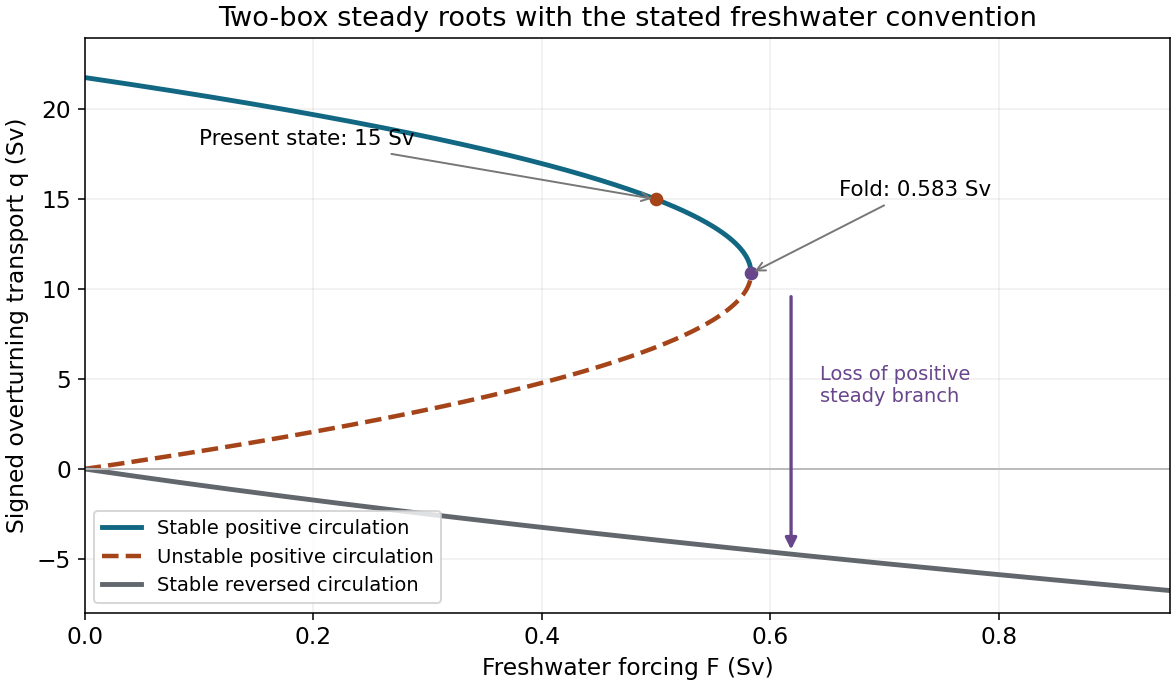
Steady transports and their stability in the explicitly stated freshwater convention; present state and critical freshwater forcing are marked
. Details. 
Interpret a uniform increase of per year from the present value as a constant slope, with in years. Under quasistatic tracking of the stable branch, the time to its fold isIf instead the phrase means a compounded fractional increase, , the corresponding time is yr. These are two different forcing prescriptions, not two different critical freshwater fluxes.
The branch does not remain exactly at Sv until that date. Differentiating its quadratic giveswhich is at the present state. The initial decrease is about Sv per year under the linear ramp. At the fold the flow is only Sv, about 27 percent below its present intensity. Thus maintained close has no unique duration without a tolerance: for example, a ten-percent decrease to Sv occurs atA five-percent criterion gives about yr. The 55-year value estimates persistence of the positive equilibrium branch, not a perfectly flat present-day circulation.
These times are model extrapolations, not forecasts. The reservoirs' finite adjustment times are unspecified; near a fold, weakening restoring rates can invalidate quasistatic tracking and produce a delayed transition. Real ocean temperatures, reference salinity, winds, mixing, ice, geometry, regional freshwater pathways and the density-to-transport relation do not stay fixed. The imposed freshwater trend and the two-box reduction need independent justification before an actual transition time can be inferred.
A strong weakening of northward Atlantic heat transport could cool the North Atlantic and northern Europe relative to a climate with stronger overturning, altering atmospheric circulation and precipitation. It does not imply that all wind-driven transport vanishes or that greenhouse forcing ceases. The defensible implication is sensitivity of regional climate to ocean heat-transport changes, while the toy model supplies a transparent example of feedback and a threshold rather than a reliable dated prediction.
Articles by others on the same topic
There are currently no matching articles.