In the northern hemisphere the coast is on the wave's right when looking in its direction of propagation. In the ocean- convention above it travels northward, with land east of the flow; for the opposite ocean side it travels southward. This follows from combining with a sea-level bulge that decreases offshore, rather than choosing propagation independently of trapping.
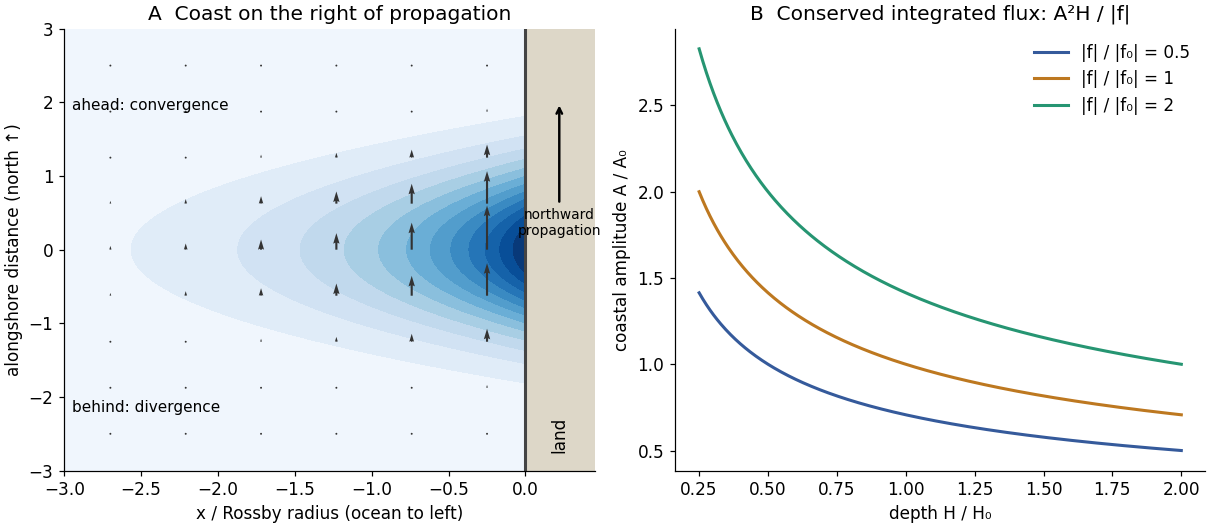
For a positive northward bulge, is northward and strongest at its crest, and there is no cross-shore velocity in the ideal mode. Ahead of the crest the current decreases northwards, so : horizontal flow convergence increases sea level, . Behind the crest : divergence lowers sea level. At the crest itself the alongshore derivative and instantaneous horizontal flow convergence vanish. These signs reverse appropriately for a trough or the opposite coast, while the trapping rule remains the same.
The first panel below sketches a positive bulge, alongshore velocity and the leading convergence/trailing divergence regions. Its cross-shore decay is the pressure-gradient/Coriolis balance, not a current directed into the coast.

Articles by others on the same topic
There are currently no matching articles.