Place a straight coast at , ocean at , and impose no normal flow at the wall. A coastal Kelvin mode has throughout. The zonal momentum equation becomes , while the remaining two equations are and . Eliminating givesFor a northward disturbance , the nontrivial solution has and . In the northern hemisphere choose ; then cross-shore geostrophic balance requiresIt decays into this ocean half-plane because and . The decay length is the external Rossby deformation radius . A Fourier component has , so both phase and alongshore group speed are , independent of wavenumber: the ideal shallow-water Kelvin wave is nondispersive.
The signed choice is part of the boundary condition. For ocean at in the same hemisphere, decay instead selects southward speed and . Without stating the ocean side, an exponential growth into the sea could be mistaken for a trapped coastal mode.
In the northern hemisphere the coast is on the wave's right when looking in its direction of propagation. In the ocean- convention above it travels northward, with land east of the flow; for the opposite ocean side it travels southward. This follows from combining with a sea-level bulge that decreases offshore, rather than choosing propagation independently of trapping.
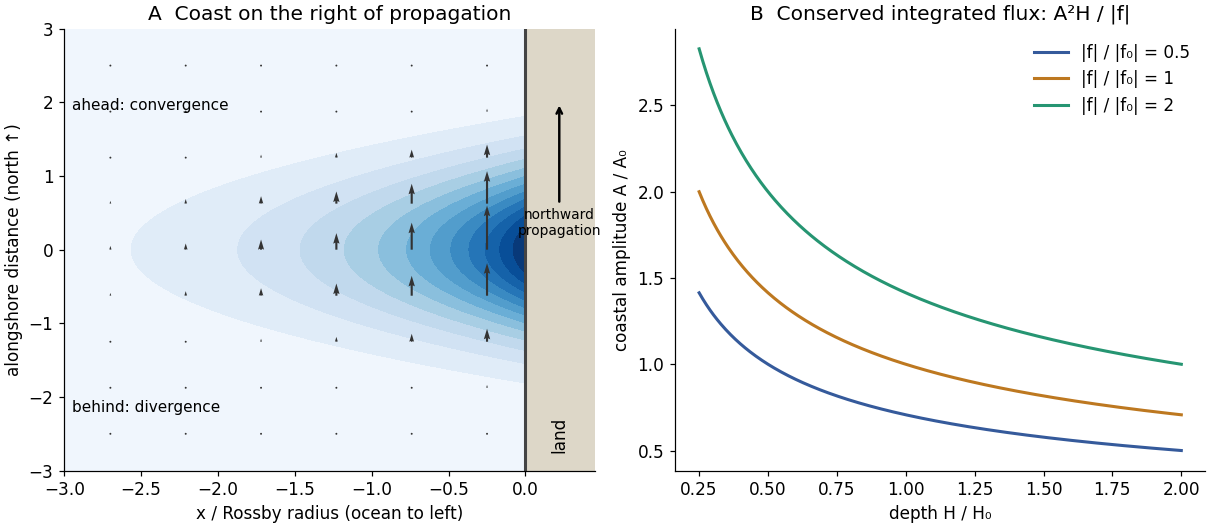
For a positive northward bulge, is northward and strongest at its crest, and there is no cross-shore velocity in the ideal mode. Ahead of the crest the current decreases northwards, so : horizontal flow convergence increases sea level, . Behind the crest : divergence lowers sea level. At the crest itself the alongshore derivative and instantaneous horizontal flow convergence vanish. These signs reverse appropriately for a trough or the opposite coast, while the trapping rule remains the same.
The first panel below sketches a positive bulge, alongshore velocity and the leading convergence/trailing divergence regions. Its cross-shore decay is the pressure-gradient/Coriolis balance, not a current directed into the coast.

For an eastward tidal signal entering the English Channel from the Atlantic, the northern coast of France lies on the right of propagation, with land to the south. It is therefore the trapping coast of the corresponding northern-hemisphere Kelvin mode. The south coast of England is across the ocean from that boundary and receives a smaller amplitude through the offshore exponential decay. For a uniform channel of width , this ideal mode would have .
Thus the mode assumption predicts the greater tidal range on the French side. It does not mean all local tides are a single Kelvin wave: channel depth and shape, friction, reflections, resonances and interference also influence the actual tidal range. The explanation concerns the stated eastward incoming tidal-mode idealization, not a universal comparison at every location or tidal constituent.
Per unit horizontal area, the linear shallow-water kinetic and gravitational potential energies areFor the Kelvin mode, and with . Therefore , and the two energies are actually equal pointwise at this order. For a harmonic wave ,The averaging supplies . These energies refer to the perturbation relative to the flat resting state; background ocean potential energy is not included.
The Kelvin-wave coastal amplitude scaling follows from the flux. For a wave with peak coastal amplitude , . Integrating the supplied flux over the offshore coordinate gives its magnitudeThe direction is the alongshore propagation direction; the expression above is positive magnitude. For slowly varying depth, negligible dissipation/reflection and no other source or sink, the transported energy per time is conserved. At fixed latitude,The coastal amplitude increases on entering shallower water. This is stronger than the familiar fixed-width shoaling law because the Kelvin mode's offshore width also contracts, . The comparison is a slowly varying trapped-mode result; abrupt topography can scatter or reflect energy and invalidate simple flux conservation for one outgoing mode. The amplitude panel in solution illustrates the scaling.
Retaining the integrated energy flux from part (i), slow changes of depth and latitude obeyAt fixed depth and higher absolute latitude in the same hemisphere, increases, so increases. The offshore trapping width narrows, concentrating the same transported energy closer to the coast.
This uses a local Kelvin-mode approximation on a slowly varying background, despite the original constant- derivation. The scale of variation must be long enough for the wave to adjust without substantial reflection, scattering or dissipation. It is not a rule to extrapolate through the equator, where the coastal trapping scale and hemisphere-dependent propagation rule change.
Articles by others on the same topic
There are currently no matching articles.