In the horizontal rotating-fluid equation of motion, scale advective acceleration as and Coriolis acceleration as , where . Their ratio is the Rossby number,A small Rossby number means that rotation strongly constrains the flow; with slow evolution, weak friction and a suitable pressure field it permits geostrophic balance. Local time dependence introduces the separate condition . A synoptic midlatitude cyclone with , and has . A tornado with and has ; its rotational motion does not mean that the Earth's rotation dominates its local dynamics.
The vertical relative vorticity is , while planetary vorticity is . Thus is of the order of the Rossby number, although it is not an identity for arbitrary velocity fields: an irrotational strain can have nonzero but zero . Absolute vorticity is .
On large, slowly evolving midlatitude scales, the horizontal pressure gradient force is mainly balanced by the Coriolis force, which is perpendicular to velocity. Consequently the wind is nearly parallel to atmospheric isobars, rather than accelerating directly into a low or out of a high. Curvature adds a gradient wind correction, and surface friction permits the cross-isobar component considered in part (d).
The internal Rossby deformation radius compares gravity-wave adjustment with rotational turning:Use for a positive length; the signed expression in the question denotes the same scale. The atmosphere has a deep troposphere and much larger internal gravity-wave speed, typically tens of metres per second. For example gives at . Atmospheric weather systems can span several such radii.
Oceanic density contrasts are small relative to the full density, so reduced gravity is small and the active stratified layer is shallower. Taking and gives and . Thus an atmospheric cyclone normally has a longer horizontal scale than a midlatitude ocean eddy. The ocean's external free-surface wave speed is not the relevant internal scale for a baroclinic eddy.
For a hydrostatic Boussinesq approximation, introduce reduced pressure and buoyancy . The geostrophic balance and perturbation hydrostatic balance equations areCommuting the mixed derivatives gives the height-coordinate thermal wind relationsEquivalently and . In an atmosphere the corresponding ideal-gas form is conveniently derived from geopotential on pressure surfaces: , , and . HenceSince , this gives the vertical shear at a fixed horizontal location,The horizontal temperature derivatives here are on isobars; replacing them by fixed-height derivatives is a small-slope approximation. This qualification avoids mixing compressible and Boussinesq density gradients.
For an illustrative poleward temperature drop across , mean , and depth ,Adding a modest surface wind gives an upper-level westerly jet of order –. The thermal wind fixes vertical shear, not the absolute wind without a boundary or reference value.
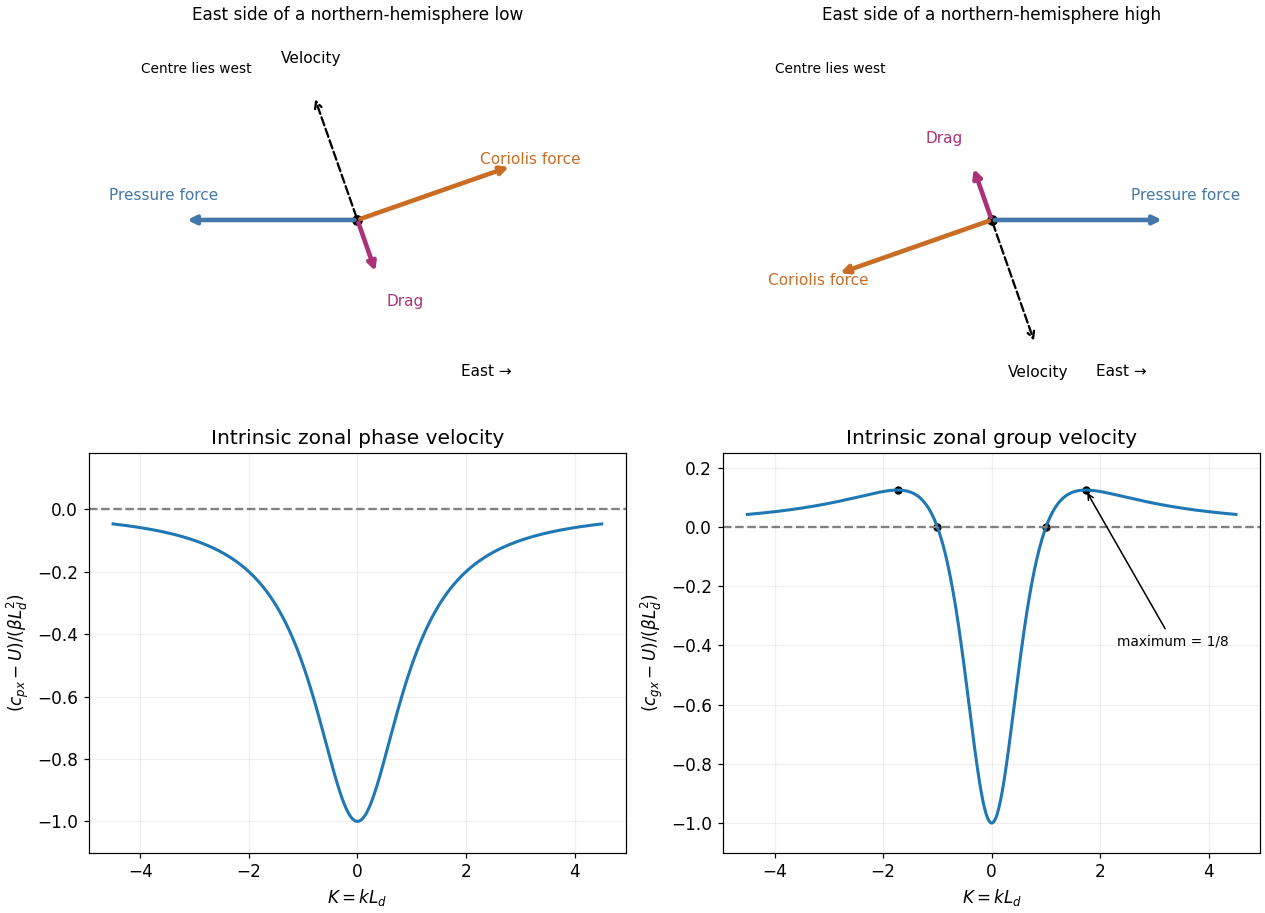
Approximate the surface layer as locally steady with small horizontal advective acceleration. Write and . Since , the drag-modified force balance can be inverted exactly:The geostrophic wind is , so the ageostrophic flow isIts cross-isobar component is , always towards lower pressure, in either hemisphere. Thus the surface wind spirals into a cyclone and out of an anticyclone. In the northern hemisphere, the nearly tangential circulation is counterclockwise around the low and clockwise around the high; those rotations reverse in the southern hemisphere. The original force diagrams below show pressure, drag and Coriolis force closing to zero at the east side of each system.
Surface convergence into a low requires upward motion out of the friction layer by the continuity equation; divergence from a high requires subsidence. In unsaturated adiabatic motion the rising parcel expands and cools, while descending air compresses and warms. The relevant warming or cooling relative to its surroundings depends on the environmental stratification, and latent heating can modify the ascending-air result.
For otherwise unsupported weather systems this is quasi-geostrophic Ekman spin-down: drag dissipates kinetic energy, convergence tends to fill a low and divergence tends to erode a high. In a simple column with upward velocity at its base and negligible vertical velocity aloft, cyclonic vorticity decreases because ; the opposite sign weakens anticyclonic vorticity. Cooling beneath a fixed upper-level pressure also tends to raise the surface pressure through the hydrostatic column, while warming tends to lower it. Real baroclinic development, upper-level mass transport and condensation can sustain or deepen a cyclone despite surface friction, so temperature changes alone do not prove a universal decay rate.

Articles by others on the same topic
There are currently no matching articles.