The first equation expresses horizontal incompressibility. The other two express steady balance of the Coriolis force, a geopotential gradient, linear drag and a prescribed zonal acceleration ; nonlinear advection has been neglected. The parameter is an inverse drag time, so the frictional acceleration is . On the equatorial beta plane, .
Use the streamfunction conventionTake of the meridional momentum equation minus of the zonal one. The mixed geopotential derivatives cancel, andHorizontal incompressibility removes the first term, leavingThe right side is the vertical curl of the imposed acceleration, with units . The left side balances planetary vorticity advection and frictional removal of relative vorticity. The streamfunction has units , since it describes horizontal velocity, rather than depth-integrated volume flux.
Put . With , Sverdrup balance givesAt an impermeable eastern wall, . Continuity impliesEquivalently,satisfies the impermeability condition with the boundary streamfunction set to zero.
At a second wall , this solution has , generally nonzero. A useful integral proof of the obstruction isfor two impermeable walls, whereas the proposed interior gives , which varies with . Friction or another departure from the inviscid model is needed for a return flow that closes the circulation.
Seek , with . The ordinary differential equation isIts constant particular solution and characteristic exponents areBoth are positive; the two homogeneous solutions are and . Their product satisfies . At small ,For the rectangular basin, choose zero streamfunction on its connected impermeable boundary. The factor already gives zero at . Enforcing yields the exact resultwhereThe narrow Stommel boundary layer approximation requiresThen is negligible, and , givingIt is an asymptotic formula: at the remaining mismatch is of order . Expanding the eastern exponential as well gives the familiar leading Sverdrup balance interior plus western correction,Printed inequality. The original PDF explicitly has as well as . The first sign is reversed for the requested small-friction limit. This can also be disproved directly: if and , the printed approximate bracket at the western wall is , while at the eastern wall it is . The latter is of the same order as the retained basin-scale signal, violating the boundary condition at leading order. The exact expression above remains available without imposing the erroneous inequalities.
The streamlines are contours of . Since , the exact streamfunction is negative inside the rectangle and zero on its perimeter. It has one interior minimum, with closed anticlockwise streamlines: a broad northward interior flow returns southward along the west wall; flow is westward near the north edge and eastward near the south edge. The western parts of the streamlines are closely packed because the western boundary current is much faster.
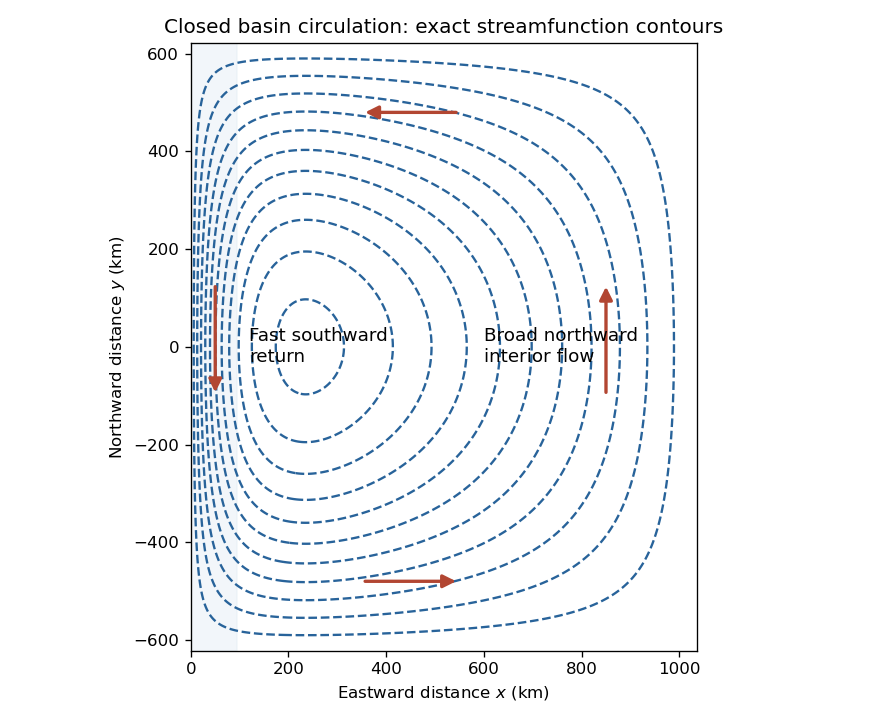

The figure uses the exact ordinary differential equation solution, so it also remains consistent with both wall conditions when the asymptotic scale separation is only moderate. It depicts the stipulated dynamical model, not observed winds or a reconstruction of the source illustration.
Along , differentiating the approximate streamfunction givesin the leading small-friction limit. Hence the velocity is strongly southward at the west wall, crosses zero after a few Stommel boundary layer widths, and approaches a much weaker northward interior value . The leading zero is when .
For plotting or finite-friction evaluation, use the exact derivativeIt increases monotonically from its negative western value to its positive eastern value because . Moreover , as required for a closed basin.
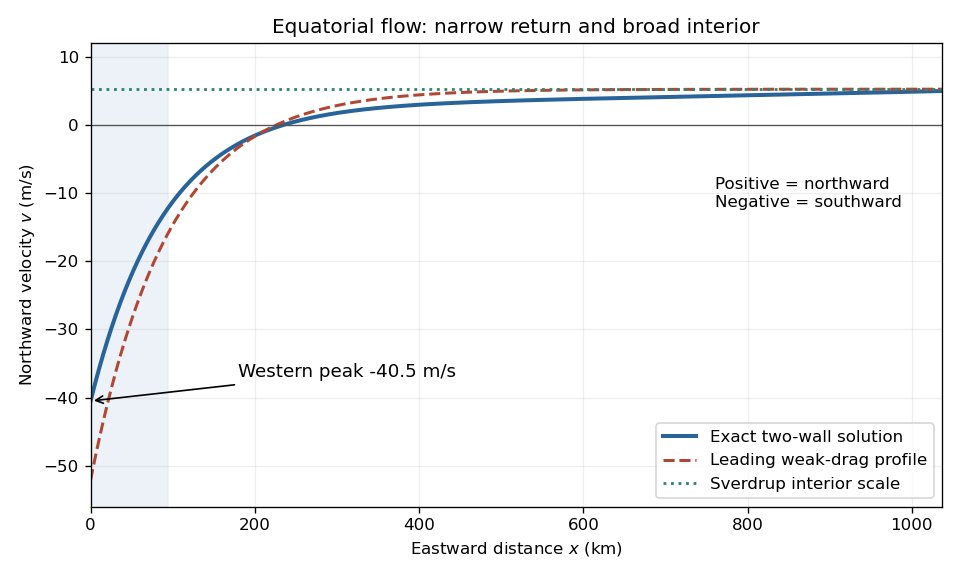
Equatorial northward velocity profile: exact linear-drag solution and leading Stommel boundary layer approximation
. Details. 
Use the positive rotation-rate convention implicit in the northward planetary vorticity gradient. One Pluto day is . At the equator,The width of the western boundary current is thereforeHere is the full meridional scale, and . For these data the exact exponents give , and . The western layer is narrow, but is only marginal. The leading estimates below should therefore be distinguished from evaluation of the exact linear model.
In the open-basin Sverdrup balance approximation,The maximum is at . Evaluating the exact finite-friction solution instead gives its largest northward velocity at the eastern side of the equator, about . Thus the requested scale is roughly northward; the exact model also resolves variation across the open basin.
To return the broad interior transport, the western boundary current has opposite sign and characteristic peakThe leading exponential profile retains the smaller interior offset, . Because is not very small, the exact two-wall solution gives a more accurate linear-model peak:All three evaluations identify an intense southward western boundary current, with peak at , of order tens of metres per second. They are predictions of the stated steady linear barotropic model. Nonlinear advection, stratification and the actual basin geometry could alter them substantially; the calculation does not establish that real Pluto winds attain these values.
Articles by others on the same topic
There are currently no matching articles.