Choose an ocean–continent convergent margin. The essential relationship is recycling of oceanic lithosphere by subduction, together with production and modification of crust in a volcanic arc.
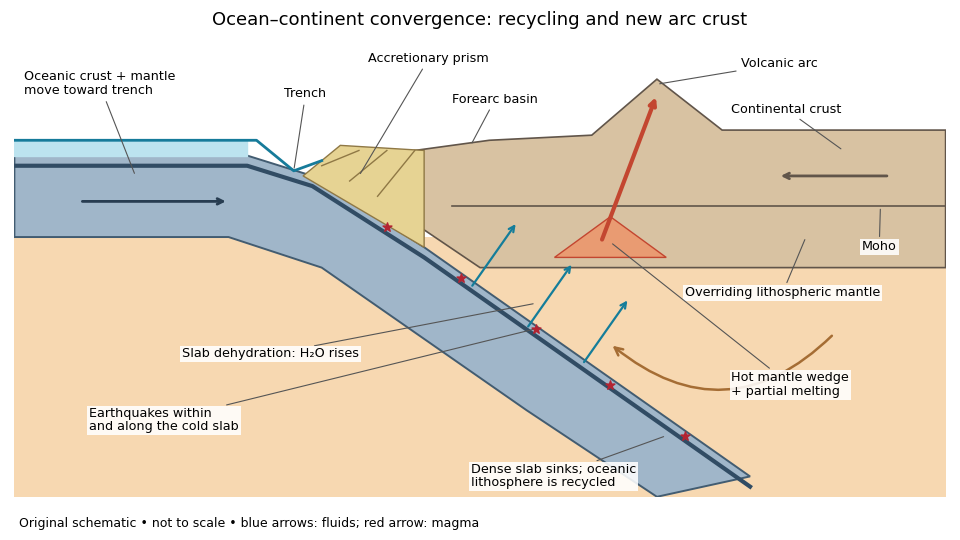
An original ocean–continent subduction cross-section, with slab recycling, fluid release and arc crust production
. Details. 
The incoming tectonic plate consists of thin oceanic crust, chiefly basalt and gabbro, above colder lithospheric mantle. As that oceanic lithosphere approaches the subduction zone, bending produces the subduction trench. Its cold interior can become denser than the surrounding mantle; the resulting slab pull helps sustain subduction. The descending slab carries both oceanic crust and lithospheric mantle into the interior. Thus the recycled unit is an entire portion of lithosphere, rather than just its crust.
At the subduction trench, some incoming sediment is scraped off and stacked by thrust faults into an accretionary prism. Material can also be added beneath the overriding plate by tectonic underplating. A forearc basin collects sediment between the accretionary prism and the volcanic arc. This is an accreting example: other convergent margins lose upper-plate material through tectonic erosion, so an accretionary prism is not universal.
The cold slab undergoes increasing pressure and metamorphism. Conversion of basaltic rocks and gabbro towards eclogite increases their density, while slab dehydration releases water from hydrated minerals. The rising fluid lowers the solidus of hot peridotite in the mantle wedge, causing flux melting. The usual source of arc magma is therefore the fluid-modified mantle wedge; extensive slab melting is not required. Thermal-petrological calculations show that the depth and amount of slab dehydration depend on the incoming slab's thermal structure.[ref]
Buoyant magma rises through the overriding plate, freezes in igneous intrusions or erupts in the volcanic arc. Fractional crystallization, interaction with existing continental crust and repeated intrusion can produce more evolved arc magmas and add new crust. Some material merely reworks old crust, and simultaneous tectonic erosion can remove it: volcanism alone does not measure net continental growth. Tectonic shortening, folding and thrust faults can thicken and raise the upper plate.
The Wadati-Benioff zone marks earthquakes along and within the cold descending slab. Shallow interface earthquakes reflect unstable slip where the plates are coupled; deeper earthquakes require mechanisms such as dehydration embrittlement and are not simply dry shallow friction operating at every depth. In contrast, the hot mantle wedge deforms mainly by material creep. Together, the subduction trench, accretionary prism, forearc basin, volcanic arc and inclined seismicity connect surface features to the processes recycling and creating crust.
Articles by others on the same topic
There are currently no matching articles.