Choose an ocean–continent convergent margin. The essential relationship is recycling of oceanic lithosphere by subduction, together with production and modification of crust in a volcanic arc.
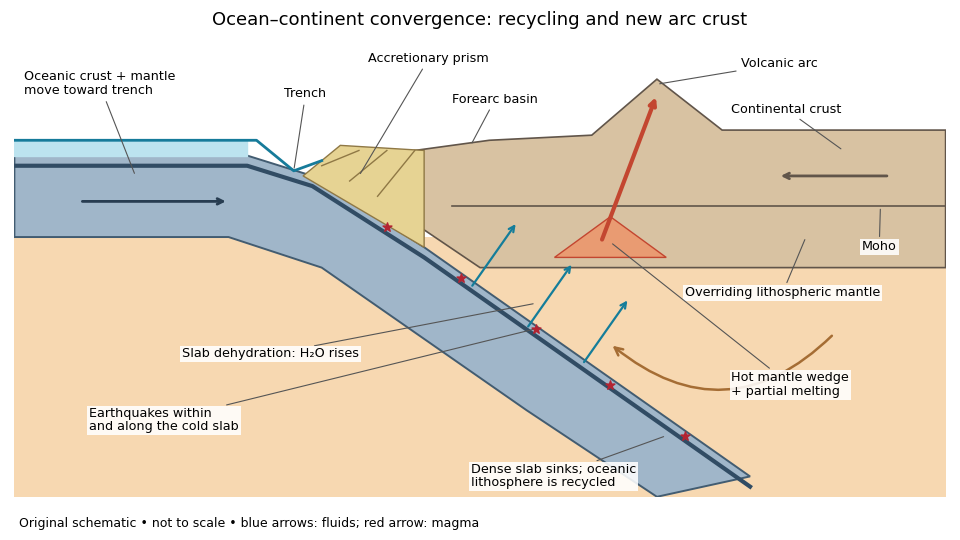
An original ocean–continent subduction cross-section, with slab recycling, fluid release and arc crust production
. Details. 
The incoming tectonic plate consists of thin oceanic crust, chiefly basalt and gabbro, above colder lithospheric mantle. As that oceanic lithosphere approaches the subduction zone, bending produces the subduction trench. Its cold interior can become denser than the surrounding mantle; the resulting slab pull helps sustain subduction. The descending slab carries both oceanic crust and lithospheric mantle into the interior. Thus the recycled unit is an entire portion of lithosphere, rather than just its crust.
At the subduction trench, some incoming sediment is scraped off and stacked by thrust faults into an accretionary prism. Material can also be added beneath the overriding plate by tectonic underplating. A forearc basin collects sediment between the accretionary prism and the volcanic arc. This is an accreting example: other convergent margins lose upper-plate material through tectonic erosion, so an accretionary prism is not universal.
The cold slab undergoes increasing pressure and metamorphism. Conversion of basaltic rocks and gabbro towards eclogite increases their density, while slab dehydration releases water from hydrated minerals. The rising fluid lowers the solidus of hot peridotite in the mantle wedge, causing flux melting. The usual source of arc magma is therefore the fluid-modified mantle wedge; extensive slab melting is not required. Thermal-petrological calculations show that the depth and amount of slab dehydration depend on the incoming slab's thermal structure.[ref]
Buoyant magma rises through the overriding plate, freezes in igneous intrusions or erupts in the volcanic arc. Fractional crystallization, interaction with existing continental crust and repeated intrusion can produce more evolved arc magmas and add new crust. Some material merely reworks old crust, and simultaneous tectonic erosion can remove it: volcanism alone does not measure net continental growth. Tectonic shortening, folding and thrust faults can thicken and raise the upper plate.
The Wadati-Benioff zone marks earthquakes along and within the cold descending slab. Shallow interface earthquakes reflect unstable slip where the plates are coupled; deeper earthquakes require mechanisms such as dehydration embrittlement and are not simply dry shallow friction operating at every depth. In contrast, the hot mantle wedge deforms mainly by material creep. Together, the subduction trench, accretionary prism, forearc basin, volcanic arc and inclined seismicity connect surface features to the processes recycling and creating crust.
Slab pull is generally the largest direct driving contribution for plates attached to substantial cold descending slabs. Cooling makes oceanic lithosphere negatively buoyant; sinking slabs transmit a pulling force to the rest of the tectonic plate. The comparison is a force balance, so the following driving and resisting processes both matter.
- Ridge push is gravitational sliding away from an elevated spreading ridge. Cooling, contraction and deepening of oceanic lithosphere establish the lateral difference in integrated pressure; ridge push is not simply magma squirting sideways into a plate.
- Basal traction on a tectonic plate transfers shear stress between the lithosphere and circulating mantle. It can help or oppose plate motion, depending on their relative velocities. Slab suction is the contribution of slab-induced mantle flow and its associated pressure and traction to nearby plate motion.
- Frictional sliding along faults, shearing along the plate interface, bending of the incoming slab and viscous dissipation in the surrounding mantle resist plate motion. Continental collision introduces additional resistance through buoyancy and deformation of thick continental crust.
- Mantle plumes and continental rifting can locally promote uplift, weakening and separation, but do not provide a universal explanation for all plate motion.
The first two gravitational contributions ultimately belong to the same coupled mantle convection system: the plates are its cold upper thermal boundary layer. They are not passive rafts on a prescribed conveyor belt. A plate with little attached descending slab need not have slab pull as its largest local driver, and a large gross slab pull can be partly consumed by bending and interface resistance. Geological observations and force comparisons nonetheless support the general dominance of slab pull for rapidly moving subducting plates.[ref]
What causes earthquakes? by British Geological Survey. Section explaining mantle circulation, ridge push and slab pull, including the association between subducting plate edges and faster motion.
Repeated assembly and dispersal are supported by mutually consistent paleogeography, paleomagnetism, dated collision belts and subsequent rifted margins. A useful reconstruction must explain both former connections and later separation, at the same geological ages.
For the youngest well-constrained example, Pangaea, matching continental outlines become more compelling when the fit uses the continental edges rather than mobile modern shorelines. More discriminating evidence includes the continuation of mountain belts, sedimentary successions and distinctive basement rocks across now-separated continents. Correlated terrestrial fossil assemblages and the distribution of glacial deposits become geographically coherent when the continents are restored. Each observation alone can have alternatives, but a single reconstruction that satisfies several independent tests is much harder to explain by coincidence.
For older examples, the most useful surviving record lies within the cratons and their margins. Dated suture zones, ophiolites, metamorphic belts and pressure-temperature-time paths document former ocean closure and continental collision. Restoring now-separated belts to continuity tests an assembly. Subsequent continental rifting, matching dike swarms, large igneous provinces and the transition to passive margins test its breakup. Uranium-lead dating of zircon, including detrital zircon populations and sedimentary provenance, helps establish whether the proposed connections existed at the same time.
Paleomagnetism supplies an independent quantitative test. A primary remanent magnetization constrains ancient latitude and orientation. After a proposed relative rotation brings two blocks together, compatible apparent polar wander paths over an interval support their travelling together; divergence of those paths can document separation. Radiometric dating, a paleomagnetic fold test and a paleomagnetic reversal test help identify primary records and distinguish them from remagnetization. There remain important ambiguities: conventional paleomagnetism does not fix absolute longitude, and sparse ages, later deformation and true polar wander complicate a reconstruction.
The broad succession is Columbia or Nuna, assembled mainly around 1.9–1.6 billion years ago; Rodinia, assembled mainly around 1.1–0.9 billion years ago and dispersed in stages during the later Proterozoic; and Pangaea, assembled by roughly 300 million years ago and breaking apart from roughly 200 million years ago. These are broad intervals rather than synchronous global events. A quantitative Nuna reconstruction combines paleomagnetism with the histories of continental margins rather than relying only on matching rock ages.[ref]
Assembly and breakup of the core of Paleoproterozoic-Mesoproterozoic supercontinent Nuna by David A. D. Evans and Ross N. Mitchell. pp. 443–446, reconstruction of the Nuna core and tests using paleomagnetic and tectonostratigraphic records.
Repeated global peaks in dated magmatism and metamorphism offer supporting evidence, but cannot prove a supercontinent cycle by themselves: erosion, burial and preferential preservation also change the observed age distribution. The persuasive case is the recurrence of dated assembly–breakup sequences in different continental configurations, with stronger geometric constraints for Pangaea than for the older supercontinents. A Wilson cycle describes an individual ocean's opening and closure; a supercontinent cycle concerns the much larger-scale continental assembly and dispersal.
Articles by others on the same topic
There are currently no matching articles.