Worked solutions to the ten marked parts of the plate tectonics paper in the Plate tectonics course of the University of Oxford, third-year examination, 25 May 2023. The examination required candidates to choose two questions; all three are treated here. Source release: Papers.zip, member
Papers/Plate Techonics/FOI-202604-431 - Paper 8 2023.pdf, printed code A17843W1, three pages. Question wording is not reproduced.Choose an ocean–continent convergent margin. The essential relationship is recycling of oceanic lithosphere by subduction, together with production and modification of crust in a volcanic arc.
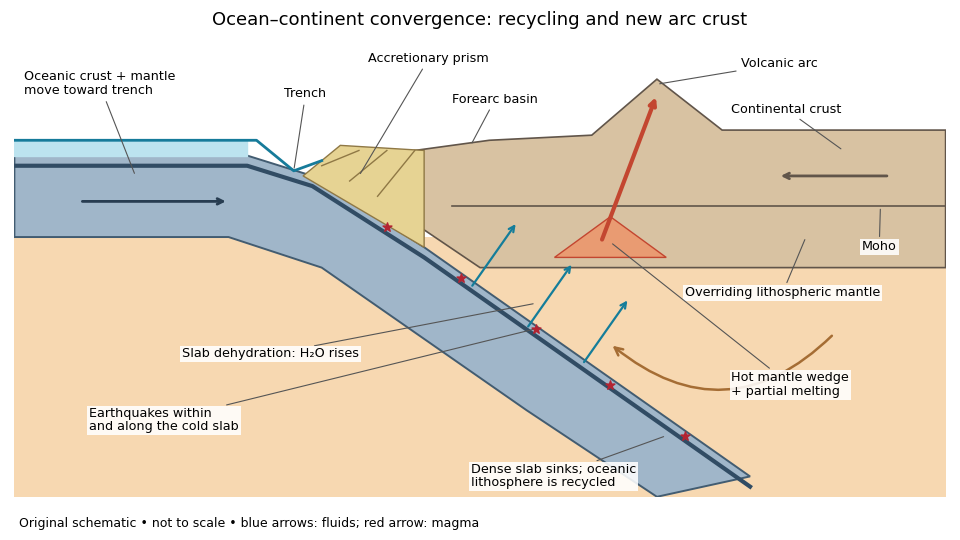
An original ocean–continent subduction cross-section, with slab recycling, fluid release and arc crust production
. Details. 
The incoming tectonic plate consists of thin oceanic crust, chiefly basalt and gabbro, above colder lithospheric mantle. As that oceanic lithosphere approaches the subduction zone, bending produces the subduction trench. Its cold interior can become denser than the surrounding mantle; the resulting slab pull helps sustain subduction. The descending slab carries both oceanic crust and lithospheric mantle into the interior. Thus the recycled unit is an entire portion of lithosphere, rather than just its crust.
At the subduction trench, some incoming sediment is scraped off and stacked by thrust faults into an accretionary prism. Material can also be added beneath the overriding plate by tectonic underplating. A forearc basin collects sediment between the accretionary prism and the volcanic arc. This is an accreting example: other convergent margins lose upper-plate material through tectonic erosion, so an accretionary prism is not universal.
The cold slab undergoes increasing pressure and metamorphism. Conversion of basaltic rocks and gabbro towards eclogite increases their density, while slab dehydration releases water from hydrated minerals. The rising fluid lowers the solidus of hot peridotite in the mantle wedge, causing flux melting. The usual source of arc magma is therefore the fluid-modified mantle wedge; extensive slab melting is not required. Thermal-petrological calculations show that the depth and amount of slab dehydration depend on the incoming slab's thermal structure.[ref]
Buoyant magma rises through the overriding plate, freezes in igneous intrusions or erupts in the volcanic arc. Fractional crystallization, interaction with existing continental crust and repeated intrusion can produce more evolved arc magmas and add new crust. Some material merely reworks old crust, and simultaneous tectonic erosion can remove it: volcanism alone does not measure net continental growth. Tectonic shortening, folding and thrust faults can thicken and raise the upper plate.
The Wadati-Benioff zone marks earthquakes along and within the cold descending slab. Shallow interface earthquakes reflect unstable slip where the plates are coupled; deeper earthquakes require mechanisms such as dehydration embrittlement and are not simply dry shallow friction operating at every depth. In contrast, the hot mantle wedge deforms mainly by material creep. Together, the subduction trench, accretionary prism, forearc basin, volcanic arc and inclined seismicity connect surface features to the processes recycling and creating crust.
Slab pull is generally the largest direct driving contribution for plates attached to substantial cold descending slabs. Cooling makes oceanic lithosphere negatively buoyant; sinking slabs transmit a pulling force to the rest of the tectonic plate. The comparison is a force balance, so the following driving and resisting processes both matter.
- Ridge push is gravitational sliding away from an elevated spreading ridge. Cooling, contraction and deepening of oceanic lithosphere establish the lateral difference in integrated pressure; ridge push is not simply magma squirting sideways into a plate.
- Basal traction on a tectonic plate transfers shear stress between the lithosphere and circulating mantle. It can help or oppose plate motion, depending on their relative velocities. Slab suction is the contribution of slab-induced mantle flow and its associated pressure and traction to nearby plate motion.
- Frictional sliding along faults, shearing along the plate interface, bending of the incoming slab and viscous dissipation in the surrounding mantle resist plate motion. Continental collision introduces additional resistance through buoyancy and deformation of thick continental crust.
- Mantle plumes and continental rifting can locally promote uplift, weakening and separation, but do not provide a universal explanation for all plate motion.
The first two gravitational contributions ultimately belong to the same coupled mantle convection system: the plates are its cold upper thermal boundary layer. They are not passive rafts on a prescribed conveyor belt. A plate with little attached descending slab need not have slab pull as its largest local driver, and a large gross slab pull can be partly consumed by bending and interface resistance. Geological observations and force comparisons nonetheless support the general dominance of slab pull for rapidly moving subducting plates.[ref]
What causes earthquakes? by British Geological Survey. Section explaining mantle circulation, ridge push and slab pull, including the association between subducting plate edges and faster motion.
Repeated assembly and dispersal are supported by mutually consistent paleogeography, paleomagnetism, dated collision belts and subsequent rifted margins. A useful reconstruction must explain both former connections and later separation, at the same geological ages.
For the youngest well-constrained example, Pangaea, matching continental outlines become more compelling when the fit uses the continental edges rather than mobile modern shorelines. More discriminating evidence includes the continuation of mountain belts, sedimentary successions and distinctive basement rocks across now-separated continents. Correlated terrestrial fossil assemblages and the distribution of glacial deposits become geographically coherent when the continents are restored. Each observation alone can have alternatives, but a single reconstruction that satisfies several independent tests is much harder to explain by coincidence.
For older examples, the most useful surviving record lies within the cratons and their margins. Dated suture zones, ophiolites, metamorphic belts and pressure-temperature-time paths document former ocean closure and continental collision. Restoring now-separated belts to continuity tests an assembly. Subsequent continental rifting, matching dike swarms, large igneous provinces and the transition to passive margins test its breakup. Uranium-lead dating of zircon, including detrital zircon populations and sedimentary provenance, helps establish whether the proposed connections existed at the same time.
Paleomagnetism supplies an independent quantitative test. A primary remanent magnetization constrains ancient latitude and orientation. After a proposed relative rotation brings two blocks together, compatible apparent polar wander paths over an interval support their travelling together; divergence of those paths can document separation. Radiometric dating, a paleomagnetic fold test and a paleomagnetic reversal test help identify primary records and distinguish them from remagnetization. There remain important ambiguities: conventional paleomagnetism does not fix absolute longitude, and sparse ages, later deformation and true polar wander complicate a reconstruction.
The broad succession is Columbia or Nuna, assembled mainly around 1.9–1.6 billion years ago; Rodinia, assembled mainly around 1.1–0.9 billion years ago and dispersed in stages during the later Proterozoic; and Pangaea, assembled by roughly 300 million years ago and breaking apart from roughly 200 million years ago. These are broad intervals rather than synchronous global events. A quantitative Nuna reconstruction combines paleomagnetism with the histories of continental margins rather than relying only on matching rock ages.[ref]
Assembly and breakup of the core of Paleoproterozoic-Mesoproterozoic supercontinent Nuna by David A. D. Evans and Ross N. Mitchell. pp. 443–446, reconstruction of the Nuna core and tests using paleomagnetic and tectonostratigraphic records.
Repeated global peaks in dated magmatism and metamorphism offer supporting evidence, but cannot prove a supercontinent cycle by themselves: erosion, burial and preferential preservation also change the observed age distribution. The persuasive case is the recurrence of dated assembly–breakup sequences in different continental configurations, with stronger geometric constraints for Pangaea than for the older supercontinents. A Wilson cycle describes an individual ocean's opening and closure; a supercontinent cycle concerns the much larger-scale continental assembly and dispersal.
Plate tectonics changes the environments in which natural selection, gene flow and extinction operate. It influences both the persistence of habitable conditions and the geographical and chemical opportunities for evolution. It does not prescribe a unique sequence of biological innovations.
Separation of continents by continental rifting divides populations and reduces gene flow, promoting allopatric speciation. Continental collision or newly exposed land connections can reunite populations, permit dispersal and introduce competitors or predators. These mechanisms connect biogeography to continental configuration. Changing the amount and fragmentation of shallow continental shelf habitat can also change the opportunities for diversification of marine organisms.
Over long intervals, volcanic outgassing, silicate weathering, carbonate burial and subduction exchange carbon among the interior, atmosphere and ocean. In a suitable regime, warmer, wetter conditions increase silicate weathering, remove atmospheric carbon dioxide and weaken the greenhouse effect. This negative feedback can support long-lived habitability, though it depends on exposed fresh rock, available water and reaction rates.[ref]
A negative feedback mechanism for the long-term stabilization of Earth's surface temperature by James C. G. Walker and others. Weathering–carbon dioxide–temperature coupling in the proposed long-term stabilization mechanism.
Mountain building changes precipitation, erosion and delivery of nutrients to the ocean, affecting primary production and organic carbon burial.The opening and closure of ocean gateways changes ocean circulation, transport of heat and the supply of oxygen to deep water. Together with movement of land through different latitudes and changes in sea level, this reorganizes climate and habitat. Enhanced organic carbon burial can change atmospheric oxygen over long intervals, while a poorly ventilated ocean can develop ocean anoxia. Such chemical changes alter which forms of metabolism are viable.
Hydrothermal circulation at spreading ridges and through fractured rock supplies chemical disequilibrium and mineral surfaces. For example, serpentinization can produce hydrogen usable by chemolithotrophy when suitable electron acceptors are available. This supplies a possible setting for abiogenesis and early ecosystems; it does not establish that life originated there.
There can also be abrupt disruption. Rapid emplacement of a large igneous province can change climate through gas release; sulfur-bearing aerosols can initially cool, whereas sustained carbon dioxide release can warm and contribute to ocean acidification and ocean anoxia. Such perturbations can contribute to mass extinction, followed by adaptive radiation among survivors. The Deccan Traps exemplify the scale of volcanism involved, but their association with the Cretaceous–Palaeogene boundary does not justify attributing the entire biological crisis to volcanism alone. Both gradual environmental reorganization and rare rapid perturbations belong in the explanation.
Interpret habitability as the ability to sustain life with broadly terrestrial biochemistry. Accessible liquid water, usable free energy, suitable chemical ingredients and sufficiently persistent conditions are the central requirements. Earth-like geography, a breathable atmosphere and actual habitation are not part of that definition.
A viable local physical environment. The relevant temperature and pressure must permit liquid water where the organisms live. For a surface habitat this normally requires an appropriate atmosphere and surface temperature; the roughly 6.1 millibar triple-point pressure of pure water is a minimum phase constraint, not a guarantee of a temperate surface. High salinity, extreme acidity and low water activity can make apparently wet environments unsuitable for known life. A subsurface ocean beneath ice can provide liquid conditions even when the surface is frozen, so the entire body need not lie in the conventional surface-water habitable zone.
A suitable orbit and rotation. For a surface-water planet, orbital distance must give an absorbed radiation budget compatible with liquid conditions after the body's Bond albedo, atmosphere and greenhouse effect are included. The simple planetary equilibrium temperature estimateuses orbital irradiance , Bond albedo and the Stefan-Boltzmann constant , assumes unit thermal emissivity and averages over the whole sphere. It is not a prediction of surface temperature beneath a atmosphere with a greenhouse effect. Excessive absorbed energy risks a runaway greenhouse; inadequate surface heating can freeze surface water, although heat from the interior or tidal heating can maintain a subsurface habitat.
The orbit must persist without collision or ejection for a biologically useful interval. Large orbital eccentricity can produce extreme variations in heating, but neither exactly circular motion nor Earth's particular obliquity is essential. Rotation period and obliquity govern illumination and seasons; atmospheric and ocean heat flux determine how severe those variations become. Tidal locking does not automatically make a body uninhabitable, because sufficient heat transport can moderate the day–night contrast. A natural satellite also needs a stable orbit around its primary and a tolerable combination of irradiation and tidal heating: enough heating may maintain an ocean, whereas excessive heating can make the environment hostile. These are constraints on the body's location and path, without requiring a particular kind of surrounding planetary system.
An adequate chemical inventory and access to it. Known life uses carbon, hydrogen, nitrogen, oxygen, phosphorus and sulfur, together with catalytic trace elements. A rocky planet supplies mineral surfaces and reservoirs, but total inventory is not enough: chemical weathering, water-rock interaction or other transport must make nutrients accessible. A water-rich body with an ocean isolated from its rocky interior by a thick high-pressure ice layer could have difficulty recycling some nutrients; this is a possible limitation, not proof of sterility.
A usable energy supply. Photosynthesis can exploit light in an illuminated habitat. A dark subsurface habitat instead needs sustained chemical disequilibrium, for example oxidized and reduced species brought together by water-rock interaction, hydrothermal circulation or radiolysis. Warm water at complete chemical equilibrium is not, by itself, an energy supply for sustained metabolism.
Retention, protection and longevity. The body's mass, radius, surface gravity and thermal history affect retention of water and an atmosphere. Escape velocity must be considered together with gas temperature, molecular mass, atmospheric escape and replenishment: there is no universal Earth-mass threshold. An atmosphere, ice or rock overburden can protect life from damaging ionizing radiation and short-wavelength light. An intrinsic planetary magnetic field can modify charged-particle exposure and escape, but it is neither a universal requirement nor a guarantee of retention.
Finally, conditions must last long enough. Stored formation heat, radiogenic heating and possibly tidal heating can maintain circulation and chemical exchange. Plate tectonics can recycle materials and support a carbonate-silicate cycle, but it is not established as a necessary condition for every habitable body: conditional long-term carbon cycling is possible on a stagnant-lid planet as well.[ref]
Carbon Cycling and Habitability of Earth-Sized Stagnant Lid Planets by Bradford J. Foley and Andrew J. Smye. Abstract and coupled thermal/carbon-cycle model; habitability is conditional on degassing, weathering and interior evolution.
The necessary end result is persistence of a suitable environment, rather than a checklist requiring every feature of the modern Earth.Prioritize accessible ancient lacustrine deposits at a preserved river delta, especially fine-grained, clay mineral-bearing mudstones, with nearby evidence of groundwater or hydrothermal circulation. The target should combine past habitability, good biosignature preservation and practical access to minimally altered rock.
An inlet valley, a river delta and a stratified basin together can establish a connected fluvial–lake paleoenvironment on Mars. A long-lived lake offers liquid water, chemical transport and a sustained habitat, while a river delta concentrates material from a larger catchment. Distal mudstone is particularly attractive: fine particles can adsorb organic molecules, burial reduces exposure, and quiet deposition can preserve small-scale structures. Rover observations have independently established ancient lake and river delta settings on Mars, so this is a geological search strategy grounded in observed environments.[ref]
A Habitable Fluvio-Lacustrine Environment at Yellowknife Bay, Gale Crater, Mars by John P. Grotzinger and others. Abstract: a fluvio-lacustrine sedimentary environment with inferred chemical conditions suitable for microbial life.
[ref]Perseverance rover reveals an ancient delta-lake system and flood deposits at Jezero crater, Mars by Nicolas Mangold and others. Abstract: delta-lake deposition followed by later high-energy flooding.
A second high-value setting is an ancient hydrothermal deposit, particularly silica-rich precipitates, spring terraces or mineralized groundwater fractures near a heat source. Such environments combine water-rock interaction, chemical disequilibrium and the possibility of rapid mineral entombment. Distal, moderate-temperature parts of a hydrothermal circulation system are preferable to strongly reheated zones where organic molecules would be destroyed. Orbital observations identify candidate ancient hydrothermal deposits on Mars, although their geological interpretation requires testing on the ground.[ref]
Ancient hydrothermal seafloor deposits in Eridania basin on Mars by Joseph R. Michalski and others. Abstract and inferred deep-water hydrothermal setting; evidence for an environment rather than evidence of life.
Carbonate-bearing sedimentary deposits can also preserve textures and chemical records of former water, but precipitation of carbonate alone is not a biosignature.Choose ancient deposits with good stratigraphy, limited later metamorphism and relatively recent exposure by erosion, or sample beneath the irradiated surface. Present exposed organic molecules can be destroyed by cosmic rays, radiolysis and oxidizing surface chemistry, so a drill, fresh scarp or recently excavated material improves the preservation prospects. Laboratory irradiation experiments on Martian analogue materials demonstrate why shallow ancient surface exposure can erase an organic record.[ref]
NASA Experiment Suggests Need to Dig Deep for Evidence of Life on Mars by National Aeronautics and Space Administration. 27 June 2022, experiments on radiation-driven destruction of amino acids and implications for subsurface sampling.
At the site, relate every sample to its sedimentary facies and mineral context. Seek several independent, spatially associated biosignatures: plausible microscopic structures, distinctive organic molecules, and isotope fractionation consistent with a biological process. Each has nonbiological alternatives, so test water-rock interaction, mineral self-organization and contamination before inferring life. Include control samples from adjacent unpromising rocks and track terrestrial contamination. A safe landing ellipse with traversable exposures of several related sedimentary facies is more useful than a spectacular but inaccessible single outcrop. The desired outcome is contextual evidence that can distinguish former life from merely former habitability.
Use a rock strength envelope: at each depth plot the smaller differential stress needed for frictional failure and for sustained ductile material creep at a specified strain rate. Shallow rock generally strengthens with depth because effective confining pressure increases; sufficiently deep hot rock weakens because thermally activated material creep becomes efficient.
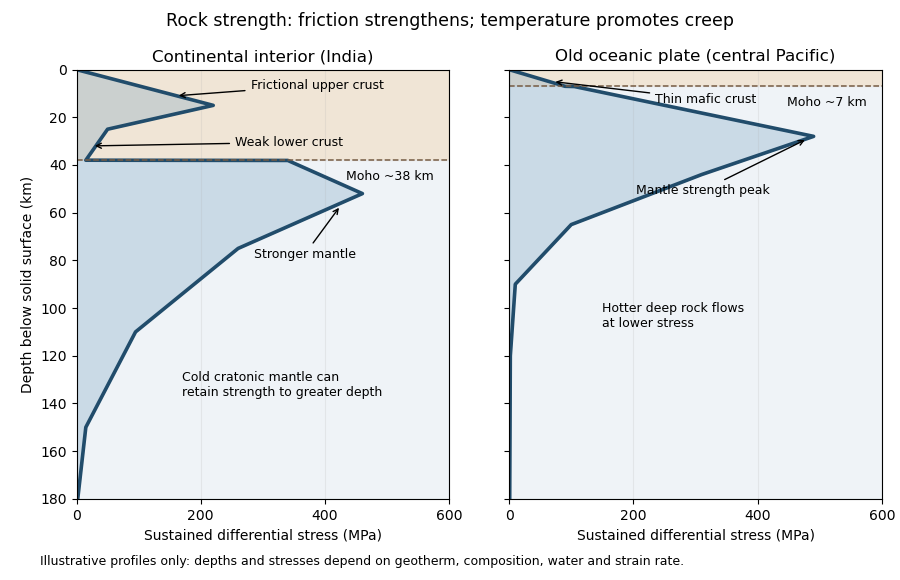
Illustrative rock-strength envelopes for a continental interior and an old central-Pacific plate; these are conceptual profiles, not measurements
. Details. 
At shallow depth, Byerlee's law or a Mohr-Coulomb failure criterion gives a relation of the formwhere is cohesion, a coefficient of friction, the compressive normal stress and the pore pressure. Increasing overburden generally increases effective stress, hence the frictional strength. Conversion from fault shear stress to differential stress depends on the stress regime and fault orientation; a sketch should not label a universal numerical slope. High pore pressure or weak fault gouge can lower the frictional strength substantially.
A simplified dislocation creep relation isHere is activation energy, activation volume, the molar gas constant and absolute temperature; and depend on composition and deformation mechanism. At fixed strain rate, increasing temperature usually decreases the required stress strongly. The competing effects of pressure, water weakening of rocks, grain size and composition also matter. The intersection with frictional failure gives a brittle-ductile transition, not a change from solid to liquid.
For the Indian continental interior, a useful first sketch has an upper-crustal strength peak, a weaker lower continental crust, and renewed strength in lithospheric mantle beneath the Moho. Quartz-bearing rocks can undergo ductile material creep at conditions where colder, drier olivine-rich mantle retains appreciable strength. This creates a possible two-peak, or “jelly sandwich”, rock strength envelope. With further depth the mantle also weakens. A cold craton can retain strong lithospheric mantle to much greater depths than a tectonically heated continental region.
For the central Pacific, show thin mafic oceanic crust above a relatively thick layer of strong lithospheric mantle. There need not be a conspicuous weak lower-crustal layer. Much of the integrated strength can reside below the Moho, with a broad strength peak followed by ductile weakening towards the asthenosphere. Cooling and age control the thickness: young hot oceanic lithosphere would give a much shallower and weaker profile than an old central-Pacific plate.
The plotted Moho depths of about 38 km and 7 km, and all plotted stresses, are illustrative assumptions. “India” alone does not specify a unique geothermal gradient, water content or strain rate, and the Pacific includes plates of different ages. The robust comparison is the possible crust–mantle layering in a continent versus the thin oceanic crust and mantle-dominated strength of an old oceanic plate. The Moho is a compositional boundary; neither it nor the deepest small plotted strength is automatically the seismic lithosphere-asthenosphere boundary.
The volume alone does not determine a unique change of elevation. A local isostatic response to an added surface layer depends on its thickness and density, so the Deccan Traps' footprint must be specified or retained as a parameter.
Let the deposited basalt have uniform thickness and density , where and is the loaded area. Let be downward displacement of the original land surface, and let be the density of displaced mantle. Assume a subaerial, laterally extensive deposit, negligible air density, unchanged thickness and density of the pre-existing crust, and complete local isostatic adjustment. Take the magma supply to be external to the local compensation column, and neglect cooling, erosion, magmatic underplating and any deep thermal or source-depletion anomaly.
Choose a compensation depth beneath all the displaced interfaces. The added column mass per unit area is . Downward translation of the pre-existing crust replaces a thickness of mantle within the column, reducing its mass by . Equality of hydrostatic pressure at the compensation depth therefore givesThe newly formed top of the basalt stands above the depressed original surface. Consequently the change of the region's top-surface elevation isThus the original substrate subsides, but the top of the deposit rises if . Distinguishing these two surfaces prevents reporting the large downward displacement as the change in plateau elevation.
For an explicitly illustrative choice , and , the deposit is 1000 m thick, the substrate subsides about 879 m, and the final surface rises about 121 m. This is a conditional estimate, not a number fixed by the paper. Half that footprint would double all three heights under the same assumptions. For a nonuniform deposit, local isostasy gives the same relation pointwise with ; the total volume still cannot specify a unique local elevation.
Elasticity lets the lithosphere share a load with neighbouring regions through lithospheric flexure. Beneath the centre of a localized load, subsidence is generally smaller than the local isostasy estimate, so the deposited surface stands higher. The surrounding plate also bends down, and a more distant flexural forebulge may rise. The extra support is regional bending resistance, rather than removal of the load's mass.
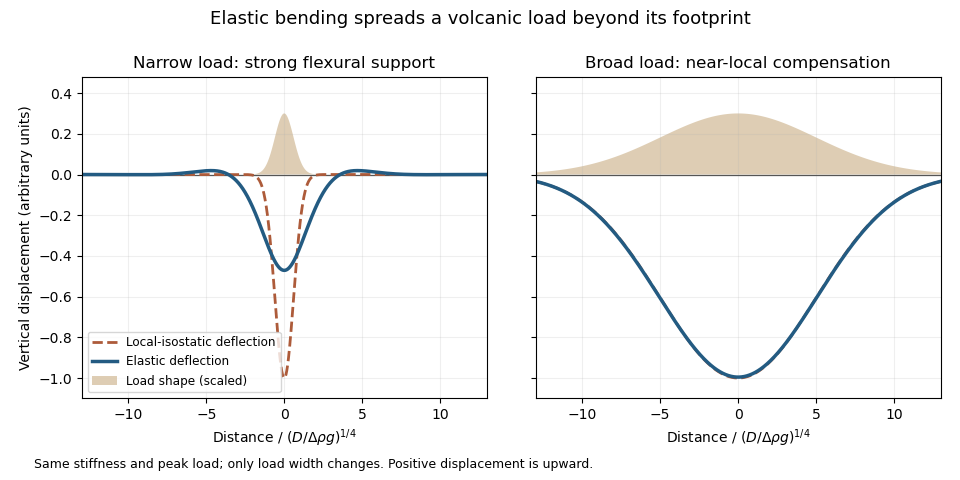
An original elastic-plate calculation contrasting narrow and broad loads at the same flexural rigidity; a broad load approaches local isostasy
. Details. 
The controlling comparison is load width against the lithosphere's flexural length, which increases with flexural rigidity and decreases with the relevant buoyant geophysical density contrast. Equivalently, the flexural support ratio becomes large for short-wavelength loading. A very broad nearly uniform load produces little curvature in its interior, so even a strong elastic lithosphere has a nearly local isostatic adjustment there. Bending matters most near its edges. A narrow load requires more curvature and can be supported appreciably by the surrounding elastic lithosphere.
The Deccan Traps form a broad continental large igneous province. The volcanic edifices of the Hawaiian Islands are more localized loads on an old oceanic lithosphere, for which regional bending and a flexural moat are prominent. Under the usual broad-Deccan versus narrow-Hawaiian-load comparison, elastic strength matters more for the Hawaiian Islands. The more coherent mantle-dominated strength of an old oceanic plate can reinforce this contrast. It cannot be deduced simply from “oceanic” versus “continental”: a cold Indian craton can be strong, and a site's effective elastic thickness depends on its thermal and loading history.
For an initially submerged Hawaiian load, replacing seawater changes both the load and buoyant restoring contrast. At fixed deposited thickness, the added load relative to the initial water column uses the rock-minus-water density, and the restoring term uses the mantle-minus-water density. An emerged island requires separate treatment of its subaerial and submerged portions. These corrections change the local isostasy reference but do not remove the importance of load width for lithospheric flexure. The broad Hawaiian swell should also be distinguished from the narrower volcanic load: deeper thermal or dynamic support of the Hawaiian swell is not the same mechanism as elastic support of the volcanic ridge.
Finally, over long periods material creep, yielding and thermal modification can reduce elastic support. Without measured load geometries, ages and effective elastic thicknesses, the ranking is a justified qualitative expectation rather than a theorem valid for every continental and oceanic load.
The asthenosphere exists because the mantle's ability to deform is strongly dependent on temperature, pressure, composition, water and deformation mechanism. Cooling from the surface creates a strong lithosphere. Beneath it, hotter mantle deforms by material creep at much lower stress on geological timescales. The asthenosphere is predominantly solid weak rock, not a global ocean of magma. On the much shorter timescale of a seismic wave, it still supports S waves.
The hot shallow mantle can be close to its solidus. Water weakening of rocks and, in some settings, a small connected melt fraction can further lower effective viscosity. At greater depths, changes in pressure, homologous temperature, mineral structure and water storage modify the deformation laws; increasing depth does not imply indefinitely decreasing viscosity. Explaining a weak upper-mantle interval does not require every location to contain the same amount of melt.
There are several physically distinct boundaries to test. The thermal lithosphere-asthenosphere boundary describes a thermal transition, the mechanical boundary a contrast in long-term strength or viscosity, and the seismic lithosphere-asthenosphere boundary a change in seismic velocity or other wave properties. They need not have identical depths. A smooth geothermal gradient can explain broad thermal weakening, but a very sharp decrease of seismic velocity may require changes in melt fraction, hydration, composition or seismic anisotropy. A sharp shallow reflector within a craton might instead be an internal lithospheric boundary.[ref]
A global view of the lithosphere-asthenosphere boundary by Catherine A. Rychert and Peter M. Shearer. Abstract and pp. 495–498: converted-wave sharpness and the possibility that the imaged cratonic discontinuity lies within thicker lithosphere.
Begin with a thermal null model. A half-space cooling model givesIf a thermal boundary corresponds to a fixed temperature , its depth isso it deepens as the square root of plate age. Test that prediction against independently determined seafloor ages, bathymetry and heat flux. An oceanic plate cooling model adds finite thickness and basal heat supply, allowing the old-age depth to approach a finite value. For continents, include radiogenic heating, crustal thickness, the history of continental rifting or tectonic thickening, and advective heating by magma or mantle flow. A cold, dry craton and a recently extended volcanic region should not share the same thermal profile.
Then calculate the observable consequences of competing mechanisms rather than merely assigning a boundary to a map:
- Use receiver functions from both P-to-S conversion and S-to-P conversion to constrain the depth and sharpness of a negative seismic velocity contrast. Check for crustal reverberations and whether the result changes with incident direction or frequency. Combine these with Rayleigh waves, Love waves and seismic tomography to constrain the broader shear-wave velocity profile.
- Measure seismic attenuation and seismic anisotropy. Elevated temperature, small amounts of melt and aligned minerals can all affect apparent seismic velocity, but predict different attenuation, polarization and directional patterns. Convert laboratory elastic and anelastic measurements into synthetic seismic observations at the relevant frequencies.
- Obtain magnetotelluric sounding constraints on electrical conductivity, together with surface heat flux. Connected melt or hydrated material can enhance electrical conductivity, but the interpretation depends on composition and connectivity. Joint thermal, seismic and electrical modelling is more discriminating than any single proxy.
- Use mantle xenoliths and erupted magmas to constrain pressure, temperature, water content, melt depletion and composition, recognizing that transport can alter a sample. Relate these observations to geodynamic modelling of mantle convection, slab flow, mantle plumes and lithospheric rejuvenation.
Compare models against the observed boundary depth and its sharpness, including uncertainty and resolution. An age–depth trend with matching heat flux favours thermal control; a sharp discontinuity that fails the thermal prediction but coincides with an electrical anomaly can support a melt- or hydration-related transition. Neither observation alone proves a unique cause. The spatially varying boundary is best understood as the result of thermal evolution interacting with composition, fluids and deformation history.
Articles by others on the same topic
There are currently no matching articles.