The answer isIt holds initially by construction. If it holds at step , then is a function of , so it is independent of the fresh inputs . Part (a)(iii) therefore gives . This completes the mathematical induction and identifies the stationary distribution of the recursion.
The two recursions use a synchronous coupling: they receive exactly the same fresh inputs. Subtraction cancels the additive term:The variable is independent of the preceding difference and has expected value . Thus expectation of a product of independent random variables givesBy Markov's inequality, for every ,This proves the requested convergence in probability; in fact the difference has L1 convergence. It is synchronous contraction of a random affine recursion, and the estimate holds for every real .
Every has the same exponential distribution, so for . Part (ii) gives . Applying Slutsky's theorem to yieldsThe limiting probability distribution does not depend on . This is precisely the attraction to the exponential invariant law of a random affine recursion.
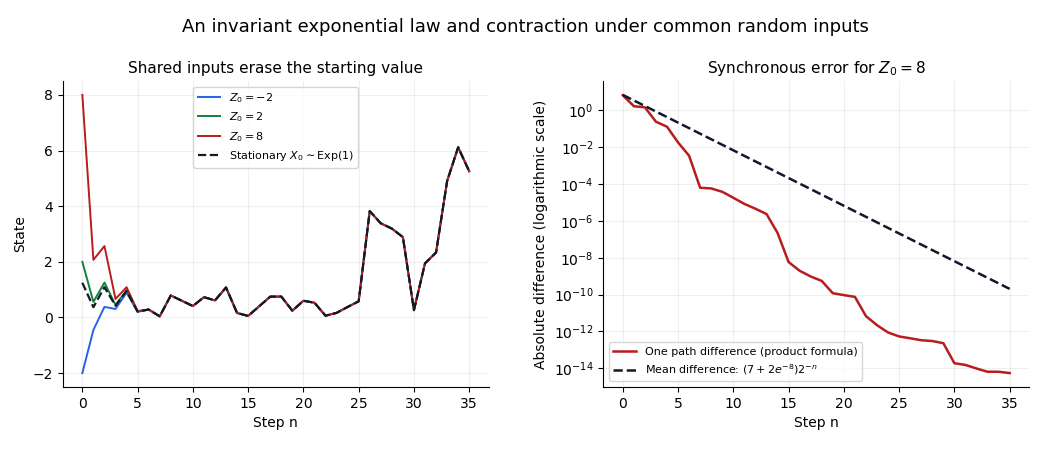
Common random inputs make different initial values approach the same stationary trajectory
. Original simulations of the affine recursion with shared inputs. The right panel compares an exactly propagated path difference with its unconditional expected value; the geometric expectation estimate, rather than the simulation, proves convergence. Details.
Articles by others on the same topic
There are currently no matching articles.