By independence of random variables, the joint probability density is the product of the two probability density functions of the rate-one exponential distributions:Its values on the boundary are immaterial, because the boundary has zero area.
Use the inverse change of variables for probability densitiesIts absolute Jacobian determinant isThereforeSince , its marginal densities are and . The joint density factorizes as , so and are independent random variables, with uniform on and in the shape-rate convention. This is beta-gamma independence with both shape parameters equal to one.
Put . The independent pair has the same joint distribution as from part (ii), because both first coordinates are uniform and independent of the same sum law. HenceConsequentlyThe rate is one. This multiplication identity is the mechanism behind the exponential invariant law of a random affine recursion.
The answer isIt holds initially by construction. If it holds at step , then is a function of , so it is independent of the fresh inputs . Part (a)(iii) therefore gives . This completes the mathematical induction and identifies the stationary distribution of the recursion.
The two recursions use a synchronous coupling: they receive exactly the same fresh inputs. Subtraction cancels the additive term:The variable is independent of the preceding difference and has expected value . Thus expectation of a product of independent random variables givesBy Markov's inequality, for every ,This proves the requested convergence in probability; in fact the difference has L1 convergence. It is synchronous contraction of a random affine recursion, and the estimate holds for every real .
Every has the same exponential distribution, so for . Part (ii) gives . Applying Slutsky's theorem to yieldsThe limiting probability distribution does not depend on . This is precisely the attraction to the exponential invariant law of a random affine recursion.
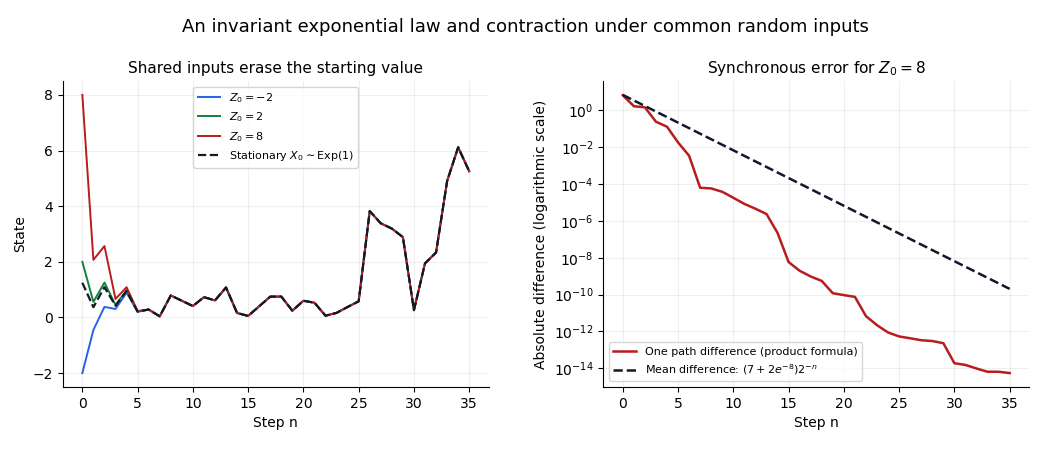
Common random inputs make different initial values approach the same stationary trajectory
. Original simulations of the affine recursion with shared inputs. The right panel compares an exactly propagated path difference with its unconditional expected value; the geometric expectation estimate, rather than the simulation, proves convergence. Details.
The update defines a time-homogeneous Markov process: given its present value, the next value depends only on independent fresh input. Part (b)(i) identifies an invariant law: initializing with the rate-one exponential distribution preserves that distribution at every time. Part (b)(iii) shows convergence of the one-time laws to this invariant law from every deterministic initial value.
For a countable state space, the analogous countable-state Markov chain convergence theorem says that an irreducible Markov chain that is aperiodic and positive recurrent converges to its unique stationary distribution from every initial state. Here the state space is continuous, so that countable-state theorem does not directly supply the proof; the explicit coupling does. The two conclusions have the same equilibrium interpretation.
Articles by others on the same topic
There are currently no matching articles.