The distance function is continuous because the triangle inequality gives . Hence is the inverse image of the closed interval , so is closed. Since it contains , it also contains the closure of that open ball:
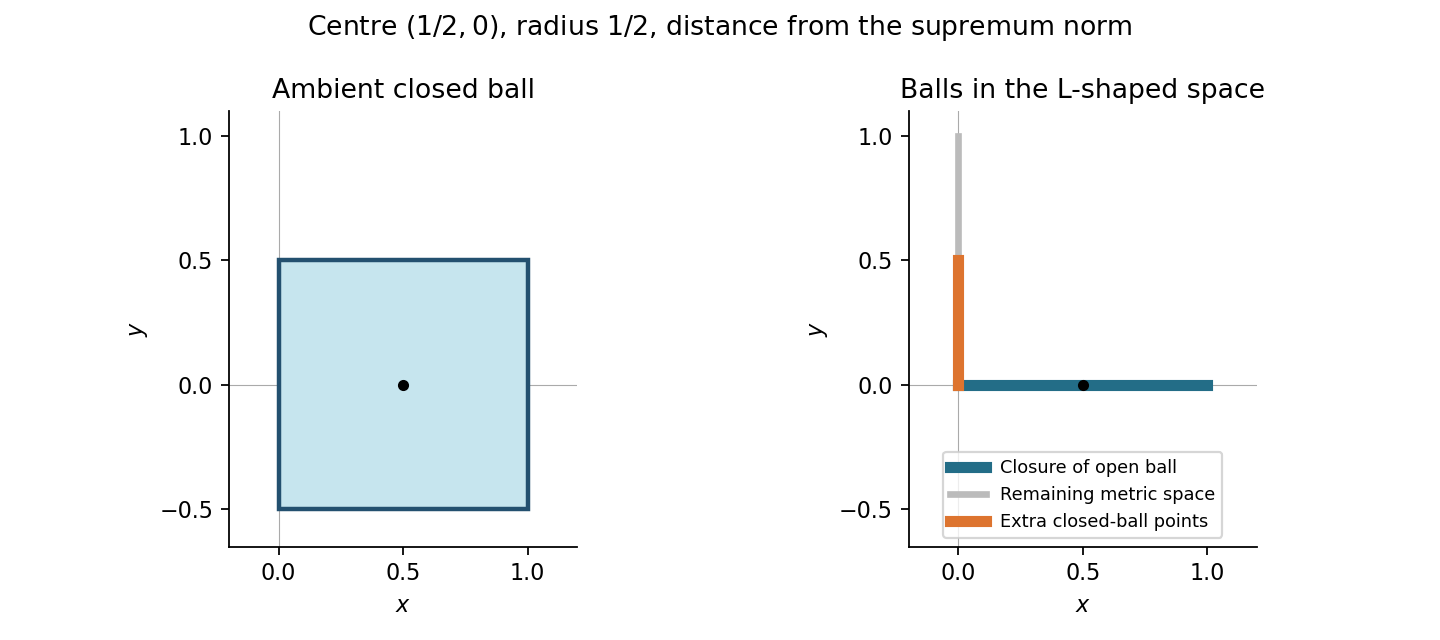

The induced-metric balls are intersections with the corresponding ambient balls. On the horizontal arm the distance from the centre is ; on the vertical arm it is . ConsequentlyThe closure relative to of the open ball is . Every point with has positive distance from that horizontal arm, so none of those points is in the closure. In particular lies in the closed ball but not in the closure of the open ball, proving strict inclusion.
Let the radius be . One inclusion follows from (a). For the reverse, if , set for . Then and , so every closed-ball point is in the closure of the open ball. HenceThe positive-radius convention matters: if radius zero is allowed, the open ball is empty whereas the closed ball is , so the asserted equality fails at that degenerate radius.
In the usual real line take . Each set is nonempty and closed, and . No real number lies in them all, because the positive integers are unbounded. Thus their intersection is empty. These sets are not compact.
Compact subsets of a Hausdorff space are closed. Regard every as a closed subset of the compact set . Any finite intersection equals the member with largest index and is therefore nonempty. The finite intersection property for closed subsets of a compact space impliesEquivalently, an empty intersection would give an open cover of by their complements, with a finite subcover contradicting nested nonemptiness.
Suppose no such exists. Nestedness then makes every nonempty. These are nested compact sets: is closed and is compact. By (i) their intersection is nonempty. But that intersection is , contrary to the hypothesis. Thus for some , and nestedness gives immediately.
The inclusion holds for every map. For the reverse choose and let . These sets are nonempty and nested. A Hausdorff space has closed singletons, and continuity makes the fibre closed, so each is compact. Part (b)(i) gives a point . Then and . Hence
Articles by others on the same topic
There are currently no matching articles.