Define as the emission cross section for an upper-level atom, averaged over the participating sublevels, and let . Detailed balance gives the upward stimulated rate per lower-level atom as , where . With the complete laser rate equations areAdding them eliminates the internal transitions. Therefore steady state has even when the radiation is strong. Substitution into the upper equation givesOne net stimulated transition changes the beam energy by , so the coefficient of optical gain for intensity is . At line center, with ,Here is the unsaturated intensity optical gain per length, which may be negative, and is the intensity at which its magnitude is halved in this model with homogeneous broadening. The cancellation of from follows from exclusive upper-to-lower decay and constant upper-state pumping. Keeping in the stimulated problem would discard the stimulated feeding term and give an incorrect saturation scale. Other decay branches or different pump constraints lead to different expressions.
For a traveling beam with uniform pump, no additional loss and local steady populations,If and , the increment becomes , approximately constant. Intensity then grows linearly, rather than exponentially, with distance while that strong-saturation regime persists. Negative gives saturable absorption and a decreasing beam.
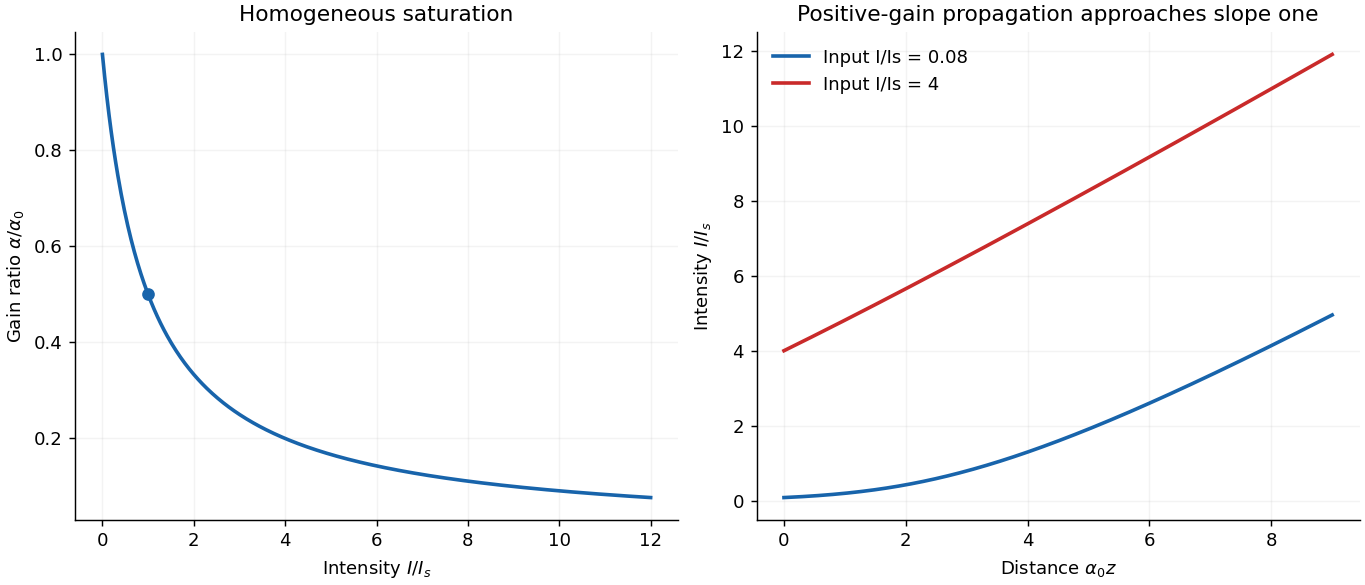
Saturated gain and the crossover from exponential to approximately linear amplification
. Original steady-state calculation for the specified open pumped model. The propagation curves assume positive unsaturated gain and no added loss; a negative gain example is absorptive. Details.
Articles by others on the same topic
There are currently no matching articles.