In the ideal three-level laser, pumping excites atoms out of the ground state to a higher auxiliary level, rapid relaxation fills a relatively long-lived upper laser level, and the laser transition returns to the ground state. A ruby laser is a standard example of this classification. Since the lower laser state initially holds most atoms, substantial pumping is needed to reverse the population per sublevel. With upper and lower degeneracies and , the positive-gain condition isFor equal degeneracies more than half the active atoms must be excited before optical gain is even positive.
In a four-level laser the lower laser level is above the ground reservoir and empties rapidly after laser emission. Pumping again feeds a higher auxiliary level which relaxes into the upper laser state, but the lower laser-state population can remain small. The helium-neon laser provides a multilevel physical realization often represented by this scheme for a four-level laser. Positive population inversion then requires much less depletion of the ground reservoir, giving a much lower laser pump threshold for comparable lifetimes, emission cross sections and cavity losses.
The threshold of a four-level laser is not literally zero. Oscillation requires round-trip optical gain to overcome output coupling and other losses, and competing decay or incomplete lower-level removal raises the required pump. Real laser media contain more atomic states than ideal diagrams for a three-level laser or a four-level laser; the labels describe the relevant pumping and laser-transition cycle rather than the total number of states in the material.
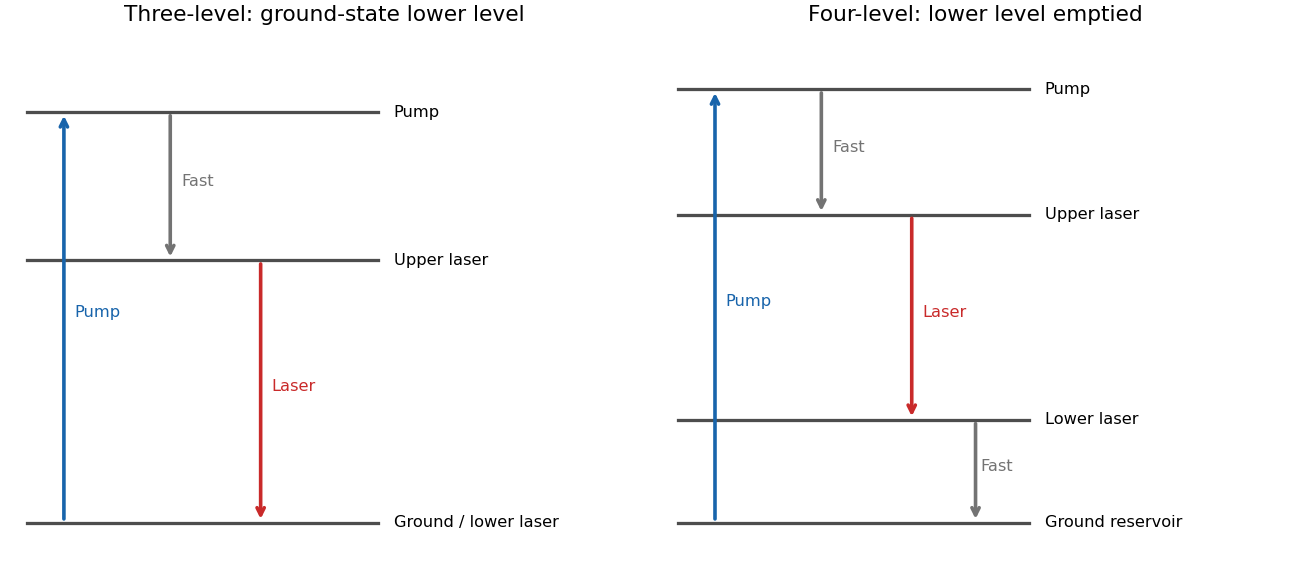
Why ground-state and rapidly emptied lower laser levels give different thresholds
. Original three- and four-level pumping cycles. The diagrams distinguish pump absorption, rapid relaxation and stimulated laser emission; real media can contain additional levels. Details.
Let and . Before stimulated emission and stimulated absorption are added, the source and decay terms giveThe upper level is fed at a specified rate of addition to the number density, its spontaneous decay feeds the lower level, and lower-level removal leads to states outside this two-level system. This is therefore an open pumped system, not a closed two-level system with conserved population.
At steady state,The degeneracy-weighted population inversion compares population per magnetic sublevel. It is positive only if ; a positive pump rate alone cannot guarantee optical gain if lower-level removal is too slow. A short lower-state lifetime is consequently helpful even when the upper-state pumping is unchanged.
The equations assume finite positive and , approximately constant pumping and no other specified sources, sinks or branching channels. A finite steady state would not exist for continuous pumping if the lower level had no escape route. The fixed source rate also presumes access to an external reservoir; it does not imply that the two populations can grow beyond all available active atoms in a real finite medium.
Define as the emission cross section for an upper-level atom, averaged over the participating sublevels, and let . Detailed balance gives the upward stimulated rate per lower-level atom as , where . With the complete laser rate equations areAdding them eliminates the internal transitions. Therefore steady state has even when the radiation is strong. Substitution into the upper equation givesOne net stimulated transition changes the beam energy by , so the coefficient of optical gain for intensity is . At line center, with ,Here is the unsaturated intensity optical gain per length, which may be negative, and is the intensity at which its magnitude is halved in this model with homogeneous broadening. The cancellation of from follows from exclusive upper-to-lower decay and constant upper-state pumping. Keeping in the stimulated problem would discard the stimulated feeding term and give an incorrect saturation scale. Other decay branches or different pump constraints lead to different expressions.
For a traveling beam with uniform pump, no additional loss and local steady populations,If and , the increment becomes , approximately constant. Intensity then grows linearly, rather than exponentially, with distance while that strong-saturation regime persists. Negative gives saturable absorption and a decreasing beam.
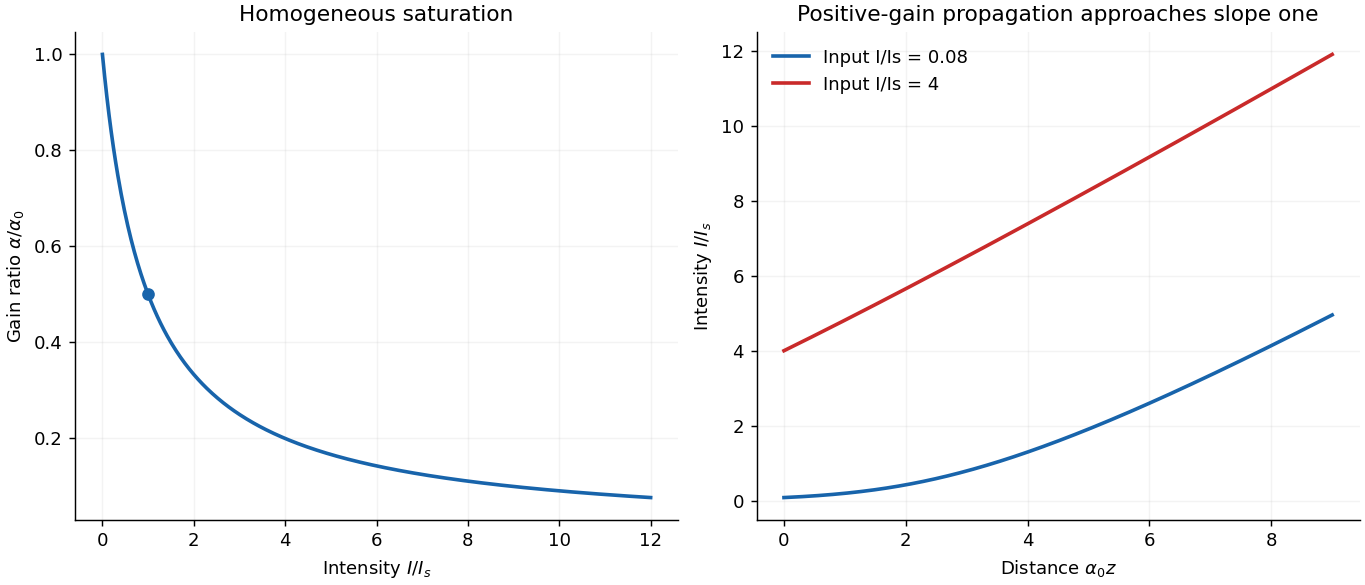
Saturated gain and the crossover from exponential to approximately linear amplification
. Original steady-state calculation for the specified open pumped model. The propagation curves assume positive unsaturated gain and no added loss; a negative gain example is absorptive. Details.
Keep the given emission cross section in square centimetres so that the density remains per cubic centimetre. For the first transition, andThusThe separate populations are cm and cm. Subtracting , rather than alone, reproduces the population inversion used above.
Here , so upper-state pumping and sufficiently rapid lower-level removal produce positive small-signal optical gain. This coefficient is an intensity optical gain; a weak field amplitude would grow with half this exponent. A positive single-pass coefficient also does not by itself establish laser oscillation without a cavity-loss budget. No transition wavelength was supplied for this numerical example, so a numerical saturation intensity is not needed or invented to calculate .
For the second transition, and the much longer lower-level lifetime changes the sign of the available population inversion:If its emission cross section equals the first transition's value, the estimate isThe word “comparable” does not specify exact equality, so the more general answer is . The quoted numerical value is an explicitly equal-cross-section estimate, while the negative sign is robust for any positive comparable emission cross section.
In this case . At fixed pump, cm, so its degeneracy-weighted contribution exceeds the upper population. The medium therefore absorbs a weak beam at this transition. Increasing the radiation saturates the photon absorption magnitude toward zero according to c; it does not convert this fixed-pump model into an optical amplifier with positive gain. Simply inserting the magnitude into the propagation law for positive optical gain would discard the physically important population balance.
Articles by others on the same topic
There are currently no matching articles.