A linear viscoelastic fluid responds linearly to small imposed strain histories but retains memory of earlier deformation. For shear strain and a relaxed initial state, Boltzmann superposition givesHere is the causal relaxation modulus, the stress following a unit step strain. Doubling a sufficiently small strain history doubles the stress, and responses to added histories add. Elasticity stores deformation energy; viscosity dissipates it. Linearity is an amplitude approximation, not an assertion that the material has no relaxation times.
The Maxwell model has a spring of modulus in series with a dashpot of viscosity . Their stresses are equal and strains add, giving . After a step strain , the strain rate is zero for , so with . Initially the spring takes the step, . Hence
For the convention , the complex viscoelastic modulus is . ThusThe storage modulus exceeds the loss modulus for , so the response is predominantly solid-like above the crossoverAt low frequency ; at high frequency .
The creep compliance is the strain per unit step stress: if , then for . A Newtonian fluid obeys , so under constant stress its initially zero strain grows as . Therefore
Passive microrheology uses thermal bead motion as a probe of mechanical compliance. The fluctuation-dissipation theorem relates equilibrium displacement fluctuations to the same linear response measured by a small applied force. The stated thermal stress scale has units of energy per bead volume; dividing the mean-square displacement by provides a dimensionless effective strain. With that prescribed analogy,The displacement is relative to the starting position, and the variance here is the sum over three spatial coordinates. For a Newtonian fluid, substitution gives , exactly the Stokes–Einstein relation .
The continuum interpretation assumes a dilute no-slip spherical probe, thermal equilibrium, linear response and a homogeneous incompressible medium on the bead scale. The stated stress estimate is an effective scale for the analogy; a literal instantaneous stress variance would also require a microscopic or temporal averaging prescription.
Under a step stress, the Maxwell spring extends immediately by , while the dashpot adds . Hence , and the microrheology of a Maxwell fluid relation givesThis idealized overdamped relation describes an elastic plateau followed by long-time diffusion. Its nonzero extrapolated intercept is not the actual displacement variance at exactly zero lag, which is zero. Inertia or fast solvent relaxation must resolve the initial rise; those processes were omitted from the ideal spring-dashpot model.
An entropic network has approximately one thermal energy of elastic cost per mesh volume, giving . At , the supplied mesh size and viscosity giveThe intermediate-time plateau in the three-dimensional mean squared displacement isAfter the omitted fast initial transient, the log-log sketch is approximately flat for , crosses over near , and grows linearly for . The figure shows the Maxwell compliance prediction over this range.
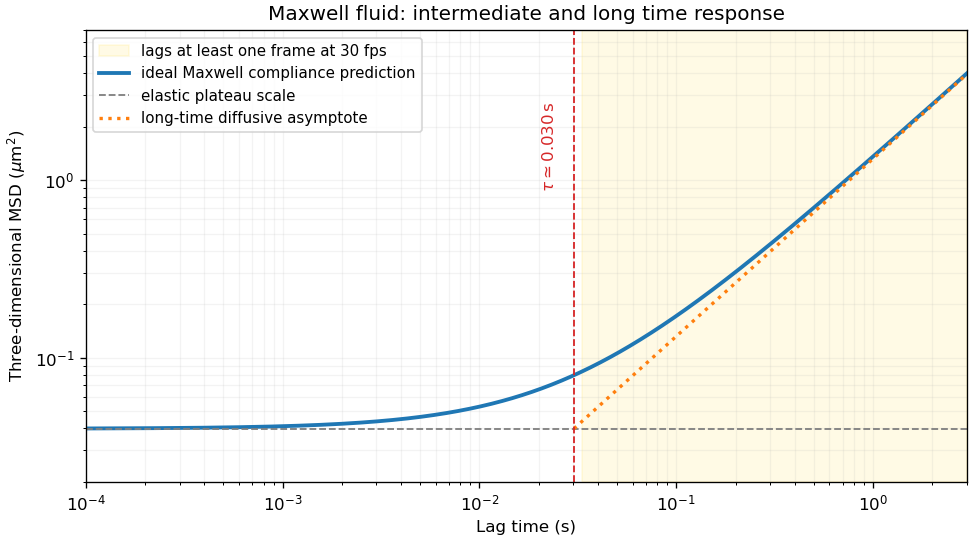
Elastic plateau and diffusive growth in the ideal Maxwell microrheology prediction, with the video time scale marked
. Details. 
An ordinary 25–30 frame-per-second recording samples intervals of about –, comparable to . It therefore has little access to a clear plateau at lags well below the crossover, even if its positional precision resolves a displacement of a few tenths of a micrometre. Higher frame rates and calibrated localization noise would improve the modulus measurement. The bead radius is only twice the mesh size, so treating the network as a homogeneous continuum is also an approximation.
Articles by others on the same topic
There are currently no matching articles.